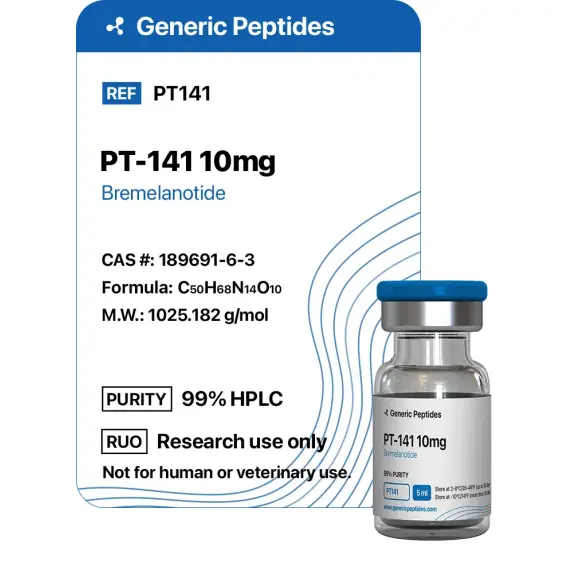
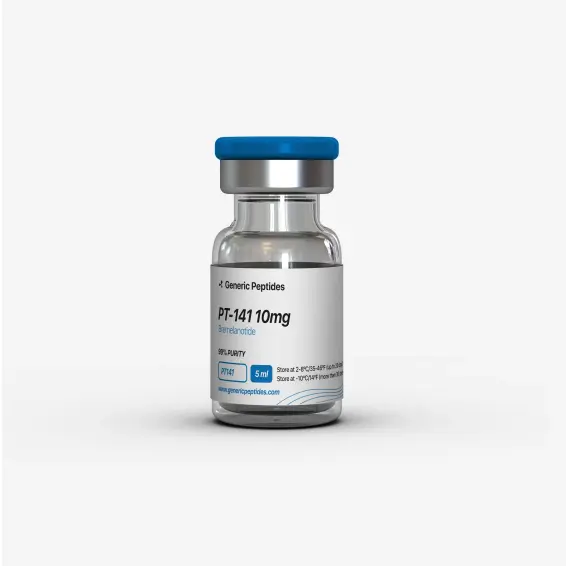
PT-141 10mg
Certificate of Analysis available
Researchers at the University of Arizona were running clinical trials on a tanning peptide in the early 1990s when the male volunteers started reporting something unexpected: spontaneous erections, often during the trial visits. The original Melanotan II compound was supposed to be about pigmentation. The arousal effect was a side note. But it turned out to be the more interesting effect, so a Princeton biotech called Palatin Technologies isolated the arousal-related activity into a cleaner molecule. That cleaner molecule became PT-141 — the first FDA-approved drug that targets sexual desire in the brain, not blood flow in the body.
PT-141 (also called bremelanotide, brand name Vyleesi) is a synthetic cyclic heptapeptide — seven amino acids arranged in a closed ring structure. It's a metabolite of Melanotan II with the C-terminal amide group removed, which eliminates the strong tanning effect while preserving the sexual response activity. The compound is a melanocortin receptor agonist with selectivity favoring MC3R and MC4R over the pigmentation-driving MC1R.
What makes the molecule pharmacologically distinct: it works entirely in the central nervous system. PDE5 inhibitors like sildenafil (Viagra) work peripherally by improving blood flow through nitric oxide signaling — they enable physical response but don't touch desire. PT-141 acts on melanocortin circuits in the hypothalamus and limbic regions to increase sexual desire and arousal at the neural level. That's a fundamentally different mechanism than every previous sexual function drug. It's also why PT-141 works in cases where PDE5 inhibitors fail.
The FDA approved Vyleesi (PT-141) in June 2019 for the treatment of acquired, generalized hypoactive sexual desire disorder (HSDD) in premenopausal women — based on two Phase 3 trials called RECONNECT (n≈1,247 across both studies). The approval was significant because it made PT-141 the first peptide drug ever approved for any sexual function indication and the first to act through a central neurogenic mechanism rather than peripheral vascular effects.
The original clinical ambition was broader. Early intranasal trials in men with erectile dysfunction showed that 34% of men with ED achieved erection sufficient for intercourse versus 9% on placebo. But the nasal formulation produced dose-dependent blood pressure increases that pushed regulators toward a narrower indication. Palatin pivoted to subcutaneous injection and to HSDD in women — a condition where no FDA-approved drug existed at the time. Off-label use in men with PDE5-resistant ED has continued, with documented evidence supporting the central mechanism's value when peripheral approaches don't work.
Here's the honest part: nausea is the most reliably reproduced side effect of PT-141. About 40% of subjects in Phase 3 trials experienced it. It's usually mild to moderate but it's real, common, and dose-dependent. Modest blood pressure elevation also occurs, which is why the FDA-approved labeling restricts use to once per 24 hours and 8 doses per month. Anyone selling PT-141 as side-effect-free is misrepresenting its clinical profile.
The mechanism is also the entire reason PT-141 is interesting: the same MC3R/MC4R receptors that mediate sexual response also mediate appetite, energy balance, and cardiovascular tone. That's why MT-II's non-selective melanocortin activity produced both arousal and appetite effects. PT-141's relative selectivity reduces — but doesn't eliminate — the off-target activations. For research designs studying central melanocortin pharmacology cleanly, the compound is unique. For drawing conclusions about drug safety in clinical use, the published clinical trial data is what matters.
Regulatory note: PT-141 / Bremelanotide is an FDA-approved prescription drug (Vyleesi, Palatin Technologies, approved June 2019). It's not on any 503A bulks list because it's a fully approved drug — different regulatory category from the peptides currently in compounding-status transition (BPC-157, Epitalon, etc.). It requires a prescription for human use. Sales as a research compound for laboratory work continue legally in a separate channel. WADA's Prohibited List does not specifically name bremelanotide as of 2025, though athletes subject to drug testing should consult their governing body's specific rules.
Here's a sourcing problem that's specific to PT-141: it's a cyclic heptapeptide — the lactam ring between specific residues is what gives the compound its three-dimensional structure for melanocortin receptor binding. Cheap synthesis routinely produces linear (uncyclized) material that lacks proper ring closure, or partially cyclized product mixed with linear contaminants. The linear form has dramatically reduced MC4R binding compared to the cyclic form. Without HPLC-MS verification specifically checking ring closure, this defect is invisible to buyers and ruins any study where receptor binding affinity matters.
Generic Peptides supplies research-grade PT-141 for sale at 99% purity, manufactured in the USA. Domestic synthesis with verified cyclic structure — the part that determines whether your melanocortin receptor binding assay produces the published profile or noise.
Order PT-141 for sale in the USA — 99% purity, cyclic structure verified, manufactured domestically.
Yes — PT-141 is legally available. It's an FDA-approved prescription drug (brand name Vyleesi) for HSDD in premenopausal women, requiring a prescription for human use. It's also commercially available as a research compound for laboratory work. The two channels operate under different regulatory frameworks.
PT-141 is a metabolite of Melanotan II with the C-terminal amide group removed. That single structural change shifted receptor selectivity away from MC1R (pigmentation) toward MC3R/MC4R (sexual function, appetite). PT-141 produces sexual response with minimal tanning; MT-II produces both. PT-141 also has cleaner regulatory status — FDA-approved versus MT-II's research-only category.
Completely different mechanisms. Sildenafil (Viagra) is a PDE5 inhibitor that works peripherally on vascular nitric oxide signaling — it improves blood flow but doesn't affect desire. PT-141 acts centrally on melanocortin receptors (MC4R) in the brain to enhance sexual desire and arousal. PT-141 works in cases where PDE5 inhibitors fail (PDE5-resistant ED). They target completely different parts of the sexual response pathway.
Yes — three names for the same molecule. Bremelanotide is the generic chemical name (the INN). Vyleesi is the FDA-approved brand name from Palatin Technologies. PT-141 is the original research designation. All three refer to the same cyclic heptapeptide.
Probably not. The cyclic structure depends on a lactam bridge that requires specific synthesis steps, which cheap production routinely skips. Linear (uncyclized) material binds melanocortin receptors much less effectively but looks identical on a basic label. Without HPLC-MS verification of ring closure, you may be buying a compound that doesn't behave like real PT-141.
Sources
FDA — "Vyleesi (bremelanotide) prescribing information," approved June 2019. Documents the FDA-approved indication, mechanism, and dosing for PT-141. https://www.accessdata.fda.gov/drugsatfda_docs/label/2019/210557s000lbl.pdf
Kingsberg SA et al. — "Bremelanotide for the Treatment of Hypoactive Sexual Desire Disorder: Two Randomized Phase 3 Trials." Obstetrics & Gynecology, 2019. The RECONNECT Phase 3 trials supporting FDA approval. https://pubmed.ncbi.nlm.nih.gov/31599840/
Diamond LE et al. — "An Effect on the Subjective Sexual Response in Premenopausal Women with Sexual Arousal Disorder by Bremelanotide (PT-141), a Melanocortin Receptor Agonist." Journal of Sexual Medicine, 2006. Foundational research on PT-141's central neurogenic mechanism. https://pubmed.ncbi.nlm.nih.gov/16839319/
Pfaus JG et al. — "The neurobiology of bremelanotide for the treatment of hypoactive sexual desire disorder in premenopausal women." CNS Spectrums, 2022. Reviews the central melanocortin mechanism in detail. https://pubmed.ncbi.nlm.nih.gov/33455598/
FDA-approved central mechanism. Cyclic structure that has to be intact. Sourcing matters.
PT-141 (bremelanotide) ships as a white lyophilized powder in a sealed glass vial, freeze-dried to preserve its cyclic heptapeptide structure and extend its shelf life. With a few simple habits — cold, dark, dry — the sealed vial stays in perfect condition for its full shelf life. Here's exactly how to store it.
| Parameter | Details | Notes |
|---|---|---|
| Storage Temperature | Freezer at −20°C (−4°F) for long-term storage up to 24–36 months. Refrigeration at 2–8°C (36–46°F) is fine for short-term use up to ~12 months. | Original sealed vial in the freezer is the safest default. |
| Light Sensitivity | Yes — PT-141 contains a tryptophan residue that's particularly prone to photodegradation. | Always keep in the original box or an opaque, amber container. |
| Freezing | Allowed and recommended. −20°C is standard for long-term storage; −80°C extends stability further if available. | Freeze from the start if you won't use it within 3 months. |
| Oxidation Sensitivity | The tryptophan and histidine residues make PT-141 susceptible to oxidation if the vial seal is broken or the powder is exposed to air. | Keep the aluminum crimp cap intact until ready to reconstitute. |
| Signs of Degradation | Healthy powder is white to off-white and loose or cake-like. Watch for yellowing, browning, clumping, visible moisture, or a sticky texture. | Any color change, clumping, or moisture = discard the vial. |
| Common Mistakes | Leaving the vial at room temperature after delivery, storing in a humid kitchen or bathroom, or opening a cold vial and letting condensation form inside. | Put it in the freezer on arrival, and let sealed vials warm to room temperature before opening. |
Every order is processed quickly and shipped with full tracking. All products come directly from the official Generic Peptides supply chain — in original manufacturer packaging, carefully handled from warehouse to your door.
| Destination | Delivery Time | Notes |
|---|---|---|
| USA Domestic | 2–5 business days | Faster when local warehouse stock is selected at checkout |
| International | 10–15 business days | Tracking included; update frequency may vary by destination country |
| Order Processing | 24–48 business hours | Processing begins after payment confirmation |
| Tracking | Provided on all orders | Tracking number sent after dispatch; multiple warehouses may result in separate shipments |
This product is supplied through the official Generic Peptides distribution chain and shipped in original manufacturer packaging. Orders are packed securely to protect the contents during transit and to respect customer privacy as a standard practice.
Outer packaging is neutral and does not display product details on the exterior — a common approach to protect shipments from damage, tampering, and unnecessary exposure during delivery.
Every order includes full authenticity assurance: official Generic Peptides presentation, batch-linked lab documentation, and sealed original packaging — giving customers confidence in every purchase.
| Authenticity Feature | Details |
|---|---|
| Packaging | Original manufacturer packaging — sealed and unaltered |
| Lab Documentation | Batch-linked certificate of analysis available on request |
| Supply Chain | Sourced exclusively through official Generic Peptides distribution |
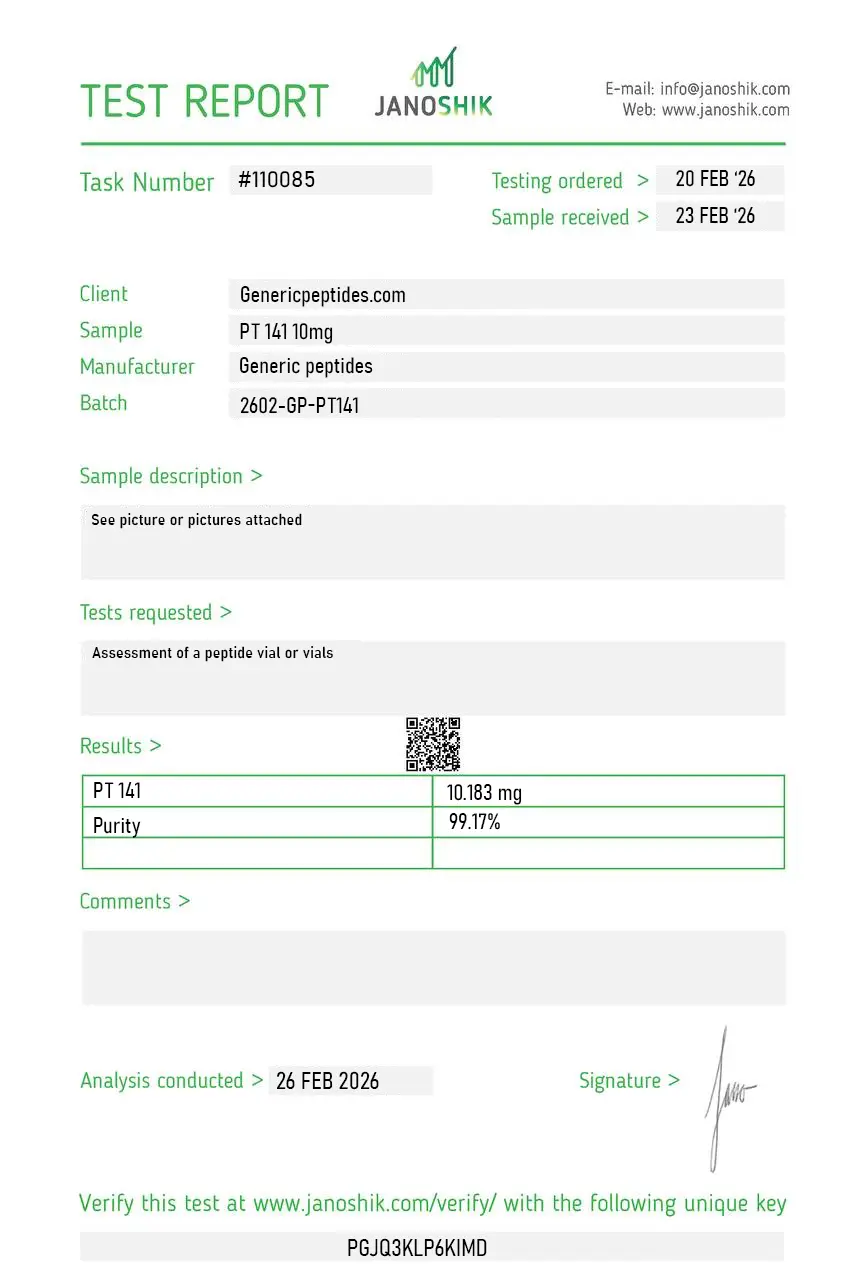
An independent lab test report is available for PT-141 10mg. The certificate provides batch-level verification details, including measured content, purity result, analysis date, and report documentation.
The whole reason to have PT-141 alongside MT-II is the selectivity contrast — bremelanotide is roughly ten-fold MC4R-preferring where MT-II hits everything across MC1R through MC5R. That non-selective-versus-selective comparison is the core melanocortin pharmacology experiment. Material activated MC4R cleanly. Star off because the C-terminal modification that drives the selectivity — free acid versus the MT-II amide — wasn't explicitly confirmed on the COA, and that one-residue difference is the entire point.
MC4R-selective agonist for our melanocortin receptor panel. cAMP response across the receptor subtypes as expected.
The structural relationship to MT-II is elegant — same cyclic core, single C-terminal change from amide to carboxylic acid, and that flips the receptor selectivity profile. One of the cleaner structure-activity examples in GPCR pharmacology. Nice that the listing treats it as the characterized compound it is. Performed as expected in our binding work.
We do melanocortin receptor crystallography and PT-141 is a standard reference ligand for MC4R structural work. The material took our usual additional purification well and gave crystal-grade quality. The listing carrying it alongside MT-II and the broader melanocortin set makes sourcing for comparative structural studies straightforward.
Selective MC4R reference for our melanocortin panel. Consistent, reordered, that covers it.
For comparative work across the melanocortin receptors, having the selective MC4R agonist and the non-selective MT-II from one source with matched documentation is what keeps the selectivity comparison interpretable. Different vendors mean different impurity profiles confounding what should be a clean receptor-selectivity readout. That single-source consistency is the actual value here.
PT-141 binds melanocortin-3 and melanocortin-4 receptors (MC3R/MC4R) in the hypothalamus and limbic regions of the brain. Activation of these G-protein-coupled receptors triggers downstream neural signaling that increases sexual desire and arousal at the neurogenic level — before any peripheral physical response. The mechanism operates entirely in the central nervous system, which is why it can produce arousal effects even when peripheral vascular function is impaired.
PT-141 is a metabolite of MT-II — specifically, MT-II with the C-terminal amide removed. That structural change dramatically alters receptor selectivity, moving away from MC1R (pigmentation) toward MC3R/MC4R (sexual function). MT-II produces strong tanning along with arousal effects; PT-141 produces sexual response with minimal pigmentation activity.
Different mechanisms targeting different parts of the sexual response. PDE5 inhibitors like sildenafil work peripherally on vascular function — they need an intact desire pathway to be useful. PT-141 acts centrally on the desire and arousal pathways themselves. In men with PDE5-resistant ED (where vascular drugs don't work), the central mechanism can produce response that peripheral drugs can't.
The melanocortin-4 receptor is expressed in brain regions involved in nausea and vomiting reflexes alongside its sexual function roles. Activating MC4R produces both effects in many subjects. Approximately 40% of Phase 3 trial participants experienced nausea, typically dose-dependent and most pronounced after the first administration. The effect is part of the receptor's pharmacology rather than an off-target side effect.
The cyclic heptapeptide structure depends on a lactam bridge between specific residues, which requires careful synthesis to form correctly. Cheap production routinely delivers linear (uncyclized) material that lacks the proper conformation for melanocortin receptor binding. Detection requires HPLC-MS analysis specifically targeting cyclization — most budget suppliers don't run this verification.
The compound emerged from research at Palatin Technologies in the early 2000s, building on the unexpected sexual response observations from Melanotan II clinical trials in the 1990s at the University of Arizona. Initial development pursued intranasal formulations for ED in men, then pivoted to subcutaneous injection for HSDD in women, leading to the 2019 FDA approval as Vyleesi.
PT-141 / bremelanotide is not specifically named on the WADA Prohibited List as of 2025. The compound's central mechanism affects sexual function rather than performance metrics, which keeps it outside standard anti-doping categories. Athletes subject to drug testing should consult their governing body's specific rules — anti-doping rules can include unspecified substances under broad categories.
Bremelanotide (the INN), Vyleesi (the FDA-approved brand name from Palatin Technologies), and PT-141 (the original research designation). Bremelanotide acetate is the salt form most commonly used commercially. CAS number 189691-06-3 for the free base. All four names refer to the same cyclic heptapeptide.
Sexual function pharmacology and central melanocortin receptor biology lead by volume — particularly in MC3R/MC4R receptor selectivity research and neurogenic arousal mechanism studies. There's also active work in appetite regulation (MC4R signaling), depression and emotion regulation models, and cardiovascular pharmacology of melanocortin agonists. PT-141's defined receptor selectivity makes it useful as a comparison compound across multiple research domains.
PT-141 is the only FDA-approved peptide drug for any sexual function indication and the only approved compound that works through a central mechanism rather than peripheral vascular effects. PDE5 inhibitors, hormonal therapies, and topical compounds all target peripheral pathways. PT-141 operates upstream — at the level of desire and arousal generation in the brain itself — which is mechanistically unique among currently available sexual function pharmacotherapy.
Researchers investigating central melanocortin pharmacology, sexual function neurobiology, and MC3R/MC4R receptor signaling consistently examine PT-141 alongside compounds that target overlapping or complementary aspects of reproductive and neuroendocrine biology. Melanotan II is the direct structural predecessor — PT-141 is a metabolite of MT-II with the C-terminal amide group removed, shifting receptor selectivity away from MC1R toward MC3R/MC4R; researchers studying the pharmacological consequences of that single structural modification examine both compounds in parallel to map which receptor subtype drives pigmentation vs sexual response vs appetite effects. Kisspeptin-10 sits upstream of the HPG axis driving GnRH and gonadotropin release — researchers studying the full neuroendocrine cascade from central desire signaling through hormonal production sometimes examine both to distinguish melanocortin-driven neurogenic effects from HPG axis-driven hormonal effects on sexual function. HCG and HMG address the gonadotropin level of the same reproductive biology — useful reference compounds when researchers need to isolate central vs peripheral contributions to sexual function and reproductive outcomes. Semax shares the broader central neuropeptide research space given its documented interactions with dopaminergic systems that intersect with the melanocortin circuits PT-141 activates.