HCG Peptide: What the Research Shows (2026)
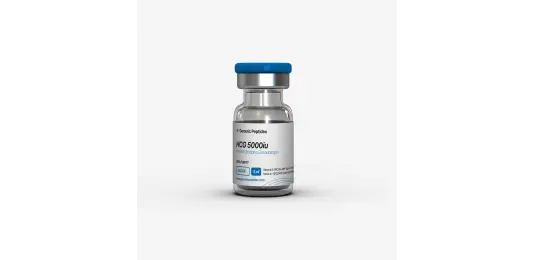
HCG Peptide: What Human Chorionic Gonadotropin Is and What Research Shows
By Medical Team of Generic Peptides
Human chorionic gonadotropin (hCG) is the hormone that pregnancy tests detect. It is also one of the oldest biological drugs in medicine and a widely studied research compound. Online it is often called "HCG peptide," although its structure is more complex than that of a typical research peptide. This guide explains what hCG is, how it works, what clinical and laboratory studies have measured, and where it stands with regulators in 2026.
What Is HCG Peptide?
hCG is a glycoprotein hormone produced mainly by the placenta. Shortly after an embryo implants, placental cells begin to release hCG, which signals the ovary to keep producing progesterone and so maintains early pregnancy [1].
hCG belongs to the same hormone family as luteinizing hormone (LH), follicle-stimulating hormone (FSH) and thyroid-stimulating hormone (TSH). All four share an identical alpha subunit and differ in their beta subunit, which gives each hormone its specific activity [1, 2].
Outside pregnancy, hCG is studied because it mimics LH. In men, LH stimulates the testes to produce testosterone; in women, a surge of LH triggers ovulation. hCG activates the same receptor and produces similar effects, but it lasts much longer in the circulation [2].
Is HCG a Peptide?
Strictly speaking, hCG is not a short peptide but a glycoprotein: a protein with large sugar chains attached.
| Feature | hCG |
|---|---|
| Structure | Two subunits (alpha and beta) held together without a covalent bond |
| Alpha subunit | 92 amino acids, shared with LH, FSH and TSH |
| Beta subunit | 145 amino acids, specific to hCG |
| Glycosylation | About 25–30% of its mass is carbohydrate |
| Molecular weight | About 36–37 kDa |
The beta subunit ends in a "C-terminal peptide" of about 30 amino acids that carries four O-linked sugar chains. LH does not have this segment, and it is a main reason why hCG stays in the circulation much longer than LH [2, 3, 11].
This structure matters in the laboratory. Because hCG is a large, heavily glycosylated protein, it cannot be checked the same way as a 5- or 15-amino-acid peptide. Its activity is usually expressed in International Units (IU) measured against a WHO reference standard, not only in milligrams (see the COA section below).
How HCG Works: the LH/CG Receptor
hCG binds the luteinizing hormone/choriogonadotropin receptor (LHCGR), a G-protein-coupled receptor found mainly on:
- Leydig cells in the testes, where activation increases testosterone production;
- theca and luteal cells in the ovary, where it supports ovulation and progesterone production by the corpus luteum.
Binding raises cyclic AMP inside the cell, which switches on the enzymes that make steroid hormones [2]. hCG and LH bind the same receptor, but hCG binds more strongly and acts longer [11], which is why it has been used clinically as a long-acting substitute for LH.
Related reproductive signals act further upstream. For example, kisspeptin-10 stimulates the hypothalamus to release GnRH, which in turn drives the body's own LH; we cover it in our kisspeptin research overview. hCG bypasses this chain and acts directly on the gonads.
HCG Half-Life: What Pharmacokinetic Studies Show
hCG is cleared from the blood in two phases. In pharmacokinetic studies of recombinant hCG in healthy volunteers, an initial phase with a half-life of about 4–5 hours was followed by a slow terminal phase with a half-life of roughly 26–29 hours [4, 5]. Product information for urinary hCG reports a similar terminal half-life. By comparison, LH has a serum half-life of roughly 1–1.5 hours [11].
The long half-life comes mainly from the sugar chains on the beta-subunit C-terminal peptide, which slow clearance by the liver and kidneys [3]. Part of the hormone is excreted unchanged in urine, which is the basis of urine pregnancy tests.
HCG and Testosterone: What Studies Measured
The link between hCG and testosterone is one of the most searched topics. The research falls into a few groups:
- Hypogonadotropic hypogonadism. In men whose pituitary does not produce enough LH, hCG has been used for decades to stimulate the testes. This is an approved indication for some hCG products (clinical use) [5].
- Testicular function during testosterone suppression. In a randomized, placebo-controlled study of 29 healthy men, testosterone treatment suppressed their own LH and lowered testosterone inside the testes by 94%. Adding low-dose hCG kept intratesticular testosterone close to baseline, with a dose-dependent effect (clinical study) [6].
- Leydig cell biology. In animal and cell studies, hCG is a standard tool for stimulating Leydig cells and studying how the testis makes steroid hormones (in vitro and animal studies) [2].
These findings describe how hCG acts on the testes. They are not a basis for self-use, and the hormonal effects of hCG are the reason it is regulated in sport (see below).
Urinary vs Recombinant HCG
There are two main sources of pharmaceutical hCG:
- Urinary hCG is purified from the urine of pregnant women. It has been used since the 1930s. Because it is extracted from a biological source, it may contain other urinary proteins and its glycosylation varies between batches [7].
- Recombinant hCG (choriogonadotropin alfa) is produced in genetically engineered Chinese hamster ovary (CHO) cells. It has a more defined composition and was approved in the US as Ovidrel in September 2000 [5].
A Cochrane review of 18 randomized trials found no evidence of a difference between recombinant and urinary hCG in live birth, ongoing pregnancy or OHSS rates [7].
HCG vs HMG
hCG is often confused with human menopausal gonadotropin (hMG). The difference is:
| Feature | hCG | hMG |
|---|---|---|
| Main activity | LH-like | FSH and LH activity combined |
| Source | Placenta (pregnancy urine) or recombinant | Urine of postmenopausal women |
| Main research use | Leydig cell and corpus luteum stimulation | Follicle development |
In fertility protocols, hMG and hCG are used at different stages, which is why they are often discussed together. We cover hMG separately in our HMG research overview; research-grade HMG is also available for laboratory use.
Safety Signals Reported in Clinical Use
Product labeling and clinical studies describe several risks [5]:
- Ovarian hyperstimulation syndrome (OHSS) in women undergoing fertility treatment, which can be serious;
- multiple pregnancy after ovulation induction;
- arterial thromboembolism (rare);
- early puberty in boys when used for undescended testes;
- hypersensitivity reactions.
hCG is also produced by some tumors, such as trophoblastic and testicular germ cell tumors, which is why it is used as a tumor marker [1].
FDA and WADA Status in 2026
- FDA approval. As of October 2026, FDA-licensed hCG products in the US include urinary chorionic gonadotropin (Novarel, Pregnyl) and recombinant choriogonadotropin alfa (Ovidrel). The urinary products are labeled for ovulation induction, selected cases of hypogonadotropic hypogonadism in males and prepubertal cryptorchidism; Ovidrel is labeled only for use in women (final follicular maturation in assisted reproduction and ovulation induction) [5]. At the time of writing, hCG does not appear on the FDA Drug Shortages list; availability of individual products can change.
- Biologic status. In March 2020, hCG products transitioned from drug approvals to biologics license applications under the Biologics Price Competition and Innovation Act. Biological products licensed under the Public Health Service Act are not eligible for the compounding exemptions in sections 503A and 503B, so pharmacies and outsourcing facilities can no longer compound hCG from bulk substance [8].
- Weight loss. hCG is not approved for weight loss. The labeling of urinary hCG products states that it has not been demonstrated to be effective adjunctive therapy in the treatment of obesity, and in December 2011 the FDA and FTC sent warning letters to companies selling over-the-counter "homeopathic" HCG diet products [5, 9].
- WADA. Chorionic gonadotrophin and LH are prohibited at all times in males under section S2.2.1 (testosterone-stimulating peptides) of the 2026 Prohibited List, together with GnRH analogues and kisspeptin [10].
What a COA Should Show for Research-Grade HCG
Because hCG is a glycoprotein, a meaningful certificate of analysis for research-grade hCG looks different from one for a short peptide:
- Potency in IU, determined by a bioassay or a validated method calibrated against a WHO International Standard;
- Identity, typically by immunoassay (ELISA) and electrophoresis (SDS-PAGE) showing the expected subunits;
- Purity, by SDS-PAGE or size-exclusion chromatography, with aggregates and fragments reported;
- Endotoxin results, especially for material from biological sources;
- Lot number and test date that match the vial.
Our guide to reading a peptide COA explains each item. Generic Peptides supplies hCG and other reproductive and endocrine research compounds for laboratory research only, with a batch-specific COA.
FAQ
What is HCG peptide?
"HCG peptide" usually refers to human chorionic gonadotropin, a placental hormone that acts on the same receptor as luteinizing hormone. It is a glycoprotein rather than a short peptide.
Is HCG a peptide?
Not in the usual sense. hCG is a glycoprotein of about 36–37 kDa made of two protein subunits with attached sugar chains. Short research peptides such as BPC-157 or kisspeptin-10 are much smaller.
What is the half-life of HCG?
Studies of recombinant hCG in healthy volunteers report an initial half-life of about 4–5 hours and a terminal half-life of roughly 26–29 hours, much longer than that of LH (about 1–1.5 hours).
How does HCG affect testosterone?
hCG stimulates Leydig cells in the testes through the LH/CG receptor, which increases testosterone production. This effect has been studied in men with hypogonadotropic hypogonadism and in healthy men whose own LH was suppressed.
Is HCG FDA-approved?
Yes, for specific fertility and endocrine indications, as a prescription biologic. It is not approved for weight loss.
References
[1] Cole LA. Biological functions of hCG and hCG-related molecules. Reprod Biol Endocrinol. 2010;8:102. doi:10.1186/1477-7827-8-102. PMID 20735820.
[2] Choi J, Smitz J. Luteinizing hormone and human chorionic gonadotropin: origins of difference. Mol Cell Endocrinol. 2014;383(1–2):203–213. PMID 24365330.
[3] Fares F. The role of O-linked and N-linked oligosaccharides on the structure-function of glycoprotein hormones: development of agonists and antagonists. Biochim Biophys Acta. 2006;1760(4):560–567. doi:10.1016/j.bbagen.2005.12.022. PMID 16527410.
[4] Trinchard-Lugan I, Khan A, Porchet HC, Munafo A. Pharmacokinetics and pharmacodynamics of recombinant human chorionic gonadotrophin in healthy male and female volunteers. Reprod Biomed Online. 2002;4(2):106–115. doi:10.1016/S1472-6483(10)61927-X. PMID 12470572.
[5] Novarel (chorionic gonadotropin for injection) prescribing information, Ferring, rev. 09/2016; Pregnyl prescribing information, Organon, rev. 06/2023; Ovidrel (choriogonadotropin alfa injection) prescribing information, EMD Serono, BLA 021149. DailyMed.
[6] Coviello AD, Matsumoto AM, Bremner WJ, Herbst KL, Amory JK, Anawalt BD, Sutton PR, Wright WW, Brown TR, Yan X, Zirkin BR, Jarow JP. Low-dose human chorionic gonadotropin maintains intratesticular testosterone in normal men with testosterone-induced gonadotropin suppression. J Clin Endocrinol Metab. 2005;90(5):2595–2602. doi:10.1210/jc.2004-0802. PMID 15713727.
[7] Youssef MA, Abou-Setta AM, Lam WS. Recombinant versus urinary human chorionic gonadotrophin for final oocyte maturation triggering in IVF and ICSI cycles. Cochrane Database Syst Rev. 2016;4:CD003719. doi:10.1002/14651858.CD003719.pub4. PMID 27106604.
[8] U.S. Food and Drug Administration. Notice to Compounders: Changes that affect compounding as of March 23, 2020; and List of Approved NDAs for Biological Products That Were Deemed to be BLAs on March 23, 2020. fda.gov.
[9] U.S. Food and Drug Administration. HCG Diet Products Are Illegal. Consumer Update, December 6, 2011. fda.gov.
[10] World Anti-Doping Agency. International Standard: Prohibited List 2026 (in effect January 1, 2026), section S2.2.1. wada-ama.org.
[11] Casarini L, Santi D, Brigante G, Simoni M. Two hormones for one receptor: evolution, biochemistry, actions, and pathophysiology of LH and hCG. Endocr Rev. 2018;39(5):549–592. PMID 29905829.