Retatrutide: What the Research Shows (2026)
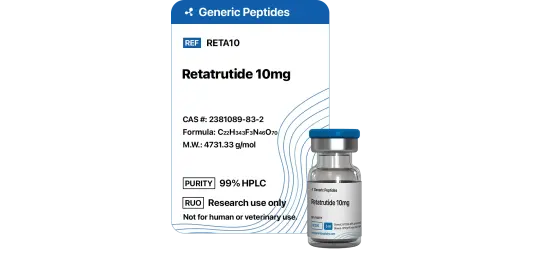
Retatrutide: What the Research Shows (2026)
By Medical Team of Generic Peptides
Retatrutide is one of the most discussed peptides in metabolic research. It is the first compound to activate three hormone receptors at once (GIP, GLP-1 and glucagon) to reach late-stage clinical trials, and its trial results have moved fast. Below we explain what retatrutide is, how a triple agonist works, what the preclinical and clinical studies reported, which safety signals have emerged and where it stands with US regulators in 2026.
What Is Retatrutide?
Retatrutide (development code LY3437943) is a synthetic peptide developed by Eli Lilly. It is a single molecule that acts on three receptors:
- GIP receptor (glucose-dependent insulinotropic polypeptide)
- GLP-1 receptor (glucagon-like peptide-1)
- Glucagon receptor
The peptide is built on a GIP-based sequence with a fatty-acid side chain that binds to albumin in the blood. This slows clearance and gives retatrutide a half-life of about six days in humans [1]. In receptor assays, it is more potent at the GIP receptor than at the GLP-1 and glucagon receptors, relative to the native hormones [1].
Retatrutide is investigational. It has not been approved by the FDA for any use.
How Does a Triple Agonist Work?
Each of the three hormones contributes something different:
- GLP-1 increases glucose-dependent insulin release, slows gastric emptying and acts on appetite centers in the brain.
- GIP also increases insulin release and acts on fat tissue and the brain. Adding GIP to GLP-1 is the basis of tirzepatide, a dual agonist.
- Glucagon usually raises blood glucose, but it also increases energy expenditure, fat breakdown and liver fat metabolism.
The idea behind a triple agonist is that GLP-1 and GIP reduce food intake while glucagon increases energy use. The insulin-raising effects of GLP-1 and GIP are expected to offset glucagon's effect on blood glucose.
This concept came from rodent research. In 2009, Day and colleagues reported that a dual glucagon/GLP-1 agonist reduced body weight in obese mice [2]. In 2015, Finan and colleagues described a single peptide acting on all three receptors that corrected obesity and diabetes in rodent models more effectively than dual agonists [3].
Preclinical and Early Clinical Research
Coskun and colleagues published the discovery of retatrutide in 2022 [1]. In obese mice, it reduced body weight and improved glucose control, with effects linked to both reduced food intake and increased energy expenditure. The same paper reported a Phase 1 study in healthy volunteers, in which a single injection was followed by dose-related weight reduction.
A Phase 1b trial in people with type 2 diabetes (Urva et al., 2022) found reductions in glucose and body weight over 12 weeks, with mostly gastrointestinal side effects [4].
Phase 2 Trials
Three Phase 2 studies have been published in peer-reviewed journals.
Obesity (Jastreboff et al., NEJM 2023). 338 adults with obesity or overweight without diabetes were randomized to retatrutide or placebo for 48 weeks. Mean weight loss at the highest dose was 24.2%, compared with 2.1% on placebo. Weight loss had not yet plateaued at 48 weeks. Heart rate increased in a dose-dependent manner, peaking around week 24 [5].
Type 2 diabetes (Rosenstock et al., Lancet 2023). 281 adults with type 2 diabetes were randomized to retatrutide, placebo or dulaglutide (a GLP-1 agonist) for 36 weeks. Higher retatrutide doses produced larger reductions in HbA1c and body weight than placebo [6].
Liver fat (Sanyal et al., Nature Medicine 2024). A substudy of the obesity trial measured liver fat in participants with metabolic dysfunction-associated steatotic liver disease (MASLD). At 24 weeks, liver fat fell by about 82% at the two highest doses, compared with almost no change on placebo. By week 48, about nine in ten participants in those groups had liver fat in the normal range (below 5%) [7].
Phase 3 Trials: The TRIUMPH and TRANSCEND Programs
Lilly's Phase 3 program includes the TRIUMPH trials in obesity and the TRANSCEND trials in type 2 diabetes. Several readouts were announced between December 2025 and July 2026:
| Trial | Population | Duration | Weight loss (highest dose) | Placebo |
|---|---|---|---|---|
| TRIUMPH-4 (n=445) | Obesity + knee osteoarthritis | 68 weeks | 28.7% | 2.1% |
| TRIUMPH-1 (n=2,339) | Obesity or overweight, no diabetes | 80 weeks | 28.3% | 2.2% |
| TRIUMPH-2 (n=1,152) | Obesity or overweight + type 2 diabetes | 80 weeks | 20.8% | 4.0% |
| TRIUMPH-3 (n=1,949) | Severe obesity + cardiovascular disease | 80 weeks | 22.6% | 3.2% |
| TRANSCEND-T2D-1 (n=537) | Type 2 diabetes | 40 weeks | 16.8% | — |
Sources: Lilly announcements and medical news coverage [8–11].
There are three points to keep in mind when reading these numbers:
- These are mostly sponsor announcements. Most Phase 3 results have been released by Lilly or presented at conferences. Full peer-reviewed publications are still pending.
- The estimand matters. The headline figures use the "efficacy estimand," which assumes participants stayed on treatment. In TRIUMPH-4, the treatment-regimen estimand, which counts everyone regardless of whether they stopped treatment, gave 23.7% at the highest dose versus 4.6% on placebo [8].
- The trials are not head-to-head. No completed trial has compared retatrutide directly with tirzepatide or semaglutide. Results from separate trials with different populations are not directly comparable.
Other findings reported in these trials include:
- In TRIUMPH-4, knee pain scores (WOMAC) fell by about 4.4 points at the highest dose, compared with 2.4 points on placebo [8].
- In TRIUMPH-2, HbA1c fell by 1.4–1.6 percentage points, compared with 0.2 on placebo [10].
- In TRANSCEND-T2D-1, HbA1c fell by up to 2.0 percentage points [11].
- In TRIUMPH-3, cardiovascular event analyses were underpowered and did not show a definitive effect. The dedicated cardiovascular outcomes trial is still ongoing [10].
Safety Signals From the Trials
The safety findings so far are broadly similar to other incretin-based peptides, with some new signals.
Gastrointestinal effects were the most common. In TRIUMPH-4, at the highest dose:
- nausea was reported in 43.2% of participants (10.7% on placebo);
- diarrhea in 33.1% (13.4%);
- constipation in 25.0% (8.7%);
- vomiting in 20.9% (0.0%) [8].
Dysesthesia, an abnormal skin sensation such as tingling or burning, emerged as a new signal. In TRIUMPH-4 it was reported in 20.9% of participants at the highest dose, compared with 0.7% on placebo. In TRIUMPH-1 it was 12.5% versus 0.9%, and in TRANSCEND-T2D-1 it was 2.3–4.5% [8, 9, 11]. Lilly described most cases as mild. The mechanism is not yet understood.
Discontinuation because of side effects was 18.2% at the highest dose in TRIUMPH-4 and 11.3% in TRIUMPH-1, compared with 4.0–4.9% on placebo [8, 9].
Heart rate increased with dose in the Phase 2 obesity trial [5]. This is thought to reflect the glucagon component, and its long-term significance is unknown.
Long-term safety beyond 80 weeks has not yet been established.
Regulatory Status in 2026
- FDA. Retatrutide is not approved. Lilly has said it plans to submit a Biologics License Application in the first quarter of 2027 [10]. Any approval decision would follow FDA review.
- Legal action. In August 2026, Lilly announced lawsuits against six companies alleged to be selling retatrutide for human use while labeling it "research use only" [12].
- WADA. Retatrutide is not named on the 2026 Prohibited List [13]. However, WADA's S0 category covers pharmacological substances without current approval for human therapeutic use, so athletes should check with their anti-doping organization.
Retatrutide in Laboratory Research
In the lab, retatrutide is studied as a tool for understanding how combined GIP, GLP-1 and glucagon receptor signaling affects metabolism. Typical uses include:
- receptor binding and signaling assays;
- studies of energy expenditure and liver fat in rodent models;
- comparisons with single and dual agonists such as semaglutide and tirzepatide.
Retatrutide is a long, lipidated peptide, so quality checks matter. A batch-specific certificate of analysis should show HPLC purity and a mass spectrometry result that includes the fatty-acid side chain. Our guide on how to read a research peptide COA explains what each section should contain. Generic Peptides supplies retatrutide research peptide for laboratory research only, with a certificate of analysis for each batch.
For context on related compounds, see our articles on semaglutide, tirzepatide and semaglutide vs tirzepatide vs retatrutide.
Open Questions
- Will the Phase 3 results hold up in full peer-reviewed publications?
- What causes dysesthesia, and why do rates differ so much between trials?
- Does retatrutide affect cardiovascular outcomes? The dedicated outcomes trial is ongoing.
- How much of the weight lost is lean mass, and is weight regained after stopping?
- What is the long-term safety of chronic glucagon receptor activation?
FAQ
What is retatrutide?
Retatrutide is an investigational synthetic peptide from Eli Lilly that activates GIP, GLP-1 and glucagon receptors. It is often called a "triple agonist."
How is retatrutide different from tirzepatide?
Tirzepatide activates GIP and GLP-1 receptors. Retatrutide also activates the glucagon receptor, which is thought to increase energy expenditure and reduce liver fat.
Is retatrutide FDA approved?
No. Retatrutide is investigational. Lilly plans to submit an application to the FDA in the first quarter of 2027.
What side effects were reported in trials?
The most common were nausea, diarrhea, constipation and vomiting. Trials also reported dysesthesia (abnormal skin sensations) and a dose-related increase in heart rate.
Is retatrutide banned in sport?
It is not named on the 2026 WADA Prohibited List, but WADA's S0 category covers non-approved substances. Athletes should check with their anti-doping organization.
References
For research use only. Not for human consumption. This content is for informational purposes and is not medical advice.
[1] Coskun T, Urva S, Roell WC, et al. LY3437943, a novel triple glucagon, GIP, and GLP-1 receptor agonist for glycemic control and weight loss: from discovery to clinical proof of concept. Cell Metab. 2022;34(9):1234–1247.e9. doi:10.1016/j.cmet.2022.07.013.
[2] Day JW, Ottaway N, Patterson JT, et al. A new glucagon and GLP-1 co-agonist eliminates obesity in rodents. Nat Chem Biol. 2009;5(10):749–757. doi:10.1038/nchembio.209.
[3] Finan B, Yang B, Ottaway N, et al. A rationally designed monomeric peptide triagonist corrects obesity and diabetes in rodents. Nat Med. 2015;21(1):27–36. doi:10.1038/nm.3761.
[4] Urva S, Coskun T, Loh MT, et al. LY3437943, a novel triple GIP, GLP-1, and glucagon receptor agonist in people with type 2 diabetes: a phase 1b, multicentre, double-blind, placebo-controlled, randomised, multiple-ascending dose trial. Lancet. 2022;400(10366):1869–1881. doi:10.1016/S0140-6736(22)02033-5.
[5] Jastreboff AM, Kaplan LM, Frías JP, et al. Triple-hormone-receptor agonist retatrutide for obesity — a phase 2 trial. N Engl J Med. 2023;389(6):514–526. doi:10.1056/NEJMoa2301972. PMID 37366315.
[6] Rosenstock J, Frias J, Jastreboff AM, Du Y, et al. Retatrutide, a GIP, GLP-1 and glucagon receptor agonist, for people with type 2 diabetes: a randomised, double-blind, placebo and active-controlled, parallel-group, phase 2 trial conducted in the USA. Lancet. 2023;402(10401):529–544. doi:10.1016/S0140-6736(23)01053-X.
[7] Sanyal AJ, Kaplan LM, Frias JP, et al. Triple hormone receptor agonist retatrutide for metabolic dysfunction-associated steatotic liver disease: a randomized phase 2a trial. Nat Med. 2024;30(7):2037–2048. doi:10.1038/s41591-024-03018-2. PMID 38858523.
[8] Eli Lilly and Company. Lilly's triple agonist, retatrutide, delivered weight loss of up to an average of 71.2 lbs along with substantial relief from osteoarthritis pain in first successful Phase 3 trial (TRIUMPH-4). Press release, December 11, 2025. investor.lilly.com.
[9] Eli Lilly and Company. TRIUMPH-1 Phase 3 topline results. Press release, May 21, 2026; reported in AJMC and HCPLive, May 21, 2026.
[10] Eli Lilly and Company. Retatrutide successful in two additional Phase 3 obesity trials (TRIUMPH-2, TRIUMPH-3). Press release, July 23, 2026; reported in HCPLive, July 23, 2026.
[11] Eli Lilly and Company. Retatrutide demonstrated significant reductions in A1C and weight in first Phase 3 trial for treatment of type 2 diabetes (TRANSCEND-T2D-1). Press release, March 19, 2026. investor.lilly.com.
[12] Healio. Eli Lilly files lawsuits against six companies for allegedly selling retatrutide. August 14, 2026. healio.com.
[13] Sport Integrity Australia. Retatrutide — substance education. sportintegrity.gov.au; World Anti-Doping Agency. 2026 Prohibited List. wada-ama.org.