What Are Peptides? What They Actually Do — Explained (2026)
What Are Peptides? What They Actually Do, Explained (2026)
Search interest in "peptides" has reportedly climbed around 400% in recent years. Here is what the hype is really about — the science, the regulation drama, and the risks.
If you have been anywhere near health content in the last two years, you have met the word "peptides." They are sold as the future of weight loss, injury recovery, and anti-aging — and, at the same time, as a controversy, because the FDA banned many of them in 2023 and is only now reconsidering. Meanwhile, millions of people are already injecting them daily, with or without a prescription.
Peptides are simultaneously the most hyped and least understood category in modern medicine. This article cuts through both extremes: what a peptide actually is, what the evidence-backed ones really do, why regulators turned against them, and what the July 2026 FDA vote changes — and does not.
A quick health note before we start: this is educational content, not medical advice. Most "longevity" peptides are not FDA-approved for the uses discussed online, and you should talk to a doctor before putting anything in your body.
What exactly is a peptide?
The simplest definition: a peptide is a short chain of amino acids.
Think of amino acids as the building blocks your body is made from. String a few together and you get a peptide. String hundreds together and you get a protein. Peptides sit in between — they are fragments of proteins, and the body uses them as tiny, targeted signaling molecules.
Where conventional drugs tend to be blunt instruments, peptides are precision tools. A typical pill might affect the whole body to get one job done; a peptide is designed to dock onto one specific receptor and trigger one specific pathway — a targeted key for a targeted lock.
This is not futuristic science. Peptides are older than most prescription drugs:
- Insulin (1921) was the first peptide ever isolated and used in medicine.
- Leuprolide (1985), a peptide used in urology, suppresses testosterone production in prostate cancer patients.
- The molecules behind today's weight-loss revolution — semaglutide and tirzepatide — are peptides too.
So when "peptide therapy" is presented as a brand-new frontier, remember: the most successful diabetes and weight-loss drugs of this generation are peptides.
Why is everyone suddenly talking about peptides?
Google search interest in the word has jumped by roughly 400% in a short period. Why now? Three forces collided:
- The ban effect. When the FDA pulled popular peptides off the legal market in 2023 (more below), demand did not disappear — it went viral. The ban created a classic forbidden-fruit effect: if regulators banned it, people reasoned, it must work.
- Short-form video. TikTok and Reels spread peptide claims faster than regulators could respond — for better and for worse.
- The GLP-1 era normalized self-injection. Millions of people now inject semaglutide or tirzepatide weekly. The stigma around needles is gone — and that opened the door to a whole cabinet of other injectable peptides.
What do peptides actually do? The honest tour
A useful way to think about peptides: they are like apps for the human body — one exists for almost every problem, from weight loss to skin quality to sleep. Here is the tour by body system, with a straight answer on how strong the evidence is for each.
Recovery and healing: BPC-157 and TB-500
BPC-157 is the most famous peptide in the fitness world — a synthetic version of a healing compound naturally found in the gut. Because the stomach is effectively a bag of acid that does not digest itself, the gut constantly produces peptides that repair its lining. BPC-157 appears to stimulate that same blood-vessel growth (angiogenesis) in injured tissue elsewhere in the body.
The animal data is striking: in one series of experiments, rats with surgically transected Achilles tendons recovered spontaneously when given BPC-157. On safety, researchers still have not identified a dose that harms even 1% of test animals — no lethal dose has been established in studies.
The honest caveat: animal results do not automatically translate to humans, and large human trials do not exist yet. Human evidence is mostly clinical experience and anecdote — which is exactly why FDA scientists remain unconvinced (more below).
TB-500 (thymosin beta-4) is BPC-157's frequent partner. It improves blood flow to an injured area, delivering the cells needed to rebuild torn tissue — often described as sending the repair crew to the damage site.
Skin and aging: GHK-Cu
GHK-Cu is a copper peptide whose natural levels decline as we age. Applied topically as a cream, it has been shown to support collagen and elastin production — the proteins that keep skin firm — and it is one of the few anti-aging peptides backed by real published research. It is also unusual in being legally available today as a cosmetic cream, because topical formulations are regulated far more loosely than injectables.
Weight loss and metabolic health: the GLP-1 peptides
Semaglutide (Ozempic, Wegovy) and tirzepatide (Mounjaro, Zepbound) are peptides that slow gastric emptying and blunt hunger, which markedly improves blood-sugar control and insulin sensitivity. Tirzepatide is currently the most potent per milligram.
The downstream effects can reach far beyond weight. Urologists who treat male infertility regularly see young men whose fertility was damaged by obesity-related hormonal disruption — low testosterone, low sperm counts, and brains not sending the signals that stimulate the testicles. Weight loss is the real treatment, and it is hard. But clinicians have reported striking turnarounds on GLP-1 therapy: in one widely cited case, a young man lost 100 pounds using tirzepatide alongside exercise and dietary changes, and his sperm count rose roughly tenfold, into the normal range.
The catch: rapid weight loss triggers catabolism, and the body does not just burn fat — it breaks down muscle too. Muscle is the most metabolically important tissue we have, which is why preserving it matters during any GLP-1 journey.
Sleep, cognition, and energy: the biohacker stack
Several peptides are promoted for brain and sleep performance:
- DSIP is associated with regulating circadian rhythm and deep sleep.
- Epitalon (epithalon) is linked to sleep, recovery, and longevity research.
- Semax — a seven-amino-acid peptide with decades of research in Russia — showed faster recovery after traumatic brain injury and stroke, and is being revisited for cognition. It is absorbed intranasally, through the nasal mucous membranes.
- Selank is used to calm the mind before sleep, promoting restorative deep-wave sleep.
- MOTS-c is marketed as "exercise in a vial" for its effects on VO₂ max and cellular energy production (ATP).
Of this group, the evidence ladder is uneven: MOTS-c is the most hyped with the least human data, while Semax has the longest research history. None are FDA-approved.
Can peptides build muscle?
This is where social media oversells hardest. The only peptide even loosely associated with muscle growth is IGF-1 LR3, a long-acting form of IGF-1, the downstream signal of growth hormone. But even physicians who work with athletes are blunt: if the goal is significant muscle mass, peptides are not the way to get there. Peptides are not steroids, and no peptide currently replaces training and nutrition. You still have to go to the gym.
The regulatory story: why were peptides banned?
This is the part of the story that went viral — and it is genuinely complicated.
2013 — the patent shock
In Association for Molecular Pathology v. Myriad Genetics, the US Supreme Court ruled that naturally occurring genes — and by extension, natural compounds — cannot be patented. That was a win for patients, but it removed the pharmaceutical industry's financial incentive to develop natural compounds. Taking a drug through FDA trials costs hundreds of millions of dollars; without patent protection, there is no way to recover that investment. Promising natural peptides were left stranded in drug-development limbo.
2013 — the compounding scandal
The same year, a contaminated compounding pharmacy in New England caused a fungal meningitis outbreak. The FDA responded by asserting federal oversight over compounding pharmacies, which make customized medications for individual patients. A list of approved "bulk substances" was created — and dozens of promising peptides ended up on it, legally compoundable.
The result: from roughly 2014, licensed compounding pharmacies could legally produce these peptides, and doctors prescribed them for injury recovery, gut health, and hormone support — for years, without a wave of reported adverse events.
2023 — the overnight ban
Without warning, the FDA moved 19 popular peptides to the prohibited category, banning them from compounding overnight. Prescribers learned about it by email from their compounding partners: "We can't make this anymore." No public evidence of widespread harm was presented; the official rationale was a lack of formal clinical-trial data.
Who benefited? Critics of the decision — a position echoed at the highest levels of the current administration — argue that commercial pharma had little interest in competing with cheap, unpatentable compounds. The claim is not that regulators are evil, but that large pharmaceutical companies are machines designed to prioritize profit, and that a dollar spent on an unpatented peptide is a dollar that does not go to a patented prescription drug. In this view, the 2023 reclassification was less about safety than about protecting the business model of patented medicines.
The gray market problem
The ban did not stop demand — it moved it underground, in what critics compare to the US experiment with alcohol prohibition. Peptides are now widely sold online as "research use only" chemicals, a labeling trick that puts them outside FDA jurisdiction. The result is zero quality control: vials that may be mislabeled, contaminated, or incorrectly dosed. Gray-market peptides have been compared to gas-station sushi — you can buy it, but you do not really know what is in it.
What happened in 2026: the FDA reversal, explained
Two developments moved the story forward this year:
- April 2026: the FDA announced it would review seven peptides for a return to legal compounding status — including BPC-157 and TB-500, the two recovery peptides at the center of the controversy.
- July 23–24, 2026: the FDA's Pharmacy Compounding Advisory Committee voted to recommend six peptides for the compounding list: BPC-157, TB-500, KPV, MOTS-c, Epitalon, and Semax. A seventh candidate (emideltide) was rejected over weak evidence.
Important context on that vote:
- It was narrow and contested — and six of the eight recently appointed committee members run clinics that offer peptide treatments, a conflict critics have pointed out.
- The FDA's own staff scientists unanimously opposed adding any of the peptides, citing a lack of rigorous clinical trials, inconsistent manufacturing, and the risk of harmful immune reactions.
- The vote is non-binding. The FDA must now draft proposed rules and open them for public comment — a process that can take up to a year. As of September 2026, no peptide has yet been legalized through this route.
- The Department of Health and Human Services has publicly backed wider peptide access, arguing that restrictions push patients toward the gray market — the same harm-reduction argument made by the committee members who voted yes.
So the headline is accurate but incomplete: yes, the FDA took the first real step toward restoring legal access to BPC-157 and related peptides — but it is a step, not a finish line, and it does not mean the FDA has declared these peptides safe or effective.
How are peptides taken?
This surprises most people: you cannot simply swallow most peptides. The digestive system breaks proteins and peptides down into individual amino acids — swallow a vial of TB-500 and the body treats it like food. That is why the majority are injected subcutaneously (just under the skin) or intramuscularly.
The notable exceptions:
- GHK-Cu as a topical skin cream (legally available today).
- Semax and Selank intranasally.
- Specialized oral BPC-157 formulations claimed to survive digestion.
If peptides return to legal compounding, access would run through licensed compounding pharmacies with a doctor's prescription — not store shelves. One legitimate advantage of compounded versions is flexibility: compounded tirzepatide, for example, can be microdosed in smaller, more frequent injections than the branded once-weekly pen. Many patients prefer this, because hunger does not creep back at the end of the week and side effects are easier to avoid. That same flexibility is why branded-drug manufacturers and the FDA have been cracking down on compounded GLP-1s — a fight widely described as existential for the weight-loss drug business model.
Are peptides safe? The honest answer
It depends entirely on which peptide you mean:
- Insulin and the GLP-1s are FDA-approved, heavily studied, and safe when used as directed under medical supervision. Their side effects — nausea, and muscle loss with rapid weight loss among them — are well documented.
- BPC-157, TB-500, MOTS-c, and similar peptides have fascinating animal data and years of clinical anecdotes, but no large human trials. "We need more data" is the honest position of most clinicians in the field. The FDA scientists' objections — unknown batch composition, potential immune reactions, no safety labeling or adverse-event tracking — are not frivolous.
- Gray-market vials are the real danger zone: no guarantee of what is in them, no sterility assurance, no dosing accuracy. Buying "research peptides" online is a gamble with your health.
Notably, even physicians who advocate hardest for peptide access typically limit themselves to FDA-approved options while the rest remain restricted — arguing for legal, regulated access rather than gray-market shortcuts. If a treatment is worth taking, it is worth taking legally and under supervision.
FAQ
1. What is a peptide in simple terms?
A short chain of amino acids — the building blocks of protein. Think of it as a tiny, targeted signaling molecule that tells specific cells in your body to do something specific.
2. Are peptides steroids?
No. Anabolic steroids are hormones that broadly promote muscle growth. Peptides are a separate class — most do not build muscle at all, and those that influence growth-hormone pathways do so indirectly and far more mildly.
3. Can peptides help me build muscle?
Not on their own. The medical consensus — even among peptide advocates — is that significant lean mass still requires resistance training and proper nutrition. Anyone selling "muscle in a vial" is overselling.
4. Are peptides legal?
Some are — insulin and the GLP-1 weight-loss drugs are FDA-approved prescription medicines. The popular "research" peptides (BPC-157, TB-500, and others) remain restricted in the US: an FDA advisory panel recommended six of them for legal compounding in July 2026, but the final decision is still pending as of September 2026.
5. Do I need a prescription for peptides?
For any legal, regulated route — yes. If you can buy a peptide without a prescription, you are almost certainly in the gray market, where quality and safety are unverified.
6. Are peptides safe?
The FDA-approved ones are, under medical supervision. For the experimental longevity peptides, the honest answer is: promising early evidence, but not enough human data to call them safe — which is exactly why regulators are cautious and why medical supervision matters.
The bottom line
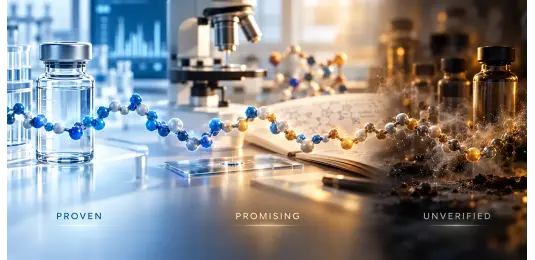
Peptides are not magic, and they are not a conspiracy either. They are a legitimate and rapidly maturing class of medicine — some of it rigorously proven (insulin, the GLP-1s), much of it promising but unproven (the recovery and longevity stack), and all of it tangled in a genuine fight over who gets to control and profit from treatments.
The sensible playbook, straight from the clinicians who know this space best:
- Treat the GLP-1s as real medicine with real side effects — especially muscle loss during rapid weight loss.
- Treat the "longevity" peptides as experimental: fascinating, plausibly useful, and short on human data.
- Never buy injectables from unregulated sellers. If legal compounding arrives, use it; until then, wait or work with a licensed clinic — and expect to hear more from the FDA before the end of 2026.
Educational content, not medical advice. Consult a licensed physician before starting any peptide or medication.