FDA Issues Warnings for All GLP-1 Drugs: What You Need to Know
FDA Issues Warnings for All GLP-1 Drugs: What You Need to Know
By Medical Team of Generic Peptides
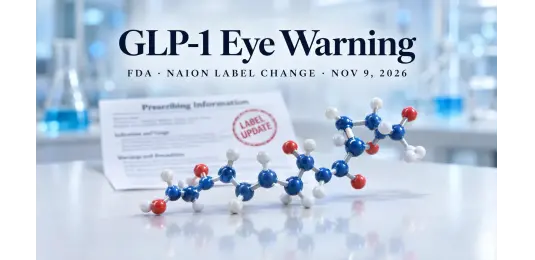
The FDA issued a Drug Safety Communication on November 9, 2026, requiring that all GLP-1 receptor agonists now contain a cautionary statement regarding the potential for an increased risk of a rare eye condition (non-arteritic anterior ischemic optic neuropathy, "NAION") in the product labeling under Warnings and Precautions.
This means that all GLP-1 drugs, including exenatide and newer agents like semaglutide and tirzepatide, will now carry the statement.
NAION Overview
Non-arteritic anterior ischemic optic neuropathy is caused by a reduction in blood supply to the front part of the optic nerve. This leads to damage in the nerve, typically causing sudden, painless loss of vision in one eye. Patients often notice it when they wake up. The vision lost can be permanent.
NAION is a rare condition. Published studies have reported 2.3 to 10.2 cases per 100,000 adults over 50 years of age each year. Risk factors include diabetes, high blood pressure, sleep apnea, smoking, anemia and kidney disease. A previous episode of NAION also increases the risk in the other eye.
Drugs Affected
All GLP-1 receptor agonist drugs sold in the US:
- Exenatide (generic products)
- Liraglutide (Victoza, Saxenda) and liraglutide with insulin degludec (Xultophy)
- Dulaglutide (Trulicity)
- Lixisenatide with insulin glargine (Soliqua)
- Semaglutide (Ozempic, Rybelsus, Wegovy)
- Tirzepatide (Mounjaro, Zepbound)
- Orforglipron (Foundayo)
Cases of NAION have been reported with every marketed GLP-1 drug.
Evidence
Following a study published in JAMA Ophthalmology (July 2024), the FDA reviewed the data. Researchers from a single academic center looked back at patients seen in neuro-ophthalmology clinics and found a higher rate of NAION among those prescribed semaglutide compared with other medications. Although the study had limitations due to being single-center and retrospective, the FDA felt it was important to investigate this "signal" further.
As such, the agency looked at a range of different data sources.
Clinical Trial Data
A meta-analysis performed using data from 126 randomized controlled trials, looking at 134,253 patients over 288,879 person-years of observation. This found 15 probable NAION cases in total: 10 in patients on GLP-1 drugs and 5 on placebo. This corresponds to roughly 6.4 cases per 100,000 person-years with GLP-1 drugs, compared with 3.8 with comparators.
Real-World Data
An analysis within the FDA's Sentinel system looked at adult patients with type 2 diabetes who started treatment with a GLP-1 drug, an SGLT-2 inhibitor or a DPP-4 inhibitor between 2019 and 2024. Compared with SGLT-2 inhibitors, GLP-1 drugs showed no statistically significant increase (hazard ratio 1.19). However, compared with DPP-4 inhibitors, GLP-1 drugs showed a statistically significant increase (hazard ratio 1.43).
Animal Data
No mechanism was identified that would cause an increased risk of NAION with GLP-1 drugs.
Overall, the FDA concluded there is a potential increased risk of rare NAION events with this class of drugs.
This conclusion was similar to the one made by European regulators. In June 2025, the safety committee (PRAC) at the European Medicines Agency concluded that NAION is a very rare side effect of semaglutide medicines (it can occur in up to 1 in 10,000 people). The FDA, however, has concluded a class effect, whereas the EMA had only identified this effect with semaglutide.
FDA Recommendations
Health care professionals are advised to tell patients to report any sudden vision changes. Suspected cases should be referred for prompt assessment by an ophthalmologist. If NAION occurs, clinicians should consider discontinuing GLP-1 treatment. Patients should report sudden, painless loss of vision in one eye, blind spots, blurring or color changes to their health care professional immediately. Anyone who has had a NAION event before should discuss continuing treatment with their health care professional.
What We Don't Know
There is no confirmation of a biological mechanism. One theory from the literature is that it may be linked to rapid metabolic changes and blood-flow control at the optic nerve head. This, however, has not been demonstrated.
Many people taking these drugs have diabetes, obesity or sleep apnea, which are themselves risk factors for NAION. This makes it difficult to separate drug effect from disease effect in the observational data.
We do not know whether certain drugs within this class, or single (GLP-1) versus dual (GLP-1/GIP) agonists, carry different risks. This is likely to remain an ongoing area of research, from epidemiology to cell and animal studies of the optic nerve.
Importance to GLP-1 Research
GLP-1 receptor agonists are among the most well-studied peptide-based drugs, and safety signals like this one shape how new molecules in this class are designed and tested. For an overview of the two most widely used drugs, see our semaglutide and tirzepatide overviews. We also offer research-grade GLP-1 compounds for laboratory investigation. These are strictly for in vitro and preclinical research only.
FAQ
What did the FDA announce on November 9, 2026?
The FDA required all GLP-1 receptor agonists to carry a cautionary statement about a potential increased risk of NAION (a rare cause of sudden vision loss in one eye) in the label under Warnings and Precautions.
How common is NAION with GLP-1 drugs?
It is a rare side effect. In the clinical trial analysis performed by the FDA, the rate was around 6.4 cases per 100,000 person-years with GLP-1 drugs, compared with 3.8 with comparators. Europe's regulator classifies it as a very rare side effect of semaglutide (up to 1 in 10,000 people).
Does this only affect Ozempic and Wegovy?
No. It affects all GLP-1 receptor agonists currently sold in the US, including tirzepatide, liraglutide, dulaglutide, exenatide, lixisenatide and orforglipron.
Has the FDA identified how GLP-1 drugs could cause NAION?
No. Animal studies did not identify a mechanism, and the FDA describes the risk as potential rather than established.
References
[1] US Food and Drug Administration. Drug Safety Communication on GLP-1 receptor agonists and NAION. November 9, 2026 (as reported by Pharmacy Times and Pharmaceutical Executive).
[2] Pharmacy Times. FDA Requires Class-Wide GLP-1 RA Labeling Changes for Potential NAION Risk. November 9, 2026. https://www.pharmacytimes.com/view/fda-requires-class-wide-glp-1-ra-labeling-changes-for-potential-naion-risk
[3] Pharmaceutical Executive. FDA Requests Updated Safety Label Warning Across All GLP-1 Receptor Agonists for Potential Risk of NAION. November 10, 2026. https://www.pharmexec.com/view/fda-requests-safety-label-warning-glp-1-receptor-agonist-risk-naion
[4] Hathaway JT, et al. Risk of Nonarteritic Anterior Ischemic Optic Neuropathy in Patients Prescribed Semaglutide. JAMA Ophthalmology. 2024.
[5] European Medicines Agency. PRAC Concludes Eye Condition NAION Is a Very Rare Side Effect of Semaglutide Medicines Ozempic, Rybelsus and Wegovy. June 2025. https://www.ema.europa.eu/en/news/prac-concludes-eye-condition-naion-very-rare-side-effect-semaglutide-medicines-ozempic-rybelsus-wegovy
For research use only. Not for human consumption. This content is for informational purposes and is not medical advice.