MOTS-c After the July 2026 PCAC Review: Human Evidence and Regulatory Status
MOTS-c After the July 2026 PCAC Review: Human Evidence and Regulatory Status
Editorial disclosure: Generic Peptides sells peptides for laboratory research. This article explains a public regulatory proceeding and is not medical or legal advice. MOTS-c is not FDA-approved for obesity, osteoporosis, or any other medical use.
Most peptides discussed in medicine are encoded by genes in the cell nucleus. MOTS-c comes from somewhere more unusual: mitochondrial DNA.
That origin helped turn a 16-amino-acid peptide into a much larger story about metabolism, exercise, aging, body weight, and bone health. In mice and cell models, MOTS-c has produced results that sound almost designed for headlines. It has been associated with improved insulin sensitivity, resistance to diet-induced obesity, increased physical capacity, and reduced bone loss in experimental models.
The human evidence tells a more limited story.
The FDA's Pharmacy Compounding Advisory Committee (PCAC) met on July 23–24, 2026, and supported placing MOTS-c-related bulk drug substances—MOTS-c free base and MOTS-c acetate—on the Section 503A Bulks List for the nominated uses of obesity and osteoporosis. The recommendation is advisory. It is not FDA approval, does not itself add MOTS-c to the 503A Bulks List, and does not immediately authorize compounding. Final regulatory action remains with the FDA.
For the broader meeting context, see our July 2026 FDA peptide meeting guide. For related regulatory coverage, see our BPC-157 FDA review update and TB-500 FDA review.
What the July 2026 PCAC Recommendation Means
The PCAC evaluated MOTS-c free base and MOTS-c acetate in the context of possible inclusion on the 503A Bulks List. FDA's meeting materials identify obesity and osteoporosis as the uses evaluated for these substances.
PCAC recommendations are non-binding advice to the FDA. A favorable recommendation is therefore an important policy development, but it is not a final agency determination. It does not:
- make MOTS-c an FDA-approved drug;
- establish that MOTS-c treats obesity or osteoporosis in humans;
- automatically place either form on the 503A Bulks List;
- authorize pharmacies to compound MOTS-c solely because of the vote; or
- establish a standardized dose, route, formulation, or clinical indication.
The FDA must consider the committee's advice and complete the applicable review and rulemaking steps before the legal status changes. The result should be reported as an advisory recommendation—not as approval or immediate legal authorization.
One Peptide, Two Different Nominations
Obesity and osteoporosis may look unrelated. One concerns excess body fat and metabolic health; the other concerns bone strength and fracture risk.
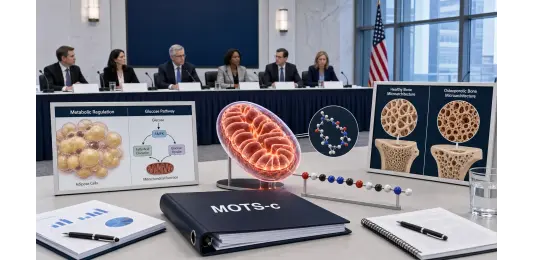
Mitochondria connect the two. They generate cellular energy, respond to stress, communicate with the rest of the cell, and influence how tissues use fuel. Muscle, fat, and bone all depend on mitochondrial function.
MOTS-c is a mitochondrial-derived peptide. Its name stands for mitochondrial open reading frame of the 12S rRNA type-c. During metabolic stress, MOTS-c has been reported to move into the cell nucleus and influence gene expression associated with adaptation and energy balance.
This biology gives researchers a plausible reason to study the same peptide in several tissues. It does not make evidence from one condition transferable to another. Obesity and osteoporosis require separate evidence of effectiveness and safety.
Why Researchers Connected MOTS-c With Obesity
The obesity story began with a widely cited 2015 study in Cell Metabolism. Researchers reported that MOTS-c influenced cellular metabolism through pathways involving the folate cycle, AICAR, and AMP-activated protein kinase, better known as AMPK.
AMPK acts as an energy sensor. When cellular energy is low, it helps shift metabolism toward producing energy rather than storing it. In mouse experiments, MOTS-c treatment was associated with:
- improved insulin sensitivity;
- increased glucose use in skeletal muscle;
- protection against age-related insulin resistance; and
- reduced high-fat-diet-induced weight gain.
Later animal work connected MOTS-c with exercise adaptation and physical capacity. In older mice, treatment improved performance and selected healthspan measurements. These findings helped create the popular description of MOTS-c as an "exercise mimetic."
That phrase needs restraint. MOTS-c may reproduce selected metabolic signals associated with exercise in experimental models. It has not been shown to replace exercise, produce reliable human weight loss, or treat obesity in controlled clinical trials.
Animal models are useful for testing mechanisms under controlled conditions. They cannot establish whether a compounded MOTS-c product would be effective or safe in people.
Why Osteoporosis Is Also Relevant
Bone is constantly being rebuilt. Osteoblasts form new bone, while osteoclasts break down older bone. Hormones, mechanical loading, inflammation, age, and cellular energy all affect that balance.
The osteoporosis rationale comes mainly from cell and animal research. A 2016 study tested MOTS-c in mice with ovariectomy-induced bone loss, a model used to study changes associated with estrogen deficiency. The researchers reported that MOTS-c reduced bone loss through a mechanism involving AMPK.
Other laboratory studies have examined:
- osteoblast growth and differentiation;
- osteoclast formation;
- type I collagen production;
- OPG/RANKL signaling, which helps regulate bone breakdown; and
- inflammatory pathways involved in osteolysis.
The bone literature is much smaller than the metabolic literature and varies in quality. Some experiments were conducted only in cultured cells or rodents. A later paper claiming that MOTS-c accelerated fracture healing was withdrawn by the authors because of inaccuracies in the organization of its images; it should not be used as supporting evidence.
Most importantly, osteoporosis is a clinical outcome, not simply a change in a cell marker. A credible human treatment program would need to evaluate bone density, bone turnover, fractures, long-term safety, and interactions with established osteoporosis therapies. No clinical program has established MOTS-c as an osteoporosis treatment.
The Human-Evidence Trap
Searching for "MOTS-c human study" produces many results. That can create the impression that MOTS-c has already been tested as a drug in people.
Most of those studies measured MOTS-c that the human body produces naturally. Researchers have examined circulating or muscular MOTS-c levels in connection with exercise, age, insulin sensitivity, obesity, polycystic ovary syndrome, cancer survivorship, and genetic variation.
Small exercise studies found that naturally occurring MOTS-c levels changed after physical activity. Other studies reported associations between circulating MOTS-c and metabolic measurements.
These are human studies about MOTS-c biology. They are not human exposure studies in which participants received a drug product containing synthetic MOTS-c.
Measuring a substance already present in blood can show that it may be associated with exercise or metabolism. It cannot determine:
- a therapeutic dose;
- absorption after administration;
- distribution through the body;
- duration of exposure;
- immune reactions;
- adverse effects; or
- effectiveness for obesity or osteoporosis.
An association can also run in either direction. If MOTS-c levels differ in people with obesity, researchers still need to determine whether the peptide contributes to the condition, responds to it, or simply changes alongside other metabolic signals.
What About CB4211?
One genuine human trial can easily be mistaken for a MOTS-c trial.
CB4211, a drug candidate developed from MOTS-c research, completed a Phase 1a/1b study in healthy volunteers and people with obesity and nonalcoholic fatty liver disease. The study is registered as NCT03998514.
CB4211 is a modified and optimized analog. It was designed to have properties different from the natural 16-amino-acid MOTS-c sequence. Its human data therefore belong to CB4211, not automatically to MOTS-c free base or MOTS-c acetate.
An analog can differ in potency, stability, metabolism, tissue exposure, and safety. CB4211 shows that the wider mitochondrial-peptide concept has reached clinical testing. It does not provide direct human exposure evidence for the substances considered by PCAC.
What FDA Says Is Missing
FDA's published safety materials state that the agency has not identified human exposure data for drug products containing MOTS-c by any route of administration.
FDA also identifies potential immunogenicity risks for certain routes, along with concerns involving peptide-related impurities and characterization of the active pharmaceutical ingredient.
Immunogenicity is the possibility that the immune system may react to the peptide or an impurity. The risk can depend on the formulation, manufacturing process, route, dose, and frequency of exposure.
Characterization matters because "MOTS-c" on a label does not answer every chemical question. Reviewers need to know the exact sequence, salt form, purity profile, degradation products, stability, and analytical methods used to confirm identity.
FDA is not saying that MOTS-c has been proven dangerous. It is saying that the available record does not show enough about exposure and safety to determine whether compounded products would cause harm.
What Happened to Category 2?
MOTS-c previously appeared in Category 2 of FDA's interim 503A policy. That category included nominated bulk substances for which the agency had identified potentially significant safety concerns.
By April 2026, FDA had moved MOTS-c from the active Category 2 table to a separate table of substances whose previous nominations had been withdrawn. Separately, FDA proceeded with the PCAC review of MOTS-c free base and MOTS-c acetate.
This was a procedural change, not a clean safety finding. FDA continued to publish its MOTS-c risk summary while the formal review was considered. The committee's subsequent recommendation is another step in the administrative record, not a final change in drug status.
The Sports Context
MOTS-c is prohibited at all times in competitive sport under the World Anti-Doping Agency's category for hormone and metabolic modulators. WADA identifies it among AMPK activators.
The anti-doping rule reflects the peptide's potential to alter metabolic signaling. It does not demonstrate that MOTS-c safely improves athletic performance in humans.
WADA and PCAC answer different questions:
- WADA determines what is prohibited in regulated sport.
- PCAC advises FDA about eligibility for a specific patient-specific compounding process under Section 503A.
Neither process is a drug approval.
What Happens Next
The July 2026 recommendation becomes part of the FDA's administrative record. The agency must still consider the committee's advice and complete the applicable review and rulemaking steps, which may include a proposed rule, public comment, and a final determination.
Until that process is complete, the recommendation should not be presented as automatic inclusion on the 503A Bulks List. It also does not create an FDA-approved indication, a standardized treatment protocol, or evidence that research products are suitable for human use.
For information about order processing, delivery times, tracking, and packaging, see Shipping & Payments.
The Bottom Line
MOTS-c is scientifically unusual and genuinely interesting. Its mitochondrial origin and effects in metabolic and bone models justify continued research.
The missing step is human evidence for the actual drug substances considered by FDA.
People naturally produce MOTS-c, and researchers have measured it in human studies. A modified analog has also entered clinical testing. Neither fact establishes the safety or effectiveness of compounded MOTS-c free base or MOTS-c acetate.
PCAC's July 23–24, 2026 recommendation supporting MOTS-c is an important advisory development. It is not FDA approval, not automatic placement on the 503A Bulks List, and not proof that MOTS-c produces weight loss, prevents fractures, or works as an exercise substitute.
Sources
- FDA: July 23–24, 2026 Meeting of the Pharmacy Compounding Advisory Committee
- FDA: July 23–24, 2026 PCAC Briefing Document
- FDA: Draft Questions for the July 2026 PCAC Meeting
- FDA: Certain Bulk Drug Substances for Use in Compounding That May Present Significant Safety Risks
- Lee C. et al.: The Mitochondrial-Derived Peptide MOTS-c Promotes Metabolic Homeostasis and Reduces Obesity and Insulin Resistance, 2015
- Reynolds J.C. et al.: MOTS-c Is an Exercise-Induced Regulator of Age-Dependent Physical Decline and Muscle Homeostasis, 2021
- Ming W. et al.: MOTS-c Suppresses Ovariectomy-Induced Bone Loss via AMPK Activation, 2016
- Hu B-T. and Chen W-Z.: MOTS-c Improves Osteoporosis by Promoting Osteogenic Differentiation, 2018
- Lu Y. et al.: MOTS-c Inhibits Osteolysis in the Mouse Calvaria, 2019
- Woodhead J.S.T. et al.: Acute Endurance Exercise Stimulates Circulating Mitochondrial-Derived Peptides in Humans, 2021
- Ramanjaneya M. et al.: Lipids and Insulin Regulate MOTS-c in PCOS and Healthy Subjects, 2019
- ClinicalTrials.gov: Phase 1a/1b Study of CB4211, NCT03998514
- World Anti-Doping Agency: The 2026 Prohibited List
- Lee C. et al.: Role of MOTS-c in the Regulation of Bone Metabolism, 2023
- European Review for Medical and Pharmacological Sciences: Withdrawal Notice for MOTS-c Accelerates Bone Fracture Healing, 2021
- Lee C. et al.: MOTS-c Translocates to the Nucleus in Response to Metabolic Stress, 2018