TB-500 After the July 2026 PCAC Review
What the evidence shows, what the PCAC recommendation means, and what still depends on FDA
Editorial disclosure: Generic Peptides sells peptides for laboratory research. This article explains a public regulatory proceeding and is not medical or legal advice. TB-500 is not FDA-approved for wound healing or any other medical use.
TB-500 is often described online as a "healing peptide" related to thymosin beta-4. The underlying science is more specific than that label suggests.
Thymosin beta-4 is a naturally occurring 43-amino-acid peptide studied in tissue repair, cell movement, inflammation, angiogenesis, and wound models. In its 2026 review, FDA defined TB-500 as a much shorter, N-terminally acetylated seven-amino-acid peptide: Ac-LKKTETQ, corresponding to residues 17–23 of thymosin beta-4. Evidence for the full-length peptide should not automatically be treated as evidence for this fragment.
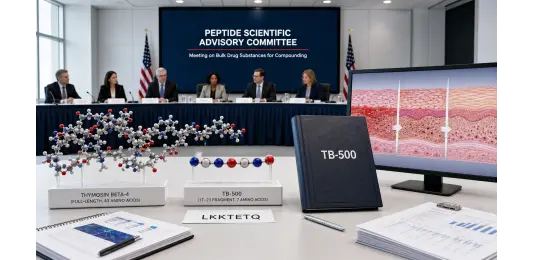
That distinction became especially important after the FDA's Pharmacy Compounding Advisory Committee (PCAC) met on July 23–24, 2026. The committee voted 8–6, with one abstention, to recommend placing both TB-500 free base and TB-500 acetate on the Section 503A Bulks List; FDA had evaluated wound healing as the nominated use. The recommendation is advisory. It is not FDA approval, does not itself add either substance to the 503A Bulks List, and does not by itself authorize compounding under Section 503A. FDA must still complete its regulatory process.
For a broader review of TB-500's molecular identity, preclinical evidence, and the limits of extrapolating from full-length thymosin beta-4, read our detailed TB-500 research overview or the broader FDA peptide meeting guide. For product specifications and laboratory documentation, see the TB-500 research peptide page. That product page identifies the offered material as full-length, 43-amino-acid thymosin beta-4—not the seven-amino-acid TB-500 fragment evaluated by FDA.
What the July 2026 PCAC Recommendation Means
The PCAC reviewed TB-500 free base and TB-500 acetate in the context of possible inclusion on the 503A Bulks List. FDA's meeting materials identify wound healing as the use evaluated, and the committee recommended inclusion of both forms in an 8–6 vote with one abstention.
PCAC recommendations are non-binding advice to the FDA. A favorable recommendation is therefore a meaningful policy signal, but it is not a final agency determination. It does not:
- make TB-500 an FDA-approved drug;
- establish that TB-500 has been shown to heal human wounds;
- automatically place either form on the 503A Bulks List;
- authorize pharmacies to compound TB-500 solely because of the vote; or
- establish a standardized dose, route, formulation, or clinical indication.
FDA addresses additions to the 503A Bulks List through notice-and-comment rulemaking. As of this September 2026 update, neither TB-500 free base nor TB-500 acetate appears in the current list at 21 CFR § 216.23. The July outcome should therefore be reported as a positive advisory recommendation—not as approval or immediate legal authorization.
Why TB-500 Is Difficult to Evaluate
The central issue is not whether thymosin beta-4 biology is interesting. It is whether the available evidence applies to the exact substance under review.
Three related names appear throughout the literature and online market:
- Thymosin beta-4: the complete, naturally occurring 43-amino-acid peptide.
- LKKTETQ: the unacetylated seven-amino-acid sequence corresponding to residues 17 through 23 of thymosin beta-4; it contains the six-residue actin-binding segment LKKTET.
- TB-500 in FDA's review: the synthetic N-terminally acetylated heptapeptide Ac-LKKTETQ. FDA treated its free-base and acetate-salt forms as distinct bulk drug substances.
These terms are often treated as synonyms, but they do not necessarily identify the same molecule. A clinical study of full-length thymosin beta-4 does not automatically establish the safety or effectiveness of TB-500. A study of unacetylated LKKTETQ may not answer every question about an acetylated peptide, an acetate salt, or a compounded formulation.
The word "acetate" also needs care. An acetate salt describes a counter-ion or salt form; it is not the same chemical feature as N-terminal acetylation of the peptide sequence.
The Wound-Healing Hypothesis
Actin is a structural protein that helps cells maintain shape and move. During wound repair, cells must migrate into damaged tissue, rebuild a surface, coordinate inflammation, and organize new extracellular matrix.
Research on full-length thymosin beta-4 has associated it with:
- cell migration;
- formation of new blood vessels;
- changes in inflammatory signaling;
- protection from programmed cell death;
- collagen organization; and
- re-epithelialization, the rebuilding of a tissue surface.
Because LKKTETQ is associated with thymosin beta-4's actin-binding region, researchers have asked whether a shorter synthetic fragment can reproduce some of the parent peptide's repair-related activity. That is a plausible research hypothesis, not proof of a clinical effect.
What the Fragment Studies Found
Early animal work directly examined LKKTETQ. A 2003 study tested full-length thymosin beta-4 in diabetic and aged mice, while the non-acetylated LKKTETQ fragment was tested in the aged-mouse model. The fragment was reported to increase epidermal closure and collagen content, but the study did not establish a dose-response relationship and did not test N-terminally acetylated TB-500. Later work detected proteins released from wounded skin after LKKTETQ treatment and explored possible signaling through purinergic receptors.
A 2010 review described LKKTETQ as a short sequence associated with cell migration, angiogenesis, and wound-healing research. These studies help explain the scientific rationale for the nomination, but they also have clear limits:
- most of the evidence is preclinical;
- animal wound models do not reproduce every feature of chronic human wounds;
- laboratory preparations may not match a commercial or compounded product; and
- the studies do not establish a human dose, route, schedule, or long-term safety profile.
In a 2024 in-vitro scratch assay cited by FDA, TB-500 free base did not significantly increase wound closure at the tested concentration, while its shorter metabolite Ac-LKKTE produced a small but statistically significant effect under the same conditions. The study used one concentration and cannot establish clinical activity. It does show why characterization matters: researchers need to know what was administered, what metabolites formed, and which molecule produced the measured endpoint.
What Human Thymosin Beta-4 Studies Can—and Cannot—Show
Full-length thymosin beta-4 has entered human clinical research. Registered studies have evaluated topical thymosin beta-4 in venous stasis ulcers and ophthalmic RGN-259 formulations in dry-eye and corneal disorders. Those programs are relevant to the biological history of the parent peptide.
They are not human trials of the short Ac-LKKTETQ substance evaluated by FDA for wound healing. At the time of its May 2026 evaluation, FDA stated that it had not identified any clinical studies or human exposure data for TB-500 free base or TB-500 acetate administered by any route. Human safety and effectiveness therefore remain unestablished for the exact TB-500 substances reviewed by FDA.
Human experience with the complete 43-amino-acid peptide therefore cannot simply be assigned to a seven-amino-acid derivative. The molecules may differ in stability, tissue distribution, metabolism, binding behavior, immune response, impurity profile, and activity outside the actin-binding region.
For a related regulatory comparison, see our BPC-157 FDA review update. The two reviews concern different peptides and different evidence bases; neither article should be read as an approval announcement.
For the corresponding BPC-157 product specifications and documentation, see the BPC-157 product overview.
Why Product Identity and Quality Matter
Online, "TB-500" may be used for products described as:
- LKKTETQ;
- N-acetyl-LKKTETQ;
- thymosin beta-4 fragment 17–23;
- synthetic thymosin beta-4; or
- full-length thymosin beta-4.
Those descriptions do not all identify the same substance. A compounding review requires a bulk drug substance to be physically and chemically characterized well enough to connect the ingredient to specifications, analytical methods, published studies, proposed formulations, and safety information.
For laboratory buyers, the same principle applies. Product identity, batch documentation, analytical methods, and storage records are more informative than a generic "TB-500" label. The Generic Peptides TB-500 product page identifies the offered material as full-length thymosin beta-4: 43 amino acids, CAS 77591-33-4, and a listed molecular weight of 4963.44 g/mol. Researchers should not treat those specifications as interchangeable with FDA's seven-amino-acid Ac-LKKTETQ substance.
FDA Safety Questions Remain Open
Before the meeting, FDA identified concerns about compounded products containing the thymosin beta-4 fragment, including possible immunogenicity related to aggregation and peptide impurities. FDA also reported that it had not identified human exposure data sufficient to define the risk with confidence.
Those statements do not prove that TB-500 is harmful. They show why a positive advisory recommendation is not the same as a safety clearance. Important questions remain about aggregation during manufacture or storage, synthesis-related impurities, route-dependent immune risk, batch reproducibility, and repeated exposure.
The earlier withdrawal of the nomination did not end FDA's review because the agency proceeded on its own initiative. Nor did the committee vote itself change the current regulation. Regulatory status depends on FDA's formal action, not on market descriptions or an advisory recommendation alone.
The Sports Context
The World Anti-Doping Agency lists thymosin beta-4 and its derivatives, including TB-500, as prohibited in sport. Anti-doping research has developed analytical methods for detecting TB-500 and its metabolites in biological samples.
This literature can help clarify chemical identity, but detection research is not evidence that TB-500 safely improves recovery or wound healing. The sports and FDA processes answer different questions:
- WADA decides which substances are prohibited in sport.
- FDA and PCAC evaluate a nominated substance for a specific compounding-policy process under Section 503A.
Neither process is a clinical approval of TB-500.
What Happens Next
The July 2026 recommendation becomes part of the FDA's administrative record. The next steps belong to the agency and may include further review, a proposed rule, public comment, and a final rule or other formal determination.
Until that process is complete, the recommendation should not be presented as automatic inclusion on the 503A Bulks List. It also does not create an FDA-approved indication, a standardized treatment protocol, or evidence that research products are suitable for human use.
The Bottom Line
TB-500's wound-healing nomination has a scientific rationale rooted in thymosin beta-4 and the LKKTETQ actin-binding region. Animal and laboratory studies are interesting, but they do not establish human efficacy or long-term safety for the exact TB-500 forms reviewed by FDA.
PCAC's July 23–24, 2026 recommendation supporting TB-500 is an important advisory development. It is not FDA approval, not automatic placement on the 503A Bulks List, and not a substitute for formal agency action. The central questions remain substance identity, quality, human exposure, safety, and the extent to which evidence from full-length thymosin beta-4 can reasonably be applied to a short fragment.
For order processing, delivery times, tracking, and packaging information, see Shipping & Payments.
Sources
- FDA: July 23–24, 2026 Meeting of the Pharmacy Compounding Advisory Committee
- FDA: Briefing Document for TB-500-Related Bulk Drug Substances
- FDA: Draft Questions for the July 2026 PCAC Meeting
- FDA: Certain Bulk Drug Substances for Use in Compounding That May Present Significant Safety Risks
- FDA: Bulk Drug Substances Used in Compounding Under Section 503A
- Electronic Code of Federal Regulations: 21 CFR § 216.23
- Pharmacy Times: What the July 2026 Peptide Vote Changes
- Philp D. et al.: Thymosin Beta 4 and a Synthetic Peptide Containing Its Actin-Binding Domain Promote Dermal Wound Repair, 2003
- Huang C-M. et al.: In Vivo Detection of Secreted Proteins From Wounded Skin, 2006
- Sosne G. et al.: Biological Activities of Thymosin Beta 4 Defined by Active Sites in Short Peptide Sequences, 2010
- Ho E.N.M. et al.: Doping Control Analysis of TB-500 in Equine Urine and Plasma, 2012
- Rahaman K.A. et al.: Quantification of TB-500 and Its Metabolites and In Vitro Wound-Healing Screening, 2024
- ClinicalTrials.gov: Study of Thymosin Beta 4 in Patients With Venous Stasis Ulcers, NCT00832091
- ClinicalTrials.gov: Thymosin Beta 4 Ophthalmic Solution in Dry Eye, NCT01387347
- Sosne G. et al.: Thymosin Beta 4: A Novel Corneal Wound-Healing and Anti-Inflammatory Agent, 2007
- World Anti-Doping Agency: The 2026 Prohibited List