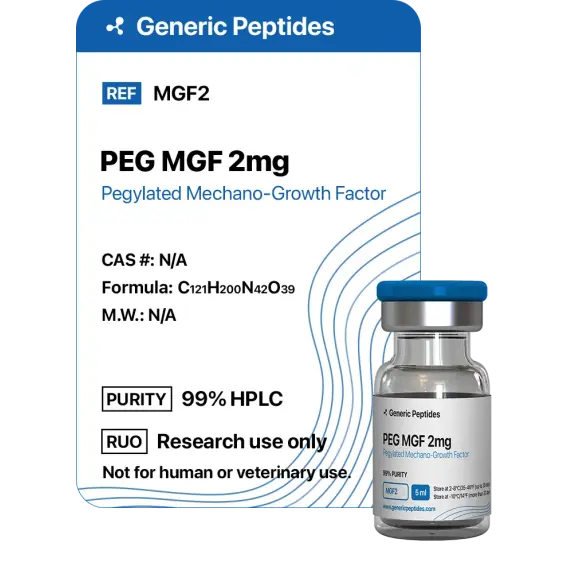
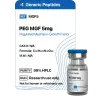
PEG-MGF 2mg
Certificate of Analysis available
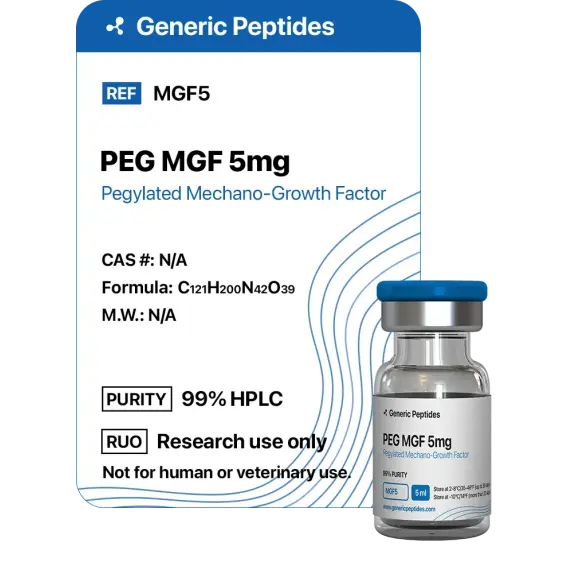
Native MGF lasts about 5 to 7 minutes in human circulation before peptidases tear it apart. That brief window of activity is the entire reason most early MGF research had to be done with direct intramuscular injection at the exact site of muscle damage. Then someone realized that wrapping the peptide in polyethylene glycol could shield it from the enzymes that destroy it. The result: PEG-MGF, with a half-life measured in hours instead of minutes — a peptide you can actually use for systemic research.
PEG-MGF is the pegylated version of Mechano Growth Factor — a 24-amino-acid peptide derived from the C-terminal "E-domain" of the IGF-1Ec splice variant, which muscle tissue produces in response to mechanical stress and damage. The "PEG" is polyethylene glycol, a biocompatible polymer covalently attached to the peptide through a process called pegylation. The PEG chains form a dense hydration shell around the peptide — the "PEG cloud" — that physically blocks access by proteolytic enzymes and dramatically reduces renal clearance.
The pharmacology is unusual. Native MGF is a local paracrine factor — it's produced at the site of muscle damage, acts on nearby satellite cells, and gets cleared before it can travel anywhere systemically. PEG-MGF circulates systemically, meaning a single subcutaneous injection can reach satellite cells in muscle groups throughout the body. That's a fundamentally different research tool than native MGF, even though the active peptide is the same.
Skeletal muscle contains a population of dormant stem-cell-like precursors called satellite cells that sit alongside muscle fibers in a quiescent state (cell cycle phase G0). When muscle is damaged or mechanically overloaded, these cells need to be activated, proliferate, and either fuse into existing muscle fibers or form new ones. Native MGF is one of the signals that wakes them up.
The MGF E-domain peptide — the part PEG-MGF actually delivers — appears to drive satellite cell activation through a receptor that's distinct from the classical IGF-1 receptor. The full IGF-1 mature domain signals through IGF-1R via PI3K/Akt/mTOR for protein synthesis. The E-domain has its own anti-apoptotic and proliferative signaling that researchers haven't fully characterized yet. That's a feature, not a bug — it means PEG-MGF may target satellite cell activation more selectively than systemic IGF-1 analogs do.
Here's the uncomfortable truth: essentially all PEG-MGF research is preclinical. There are no human clinical trials. The most-cited studies are animal work and in vitro cell culture experiments. Anyone selling PEG-MGF with guaranteed muscle-growth outcomes in humans is going far beyond what the published literature supports. The mechanism is interesting, the animal data is consistent, the human translation question remains genuinely open.
The IGF-1 connection also matters for risk assessment. Even though PEG-MGF appears to act primarily through the E-domain rather than the classical IGF-1R, the broader IGF-1 pathway is implicated in cell proliferation and potentially tumor biology in some research contexts. The E-peptide's separate signaling reduces this concern compared to direct IGF-1 administration, but doesn't eliminate it. This is one reason the compound has stayed in research use rather than progressing to clinical development.
Regulatory note: PEG-MGF was placed on the FDA's Category 2 bulks list in 2023. On April 22, 2026, the FDA removed PEG-MGF from Category 2 after the original nominations were withdrawn. PEG-MGF was deferred to the second-tier reclassification group with a PCAC consultation scheduled before the end of February 2027 — placed alongside Cathelicidin LL-37, Dihexa, GHK-Cu (all routes), and Melanotan II rather than the July 2026 first-tier review group. As of May 2026, PEG-MGF is in regulatory transition. WADA prohibits MGF and analogs for athletes in tested sports under category S2.
Here's a sourcing problem that's specific to PEG-MGF: the PEG conjugation chemistry is the technically demanding part, and "PEG-MGF" labels routinely cover wildly inconsistent products. Different PEG sizes (typically 2-40 kDa), different linkage points on the peptide, different conjugation efficiencies — all sold under the same name. Cheap suppliers often deliver under-pegylated material with most of the peptide remaining unconjugated, or use poorly characterized PEG chains that produce unpredictable pharmacokinetics. The whole reason researchers choose PEG-MGF over native MGF is the extended half-life from proper pegylation. If the conjugation is inconsistent, you have neither MGF nor PEG-MGF — you have a poorly defined mixture.
Generic Peptides supplies research-grade PEG-MGF for sale at 99% purity, manufactured in the USA. Domestic production with documented PEG conjugation — the part that determines whether your half-life data matches published research or fails to replicate.
Order PEG-MGF for sale in the USA — 99% purity, verified PEG conjugation, manufactured domestically.
Yes — PEG-MGF is legally available as a research compound in the United States. As of April 22, 2026, it has been removed from FDA Category 2 with PCAC consultation deferred to before the end of February 2027 (second-tier reclassification group). Not FDA-approved for human use. WADA prohibits MGF and analogs for tested athletes.
PEG-MGF is native MGF with polyethylene glycol chains attached. Native MGF has a 5-7 minute half-life and acts as a local paracrine factor at the injection site. PEG-MGF has a half-life of hours and circulates systemically, reaching satellite cells throughout the body from a single injection. The active peptide sequence is the same; the pharmacokinetics are completely different.
Honestly, no human clinical trial data exists. Essentially all PEG-MGF research is animal and in vitro work. The mechanism is well-characterized at the cellular level, animal studies show satellite cell activation and muscle regeneration effects, but human efficacy is genuinely unknown. Anyone guaranteeing specific human outcomes is going beyond what the literature supports.
Different peptides from the same gene. IGF-1 LR3 is the systemic mature IGF-1 domain with engineered stability — acts through IGF-1R for general anabolic signaling. PEG-MGF is the muscle-specific E-domain splice variant — appears to act through a separate receptor for satellite cell activation. Both target muscle research applications but with different molecular mechanisms.
Probably not. The pegylation step is the technically demanding part of PEG-MGF synthesis, and cheap suppliers routinely deliver under-pegylated material, inconsistent PEG chain sizes, or poorly characterized conjugation chemistry. Without analytical verification of the PEG attachment, the half-life that defines this compound's research utility may not actually be there.
Sources
Goldspink G — "Mechanical signals, IGF-I gene splicing, and muscle adaptation." Physiology, 2005. Foundational research on MGF as an IGF-1 splice variant and its role in mechanical loading response. https://pubmed.ncbi.nlm.nih.gov/15814847/
Hill M, Goldspink G — "Expression and splicing of the insulin-like growth factor gene in rodent muscle is associated with muscle satellite (stem) cell activation following local tissue damage." Journal of Physiology, 2003. Documents satellite cell activation mechanism. https://pubmed.ncbi.nlm.nih.gov/14506321/
Riddoch-Contreras J et al. — "Mechano-growth factor, an IGF-I splice variant, rescues motoneurons and improves muscle function in SOD1(G93A) mice." Experimental Neurology, 2009. Documents neuroprotective effects of MGF E-peptide. https://pubmed.ncbi.nlm.nih.gov/19014940/
FDA — "Bulk Drug Substances Nominated for Use in Compounding Under Section 503A," updated April 22, 2026. Documents PEG-MGF removal from Category 2 and the deferred February 2027 PCAC consultation. https://www.fda.gov/media/94155/download
A peptide whose entire utility depends on the PEG attachment being right. Sourcing isn't optional.
PEG-MGF (Pegylated Mechano Growth Factor) ships as a white lyophilized powder in a sealed glass vial, freeze-dried to preserve the pegylated peptide structure and extend its shelf life. With a few simple habits — cold, dark, dry — the sealed vial stays in perfect condition for its full shelf life. Here's exactly how to store it.
| Parameter | Details | Notes |
|---|---|---|
| Storage Temperature | Freezer at −20°C (−4°F) for long-term storage up to 24 months. Refrigeration at 2–8°C (36–46°F) is fine for short-term use up to ~3 months. | Original sealed vial in the freezer is the safest default. |
| Light Sensitivity | Yes — protect from direct light and UV exposure to prevent photodegradation. | Keep in the original box or an opaque, amber container. |
| Freezing | Allowed and recommended. −20°C is standard for long-term storage; −80°C extends stability further if available. | Freeze from the start if you won't use it within 3 months. |
| Signs of Degradation | Healthy powder is white to off-white and loose or cake-like. Watch for yellowing, browning, clumping, visible moisture, or a sticky texture. | Any color change, clumping, or moisture = discard the vial. |
| Common Mistakes | Leaving the vial at room temperature after delivery, storing in a frost-free freezer with temperature swings, or opening a cold vial and letting condensation form inside. | Put it in the freezer on arrival, and let sealed vials warm to room temperature before opening. |
Every order is processed quickly and shipped with full tracking. All products come directly from the official Generic Peptides supply chain — in original manufacturer packaging, carefully handled from warehouse to your door.
| Destination | Delivery Time | Notes |
|---|---|---|
| USA Domestic | 2–5 business days | Faster when local warehouse stock is selected at checkout |
| International | 10–15 business days | Tracking included; update frequency may vary by destination country |
| Order Processing | 24–48 business hours | Processing begins after payment confirmation |
| Tracking | Provided on all orders | Tracking number sent after dispatch; multiple warehouses may result in separate shipments |
This product is supplied through the official Generic Peptides distribution chain and shipped in original manufacturer packaging. Orders are packed securely to protect the contents during transit and to respect customer privacy as a standard practice.
Outer packaging is neutral and does not display product details on the exterior — a common approach to protect shipments from damage, tampering, and unnecessary exposure during delivery.
Every order includes full authenticity assurance: official Generic Peptides presentation, batch-linked lab documentation, and sealed original packaging — giving customers confidence in every purchase.
| Authenticity Feature | Details |
|---|---|
| Packaging | Original manufacturer packaging — sealed and unaltered |
| Lab Documentation | Batch-linked certificate of analysis available on request |
| Supply Chain | Sourced exclusively through official Generic Peptides distribution |
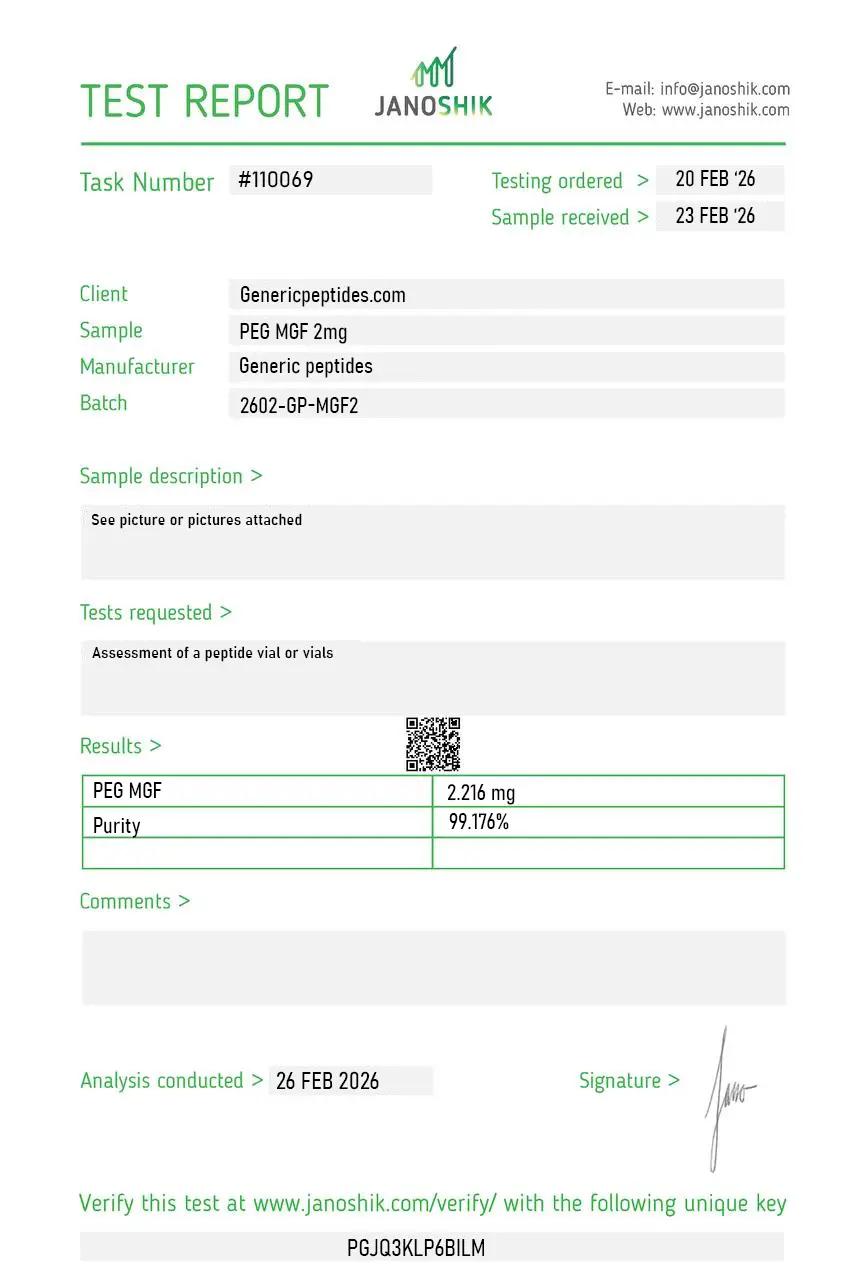
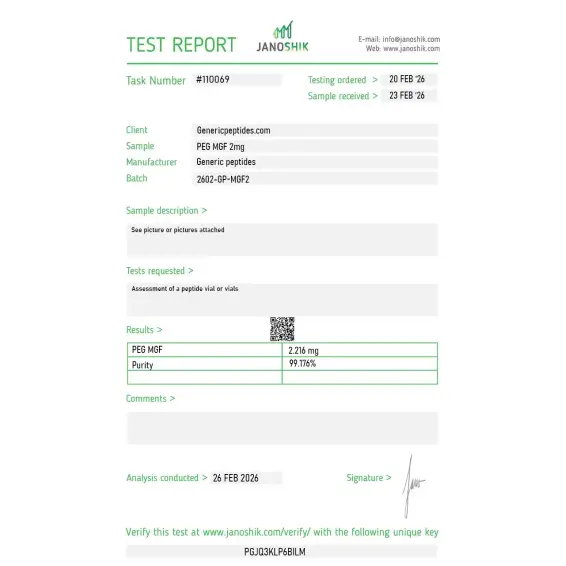
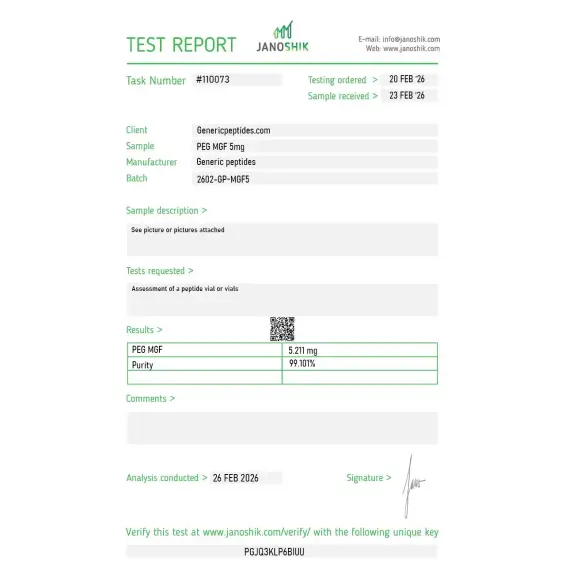
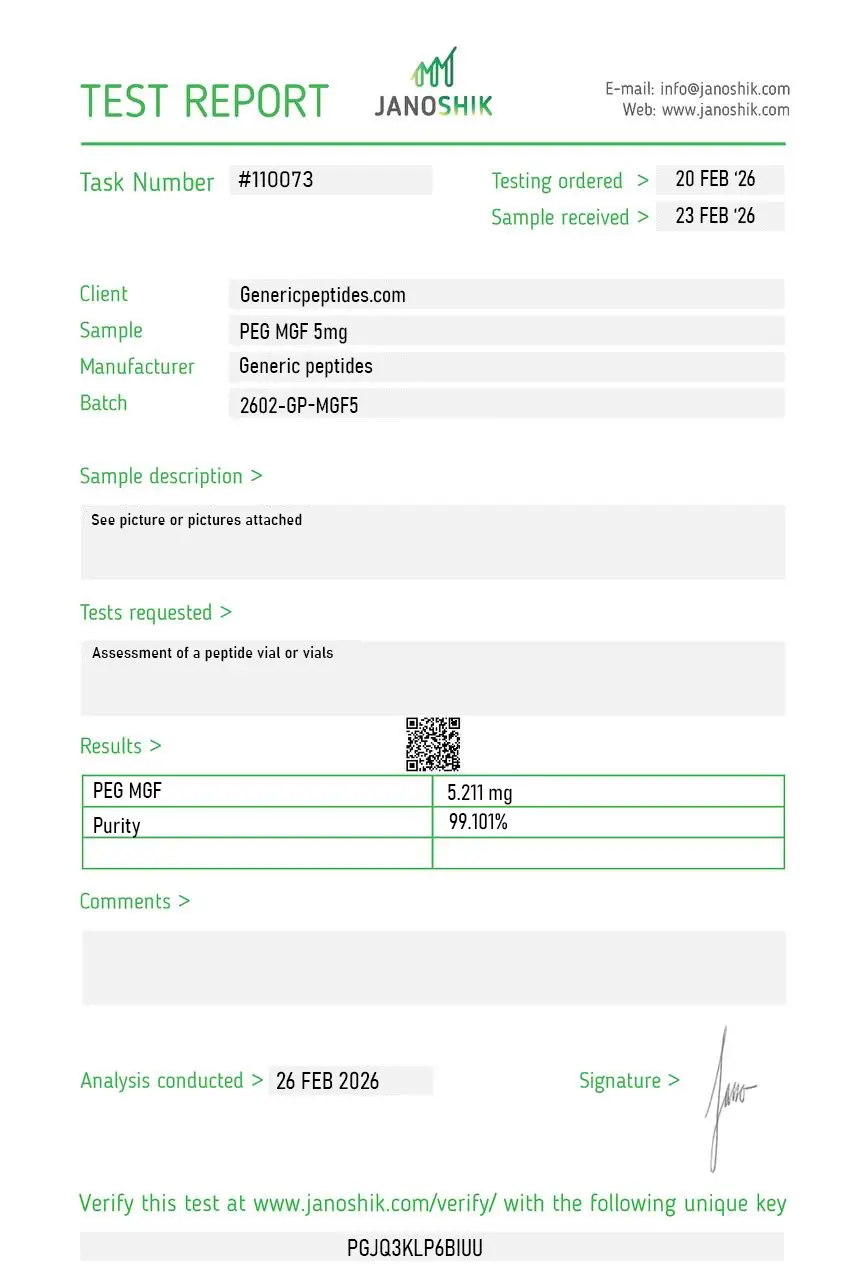
Independent lab test reports are available for PEG-MGF 2mg and 5mg batches. Each certificate provides batch-level verification details, including measured content, purity result, analysis date, and report documentation.
Satellite cell activation in C2C12 myoblast cultures. The MGF E-peptide signaling we were after came through reproducibly.
Buyers should grasp one thing before ordering: MGF does not bind the IGF-1 receptor. People assume it's an IGF-1 variant that hits IGF-1R — it's the Ec-domain splice peptide and it works through a separate, still-poorly-characterized receptor. This vendor at least doesn't conflate it with IGF-1. Star off because that receptor distinction deserves a clearer statement on the page; too many catalogs imply IGF-1R signaling.
The PEGylation itself is what I actually study — PEG-MGF is a useful model for how a 5-kDa PEG chain alters a small peptide's pharmacokinetics and aggregation behavior. For that work the conjugate quality matters more than the MGF biology, and the material's PEG attachment looked consistent by size-exclusion. Niche use, but it delivered.
The honest framing on the listing is what stood out — it acknowledges that the MGF receptor isn't definitively identified and that the systemic-PEGylated form changes the biology away from the local autocrine signal native MGF provides. Most sources gloss right over that the engineering tradeoff fundamentally alters what the molecule does. Material behaved as expected for the conjugate.
We compare PEG-MGF against native unmodified MGF specifically to characterize how PEGylation shifts the signaling kinetics — local short-lived native peptide versus the extended systemic conjugate. Having both forms from one source keeps that comparison clean. The whole question is what the PEG does to the biology, and you can't ask it without the matched native counterpart.
For myogenic stem-cell work the value is that PEG-MGF persists long enough in culture to study extended timepoints, where native MGF degrades almost immediately. That stability is the entire engineering rationale and it's the right tool when your experiment runs past the native peptide's lifespan. Material gave consistent activation across our timecourse.
Ran it in primary myoblasts rather than the C2C12 line for a more physiologically relevant readout — primary cells are fussier and reagent quality shows up faster. The material held its activation profile in the primary prep, which is a harder test than the immortalized line. That gave me confidence in the batch.
The actual reason we keep this in the freezer is comparison — it's the PEGylated endpoint in a series running native MGF, the bare E-peptide fragment, and the conjugate, characterizing how each modification stage shifts persistence and signaling. PEG-MGF is the "maximally stabilized" end of that spectrum. Material slotted into the series without introducing a batch artifact.
PEG-MGF delivers the MGF E-domain peptide systemically. The E-peptide appears to bind a receptor distinct from the classical IGF-1 receptor and activates dormant satellite cells (muscle stem cells) in the G0 phase of the cell cycle, driving them into proliferation. Once activated, satellite cells either fuse into existing muscle fibers or form new ones — the foundational biology of muscle repair and adaptation.
The PEG (polyethylene glycol) modification. Native MGF has a biological half-life of 5-7 minutes and acts as a local paracrine factor at the injection site. PEG-MGF has a half-life measured in hours and circulates systemically. Same active peptide sequence, fundamentally different pharmacokinetics — and that's exactly the engineering goal.
The MGF E-domain appears to signal through a receptor separate from IGF-1R, which is the pathway responsible for systemic protein synthesis effects. The E-peptide's separate signaling cascade preferentially targets quiescent satellite cell activation rather than acute protein synthesis in mature muscle fibers. This selectivity is part of what makes PEG-MGF mechanistically distinct from IGF-1 LR3 and similar systemic anabolic peptides.
The PEG conjugation chemistry is the technically demanding part, and "PEG-MGF" labels cover wildly inconsistent products — different PEG chain sizes, different conjugation positions, different conjugation efficiencies. Cheap suppliers routinely deliver under-pegylated material that lacks the half-life extension that defines the compound's research utility. Verification requires analytical methods most budget producers don't run.
Native MGF was characterized as an IGF-1 splice variant in the 1990s by Geoffrey Goldspink's research group, with the foundational papers on satellite cell activation appearing in the early 2000s. PEG-MGF as a research compound emerged in the mid-2000s when the half-life limitations of native MGF became clear. The MGF E-peptide remains an area of active research without clinical translation to date.
Yes. WADA prohibits MGF and its pegylated analogs under category S2 (Peptide Hormones, Growth Factors, Related Substances and Mimetics). The classification covers MGF in all forms — native, recombinant, and engineered analogs including PEG-MGF. Athletes subject to drug testing should avoid the compound regardless of how it's obtained.
Pegylated Mechano Growth Factor, PEG-Mechano Growth Factor, PEGylated MGF, PEG-MGF E-peptide. The underlying peptide is also called IGF-1Ec E-domain or MGF E-peptide. Different naming conventions across literature, all referring to the same pegylated 24-amino-acid C-terminal peptide of the IGF-1Ec splice variant.
Skeletal muscle biology and satellite cell activation lead by volume — particularly studies of muscle regeneration after injury, muscle wasting in disease models, and exercise-induced muscle adaptation. There's also active research in cardioprotection (MGF E-peptide reduces cardiomyocyte apoptosis in some studies) and neuroprotection (MGF E-peptide protects hippocampal neurons in animal models of stroke and excitotoxicity).
PEG-MGF is derived from the same gene as IGF-1 but represents a specific splice variant (IGF-1Ec) that's expressed in muscle in response to mechanical loading. The E-domain that PEG-MGF delivers comes from this splice variant. Mature IGF-1 (used in research as IGF-1 LR3 and similar analogs) has different signaling than the E-domain peptide. Same gene, different products, different research applications.
Most muscle-targeted research peptides act through systemic anabolic pathways — IGF-1 LR3 activates IGF-1R, follistatin antagonizes myostatin, growth hormone secretagogues stimulate GH/IGF-1 axis. PEG-MGF is one of the few that targets satellite cell activation specifically, working at the muscle stem cell level rather than affecting mature fiber protein synthesis directly. That mechanistic specificity is what makes it interesting and what limits direct comparison with other anabolic peptides.
Researchers investigating satellite cell activation, muscle regeneration, and IGF-1 splice variant pharmacology consistently examine PEG-MGF alongside compounds that target overlapping or complementary muscle repair and growth pathways. IGF-1 LR3 is the most natural structural comparison — both derive from the same IGF-1 gene through alternative splicing, but IGF-1 LR3 signals through IGF-1R for systemic anabolic effects while PEG-MGF's E-domain activates satellite cells through a distinct receptor; researchers studying local vs systemic muscle growth signaling typically examine both in parallel to isolate which mechanism drives a given regenerative phenotype. BPC-157 addresses tissue repair through angiogenesis and growth factor signaling at local injury sites — a different molecular mechanism than E-domain satellite cell activation but targeting similar recovery outcomes, and the two are frequently examined together in musculoskeletal repair research. TB-500 works through G-actin sequestration affecting cell motility and migration — particularly relevant alongside PEG-MGF in satellite cell biology research where migratory and proliferative effects address complementary aspects of muscle regeneration. Ipamorelin and Mod GRF (1-29) stimulate endogenous GH release which drives systemic IGF-1 production — researchers studying the full GH/IGF-1/MGF signaling cascade sometimes examine secretagogues alongside direct IGF-1 splice variants to compare upstream stimulation vs direct receptor activation.