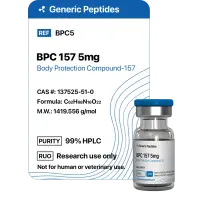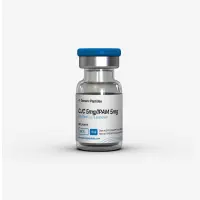
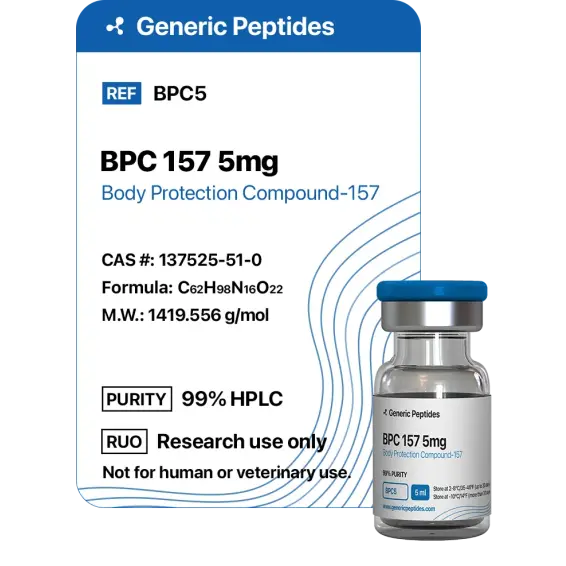
BPC-157 5mg
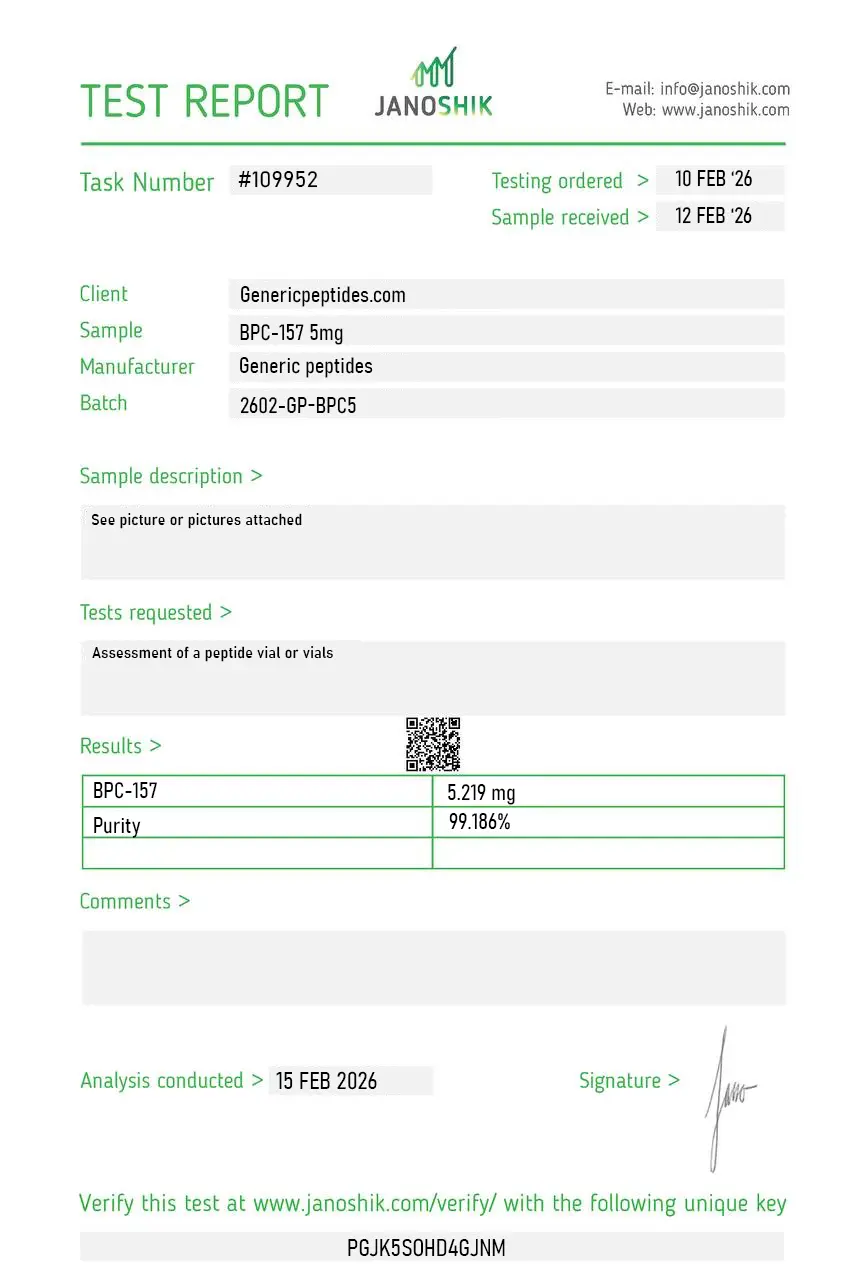
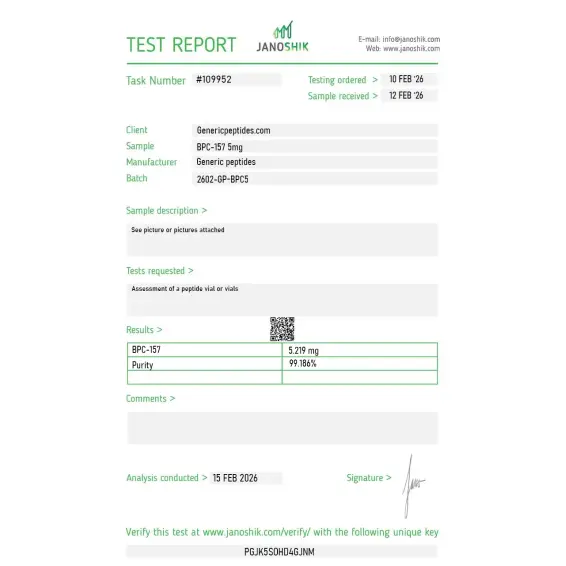
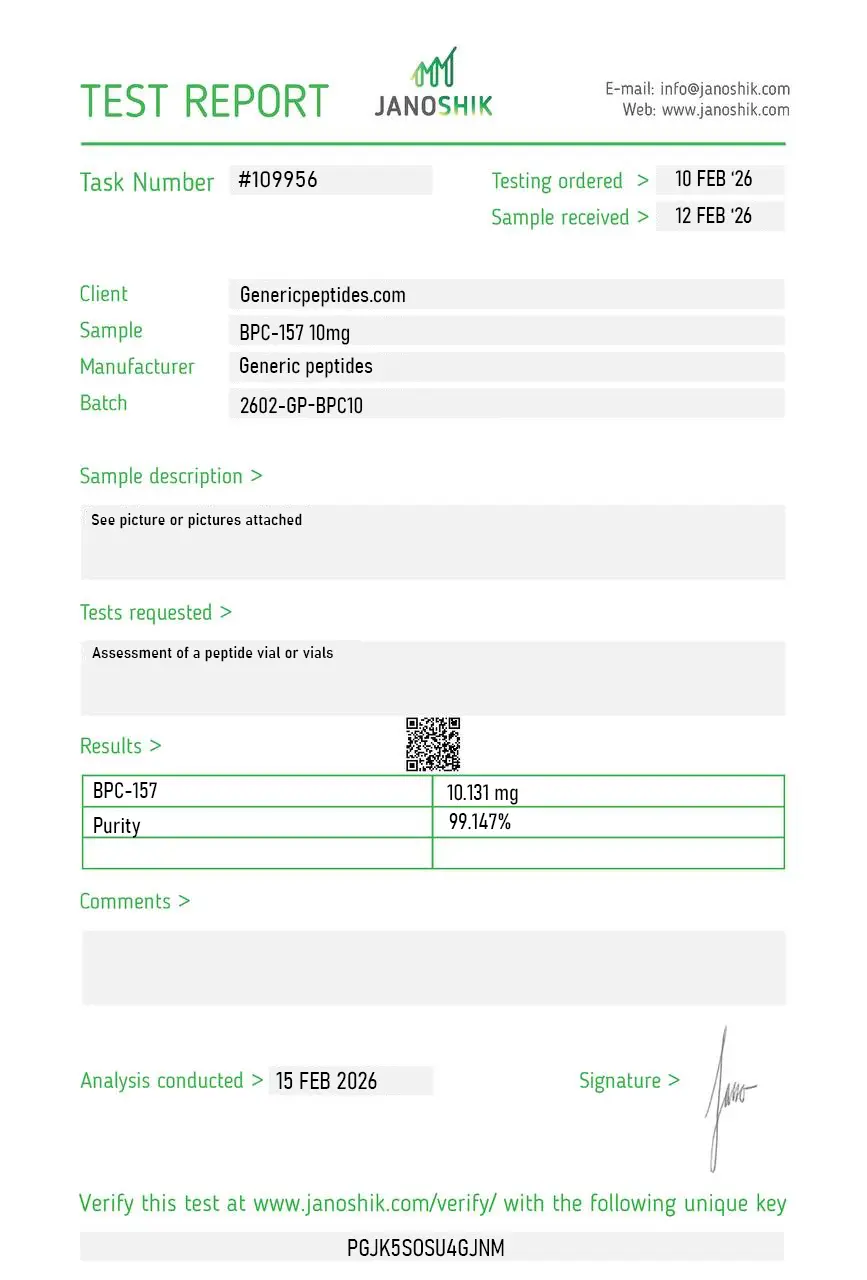
Purity: 99.186% · Content: 5.219 mg
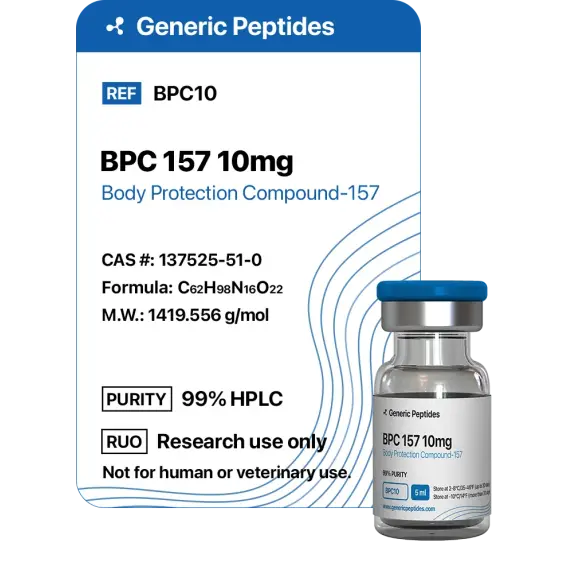
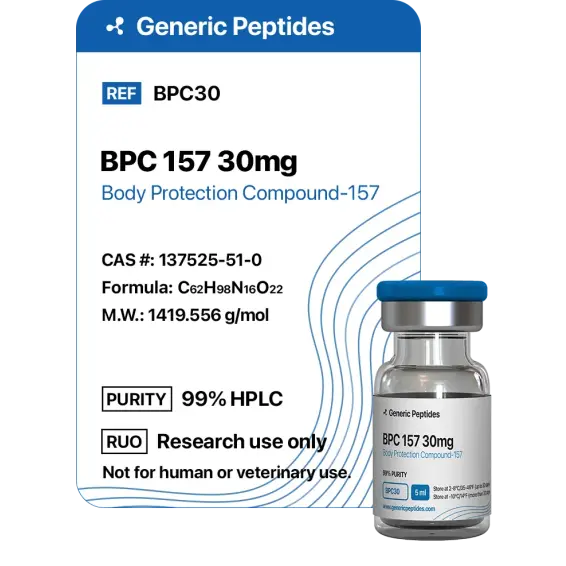
A 15-amino-acid fragment isolated from human stomach juice helped completely severed Achilles tendons heal in animal models. That's not marketing. It's published research, repeated across multiple labs since the 1990s. BPC-157 is the most-discussed recovery peptide on Reddit, in gym communities, and among injured athletes for one reason: the animal data is strange enough to make even cautious researchers pay attention.
BPC stands for Body Protection Compound. The full molecule was originally isolated from human gastric juice — the stomach's natural protective system — and BPC-157 is a stable 15-amino-acid fragment of it (sequence: Gly-Glu-Pro-Pro-Pro-Gly-Lys-Pro-Ala-Asp-Asp-Ala-Gly-Leu-Val). Researchers call it a pentadecapeptide. It's chemically distinct from any other known peptide and stable enough to survive oral delivery in animal studies — rare for something this size.
The reason researchers won't drop it: BPC-157 appears to accelerate healing across nearly every tissue tested. Tendons, ligaments, muscle, bone, gut lining, blood vessels, even nerves. That breadth is genuinely unusual. Most healing compounds work in one tissue. This one keeps showing up in studies across nearly all of them.
The most-cited research used rats with completely severed Achilles tendons. Treated animals showed faster collagen production, stronger functional recovery on movement tests, and tendons that could withstand more force before failing. Similar results came out of medial collateral ligament transection studies. The proposed mechanisms — angiogenesis (new blood vessel formation), collagen synthesis, and upregulation of growth hormone receptors on tendon fibroblasts — match what you'd expect from a real healing compound.
Here's what the marketing pages don't usually mention: there are no completed Phase 3 human trials. A few small clinical studies on inflammatory bowel disease showed promise. The rest is animal work, anecdotal reports, and a community that won't stop using it because their own injuries got better. That gap — between strong animal data and limited human evidence — is where BPC-157 lives.
BPC-157's regulatory situation just changed. In late 2023, the FDA placed it on the Category 2 bulks list, citing immunogenicity concerns and limited safety data — effectively shutting down compounding pharmacy access. On April 22, 2026, the FDA removed BPC-157 from Category 2 after the original nominations were withdrawn. A PCAC advisory committee review is now scheduled for July 23, 2026, to determine whether BPC-157 will be added to the Category 1 list. Until that review concludes, BPC-157 is in regulatory limbo: no longer formally restricted, not yet formally approved for compounding. Status as of May 2026.
The animal data underneath all this regulatory motion is what made BPC-157 famous in the first place — and it hasn't changed. The compound's chemistry is the same. The published research is the same. What changes month to month is which suppliers can legally make what, and who's regulated by whom. WADA still prohibits BPC-157 for athletes in tested sports. None of this affects sales as a research compound.
Here's a sourcing problem that's specific to BPC-157: the molecule is small (15 amino acids) and relatively easy to synthesize, which means almost anyone with a peptide synthesizer can make it — and many do, badly. Truncated sequences, peptide impurities, and underdosed product are the most common quality failures, and most buyers find out only when their results don't replicate or the vial doesn't behave the way the published research describes. With the regulatory landscape still settling, the research-supplier market has flooded with low-cost product from unverified sources.
Generic Peptides supplies research-grade BPC-157 for sale at 99% purity, manufactured in the USA. Domestic synthesis means a sourcing chain that's actually traceable. For a peptide this widely faked, that traceability is the difference that matters.
Order BPC-157 for sale in the USA — 99% purity, full 15-amino-acid sequence, manufactured domestically.
Yes — BPC-157 is legally available as a research compound in the United States. As of April 22, 2026, it has been removed from the FDA's Category 2 list, with a PCAC review scheduled for July 23, 2026 to determine its compounding status. It's not FDA-approved for human use, and WADA still prohibits it for tested athletes.
Probably not at the same purity. BPC-157 is small enough that low-end synthesis is cheap, which means truncated sequences and peptide impurities are everywhere in the budget end of the market. The price gap reflects synthesis quality and verification, not pure markup.
Honestly, that question isn't fully answered. Animal data is consistent and impressive across multiple tissue types. Human evidence beyond a few small IBD studies is mostly anecdotal — clinical observations and community reports, but not large randomized trials. Anyone guaranteeing you specific human outcomes is going beyond what the literature supports.
BPC-157 is a 15-amino-acid fragment of the larger Body Protection Compound (BPC, ~40,000 mol weight) found naturally in gastric juice. The full BPC molecule is too large to be useful as a research peptide; the 157 fragment carries the activity in a stable, manageable size. Same family — but BPC-157 specifically refers to the fragment.
Sort of. On April 22, 2026, the FDA removed BPC-157 from Category 2 because the original nominations supporting the restriction were withdrawn. A formal review by the Pharmacy Compounding Advisory Committee is scheduled for July 23, 2026 to decide whether it lands on the Category 1 (allowed) list. As of May 2026, it's no longer formally restricted, not yet formally approved.
Sources
Chang CH, Tsai WC, Hsu YH, Pang JH — "Pentadecapeptide BPC 157 Enhances the Growth Hormone Receptor Expression in Tendon Fibroblasts." Supports the growth hormone receptor mechanism in tendon healing. https://www.ncbi.nlm.nih.gov/pmc/articles/PMC6271067/
Chang CH et al. — "The promoting effect of pentadecapeptide BPC 157 on tendon healing involves tendon outgrowth, cell survival, and cell migration." Journal of Applied Physiology, 2011. Supports tendon-healing mechanism and full BPC-157 sequence. https://journals.physiology.org/doi/full/10.1152/japplphysiol.00945.2010
Gwyer D, Wragg NM, Wilson SL — "Gastric pentadecapeptide body protection compound BPC 157 and its role in accelerating musculoskeletal soft tissue healing." Cell and Tissue Research, 2019. Reviews tendon and ligament studies cited in the copy. https://link.springer.com/article/10.1007/s00441-019-03016-8
FDA — "Bulk Drug Substances Nominated for Use in Compounding Under Section 503A," updated April 22, 2026. Documents BPC-157 removal from Category 2 and the July 23, 2026 PCAC consultation. https://www.fda.gov/media/94155/download
15 amino acids. 30 years of research. 99% purity sourcing. Order with confidence.
BPC-157 ships as a white lyophilized powder in a sealed glass vial, freeze-dried to preserve its 15-amino-acid structure and extend its shelf life. The peptide is known for being unusually stable, and with a few simple habits — cold, dark, dry — the sealed vial stays in perfect condition for its full shelf life. Here's exactly how to store it.
| Parameter | Details | Notes |
|---|---|---|
| Storage Temperature | Freezer at −20°C (−4°F) for long-term storage up to 24–36 months. Refrigeration at 2–8°C (36–46°F) is fine for short-term use up to ~3 months. | Original sealed vial in the freezer is the safest default. |
| Light Sensitivity | Yes — protect from direct light and UV exposure to prevent photodegradation. | Keep in the original box or an opaque, amber container. |
| Freezing | Allowed and recommended. −20°C is standard for long-term storage; −80°C extends stability further if available. | Freeze from the start if you won't use it within 3 months. |
| Signs of Degradation | Healthy powder is white to off-white and loose or cake-like. Watch for yellowing, browning, clumping, visible moisture, or a sticky texture. | Any color change, clumping, or moisture = discard the vial. |
| Common Mistakes | Leaving the vial at room temperature after delivery, storing in a humid kitchen or bathroom, or opening a cold vial and letting condensation form inside. | Put it in the freezer on arrival, and let sealed vials warm to room temperature before opening. |
Every order is processed quickly and shipped with full tracking. All products come directly from the official Generic Peptides supply chain — in original manufacturer packaging, carefully handled from warehouse to your door.
| Destination | Delivery Time | Notes |
|---|---|---|
| USA Domestic | 2–5 business days | Faster when local warehouse stock is selected at checkout |
| International | 10–15 business days | Tracking included; update frequency may vary by destination country |
| Order Processing | 24–48 business hours | Processing begins after payment confirmation |
| Tracking | Provided on all orders | Tracking number sent after dispatch; multiple warehouses may result in separate shipments |
This product is supplied through the official Generic Peptides distribution chain and shipped in original manufacturer packaging. Orders are packed securely to protect the contents during transit and to respect customer privacy as a standard practice.
Outer packaging is neutral and does not display product details on the exterior — a common approach to protect shipments from damage, tampering, and unnecessary exposure during delivery.
Every order includes full authenticity assurance: official Generic Peptides presentation, batch-linked lab documentation, and sealed original packaging — giving customers confidence in every purchase.
| Authenticity Feature | Details |
|---|---|
| Packaging | Original manufacturer packaging — sealed and unaltered |
| Lab Documentation | Batch-linked certificate of analysis available on request |
| Supply Chain | Sourced exclusively through official Generic Peptides distribution |
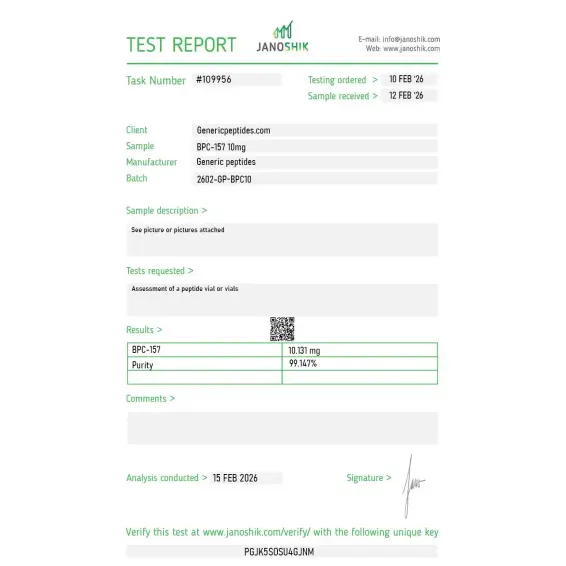
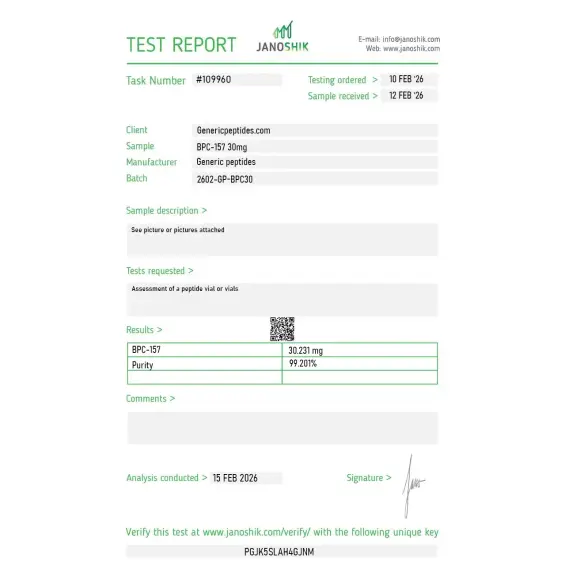
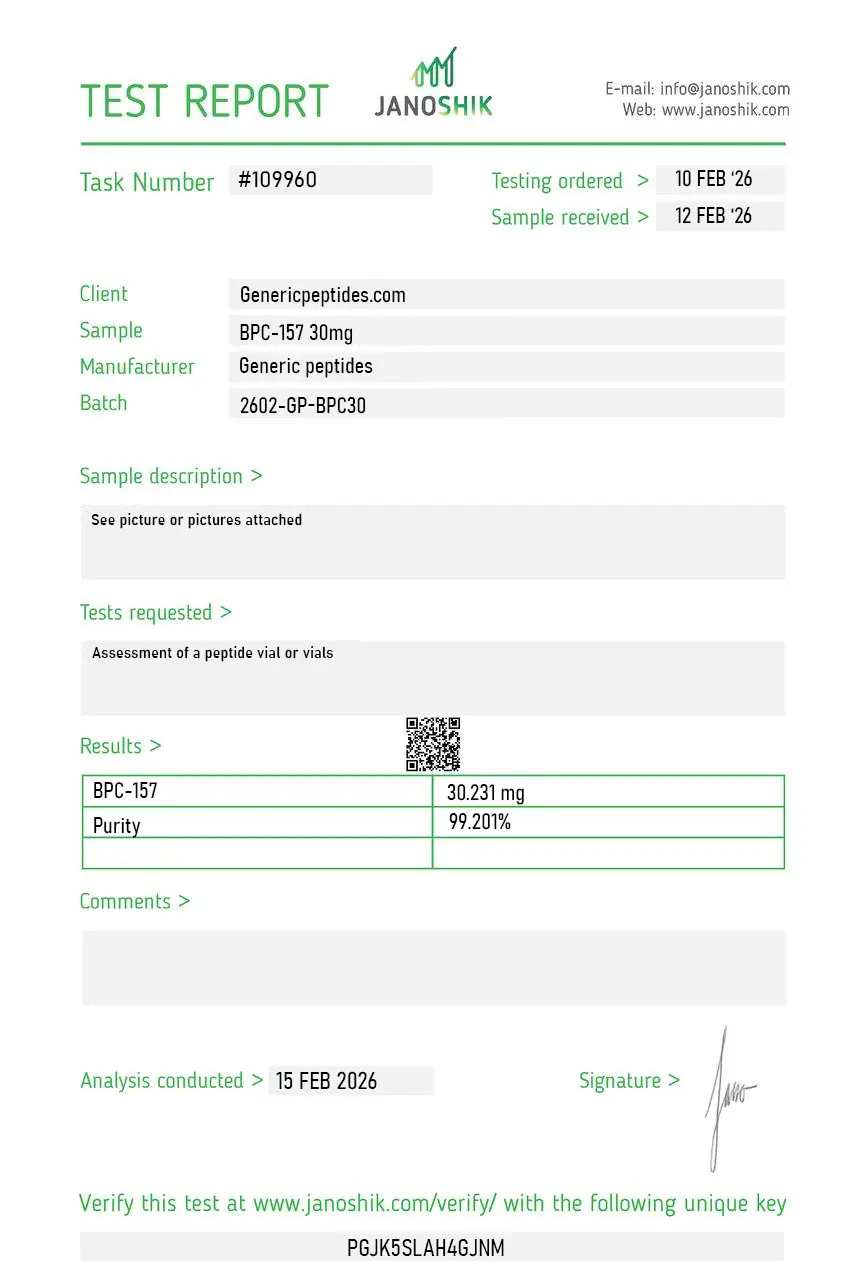
Independent Janoshik test reports are available for BPC-157 5mg, 10mg, and 30mg batches. Each certificate includes batch identification, measured content, purity result, analysis date, and verification key.
Angiogenic signaling in endothelial culture. The material gave the tube-formation response we characterize, consistent across two orders.
We run it next to TB-500 in a comparative regeneration design — different mechanisms, but they're the two compounds everyone studies in parallel in this area, so the comparison's worth doing properly with matched sourcing. BPC-157 held its profile across the conditions.
Fifteen residues, dissolved fine, no haze. Four rather than five because for a peptide this widely sold the COA was thinner than I'd like — purity figure, but no mass-spec sequence confirmation, and for something with this many vendors of varying quality I'd want the identity nailed down explicitly. Worked in our assay; I'd just rather verify than infer.
Reconstituted clean, ran consistently in our endothelial migration assays. We aliquot single-use as standard. Mass spec, when we ran our own, matched the GEPPPGKPADDAGLV sequence — worth doing yourself for a compound with this many suppliers of uneven quality.
Our angiogenesis-pathway reference, such as the evidence allows. Repeated orders, consistent material. The biology's more contested than the popular discussion admits, which is exactly why we keep characterizing it ourselves rather than taking the literature on faith.
Product itself has been good across two orders, lyophilized material in proper condition, documentation thorough. Four stars rather than five because BPC-157 has been out of stock periodically over the past few months — I understand this is likely related to the regulatory situation, but a notification system for restocks would be useful for those of us with ongoing projects.
Reliable supplier for a compound that's increasingly difficult to source from properly documented sources. BPC-157 arrived in good condition, properly labeled with batch number, sequence, and storage requirements. The COA was included with the shipment rather than requiring a follow-up request. Pricing is reasonable for the purity grade and the documentation standard.
The primary mechanism is angiogenesis — BPC-157 stimulates the formation of new blood vessels at injury sites, increasing oxygen and nutrient delivery to damaged tissue. It also upregulates growth hormone receptors on fibroblasts (the cells that build connective tissue), increases collagen production, and interacts with the nitric oxide system. Most healing compounds target one pathway. BPC-157 hits several at once.
Different mechanisms, often combined in research stacks. BPC-157 works primarily through angiogenesis and growth factor signaling at local injury sites. TB-500 (a thymosin beta-4 fragment) works through actin regulation and broader systemic distribution. Researchers studying recovery often look at both individually before combining them.
The gut research is some of the strongest. BPC-157 was originally isolated from gastric juice — the digestive system is where it naturally exists. Animal studies and a few small human studies on inflammatory bowel disease showed reduced inflammation and improved gut barrier function. Some researchers consider gut healing the best-supported application beyond musculoskeletal work.
The peptide is only 15 amino acids long, which makes synthesis cheap and easy — but cheap synthesis routinely produces truncated sequences and peptide impurities. With pharmacy compounding shut down for years, the market filled with research-compound suppliers offering minimal verification. Without third-party purity testing, you're trusting whatever number is on the label.
The compound was characterized in the 1990s by researchers in Croatia, originally focused on its protective effects on the stomach lining. Tendon and ligament research came later, in the 2000s and 2010s, expanding the application range. The published research trail spans nearly three decades.
Yes. WADA prohibits BPC-157 for athletes subject to drug testing, classifying it under growth factors and related substances. The FDA's April 2026 reclassification doesn't change WADA status. Athletes in tested sports should avoid it regardless of US regulatory shifts.
BPC 157, Bepecin, PL-10, PL-14736, and Body Protection Compound-157 all refer to the same molecule. The CAS number is 137525-51-0. The full sequence — Gly-Glu-Pro-Pro-Pro-Gly-Lys-Pro-Ala-Asp-Asp-Ala-Gly-Leu-Val — identifies it unambiguously regardless of label.
Tendon and ligament healing leads by volume, followed by gut research where the compound originally came from. There's also active work in angiogenesis, neuroprotection, and gastric ulcer models. The breadth is part of what makes the compound interesting and part of what makes some researchers skeptical — compounds that "work for everything" warrant scrutiny.
Both delivery methods have been used in published animal research. The peptide is stable enough to survive oral administration in drinking water, intraperitoneal injection, and topical cream application — the 2003 Achilles tendon study used all three routes. That oral stability is unusual for a peptide its size and is part of what makes it interesting as a research tool.
Most healing peptides target a specific pathway or tissue. BPC-157 appears to act through multiple mechanisms across multiple tissue types — angiogenesis, growth hormone receptor upregulation, collagen synthesis, and nitric oxide signaling. That multi-mechanism profile is uncommon and is exactly what makes the research community alternately fascinated and cautious about it.
Researchers investigating tissue repair, wound healing, and musculoskeletal recovery consistently pair BPC-157 with compounds that target overlapping or complementary regenerative pathways. TB-500 (Thymosin Beta-4) is the most common pairing — BPC-157 works primarily through angiogenesis and growth factor signaling at local injury sites while TB-500 works through G-actin sequestration affecting cell motility and migration; the two mechanisms are distinct enough that researchers typically study each individually before combining. IGF-1 LR3 activates the IGF-1 receptor for systemic anabolic and tissue-repair signaling — a broader hormonal approach compared to BPC-157's local gastroprotective and angiogenic effects. PEG-MGF targets satellite cell activation in skeletal muscle specifically, making it a natural complement in muscle regeneration research. Thymosin Alpha-1 is sometimes examined alongside BPC-157 in immune modulation and gut health research given BPC-157's documented effects on the gut-immune axis.