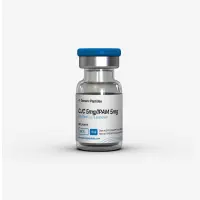
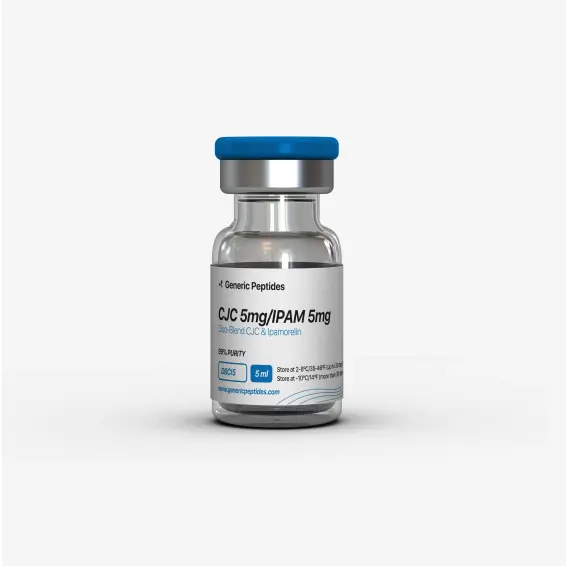
Duo-Blend CJC 5mg / IPAM 5mg
Certificate of Analysis available
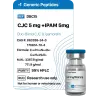
Two peptides. Two completely different receptors. One coordinated growth hormone response that's roughly 3 to 5 times stronger than what either compound produces alone. That's the entire point of the CJC-1295 / Ipamorelin blend — and it's the most-prescribed GH research peptide combination in anti-aging medicine for a reason.
This is a peptide blend — two distinct synthetic peptides combined in a single research preparation. CJC-1295 (the no-DAC version, also called Modified GRF 1-29) is a 29-amino-acid GHRH analog. Ipamorelin is a 5-amino-acid pentapeptide that mimics ghrelin. They target completely different receptors on the same pituitary cells, which is exactly why combining them works.
CJC-1295 hits the GHRH receptor, telling the pituitary to make and release more growth hormone through the cAMP-PKA cascade. Ipamorelin hits the ghrelin receptor (GHS-R1a), triggering calcium-mediated GH release through a separate pathway. When both fire simultaneously, the combined GH pulse is dramatically larger than either pathway alone produces — and it stays within physiological pulsatile patterns, which most researchers consider closer to natural GH biology than CJC-1295 DAC's sustained elevation.
The pairing wasn't accidental. Researchers needed a tool to study coordinated GH axis activation without the side effects that older secretagogues caused. Ipamorelin's selectivity is what made this possible — unlike GHRP-2 or GHRP-6, it doesn't significantly affect cortisol, prolactin, or aldosterone. So when you combine CJC-1295 (no DAC) with Ipamorelin, you get amplified GH release that's still relatively clean from a hormonal standpoint.
Why the no-DAC version of CJC-1295 in this blend specifically? Because Ipamorelin's effect is pulsatile by design, and pairing it with a long-acting CJC-1295 DAC version would smear the pulse into sustained elevation — defeating the entire reason researchers chose this combination over single-compound CJC-1295 DAC. Modified GRF 1-29's 30-minute half-life matches Ipamorelin's 2-hour half-life closely enough to produce coordinated pulses rather than constant baseline shift.
Here's the part the marketing pages don't always mention: the "3-5x increase in GH levels" figure is real, but it comes from animal and short-term human studies. Long-term clinical data on combined administration in humans is genuinely limited. Anyone selling this blend with guaranteed body composition outcomes is overpromising what the published research actually demonstrates.
Regulatory note: both CJC-1295 (no DAC) and Ipamorelin acetate were placed on the FDA's Category 2 list in 2023, then removed from Category 2 in September 2024 after nomination withdrawals. The PCAC reviewed both at meetings in October and December 2024 and voted against adding them to the Category 1 bulks list. As of May 2026, neither compound is in Category 2, neither is in Category 1, and 503A compounding pharmacies cannot legally produce them. Sales as a research compound continue legally. WADA prohibits both for tested athletes.
Here's a sourcing problem that's specific to peptide blends: ratios matter enormously. The published research that established the 3-5x synergy used specific, balanced ratios of GHRH analog to ghrelin mimetic. Cheap blend production routinely shortcuts the math — putting in less of the more expensive peptide, padding with the cheaper one, or selling unbalanced ratios as "research grade." If your blend is heavy on Ipamorelin and light on CJC-1295, you're not running the experiment you think you're running.
Generic Peptides supplies the research-grade CJC-1295 / Ipamorelin blend for sale at 99% purity, manufactured in the USA. Both peptides synthesized domestically, balanced ratio, full sequence verification — the only way coordinated GHRH/GHS-R activation research actually works.
Order CJC-1295 / Ipamorelin blend for sale in the USA — 99% purity, balanced ratio, both peptides verified.
Yes — both peptides are legally available as research compounds in the United States. They were removed from FDA Category 2 in September 2024, but PCAC subsequently voted against Category 1 inclusion, so they cannot currently be compounded by 503A pharmacies. As research compounds for laboratory use, they remain commercially available.
Because the whole point of pairing with Ipamorelin is producing coordinated pulses, not sustained elevation. Modified GRF 1-29 (no DAC) has a 30-minute half-life that matches Ipamorelin's pulse pattern. CJC-1295 DAC's 6-8 day half-life would smear the response into constant baseline GH, which is what researchers wanting pulsatile data are specifically trying to avoid.
It's based on real research, but with caveats. The synergistic amplification comes from animal studies and short-term human pharmacokinetic work. What hasn't been rigorously studied is long-term outcomes in humans on body composition, recovery, or any other downstream metric. The GH release data is solid; the clinical translation is less established.
Yes, importantly. CJC-1295 (no DAC), also called Modified GRF 1-29, has the four amino acid substitutions but no albumin-binding tag. Half-life is roughly 30 minutes. CJC-1295 DAC adds the Drug Affinity Complex tag and lasts 6-8 days. Different research tools for different questions — and the no-DAC version is what's used in this blend.
Pre-blended formulations save reconstitution steps and ensure ratio consistency across studies. Researchers running coordinated GHRH/GHS-R activation work want the same ratio in every experiment. Buying separate vials and mixing introduces pipetting variability that compromises reproducibility.
Sources
Teichman SL et al. — "Prolonged stimulation of growth hormone (GH) and insulin-like growth factor I secretion by CJC-1295." Journal of Clinical Endocrinology & Metabolism, 2006. Documents CJC-1295 GHRH receptor pharmacology. https://pubmed.ncbi.nlm.nih.gov/16352683/
Raun K et al. — "Ipamorelin, the first selective growth hormone secretagogue." European Journal of Endocrinology, 1998. Foundational research on Ipamorelin's selectivity for GHS-R1a without cortisol/prolactin effects. https://pubmed.ncbi.nlm.nih.gov/9801028/
Bowers CY et al. — "On the actions of the growth hormone-releasing hexapeptide, GHRP." Endocrinology, 1990. Foundational research establishing GHRH analog and ghrelin mimetic synergy at the pituitary level. https://pubmed.ncbi.nlm.nih.gov/1967282/
FDA — "Bulk Drug Substances Nominated for Use in Compounding Under Section 503A," updated April 22, 2026. Documents CJC-1295 and Ipamorelin removal from Category 2 (September 2024) and the negative PCAC recommendations. https://www.fda.gov/media/94155/download
Duo-Blend CJCTwo receptors. One blend. Ratio integrity is the entire experiment.
This Duo-Blend ships as a co-lyophilized white powder in a single sealed glass vial, combining 5 mg of CJC-1295 and 5 mg of Ipamorelin in freeze-dried form to preserve both peptides and extend their shelf life. With a few simple habits — cold, dark, dry — the sealed vial stays in perfect condition for its full shelf life. Here's exactly how to store it.
| Parameter | Details | Notes |
|---|---|---|
| Storage Temperature | Freezer at −20°C (−4°F) for long-term storage up to 24 months. Refrigeration at 2–8°C (36–46°F) is fine for short-term use up to ~3 months. | Original sealed vial in the freezer is the safest default. |
| Light Sensitivity | Yes — protect from direct light and UV exposure to prevent photodegradation. | Keep in the original box or an opaque, amber container. |
| Freezing | Allowed and recommended. −20°C is standard for long-term storage; −80°C extends stability further if available. | Freeze from the start if you won't use it within 3 months. |
| Signs of Degradation | Healthy powder is white to off-white and loose or cake-like. Watch for yellowing, browning, clumping, visible moisture, or a sticky texture. | Any color change, clumping, or moisture = discard the vial. |
| Common Mistakes | Leaving the vial at room temperature after delivery, storing in a frost-free freezer with temperature swings, or opening a cold vial and letting condensation form inside. | Put it in the freezer on arrival, and let sealed vials warm to room temperature before opening. |
Every order is processed quickly and shipped with full tracking. All products come directly from the official Generic Peptides supply chain — in original manufacturer packaging, carefully handled from warehouse to your door.
| Destination | Delivery Time | Notes |
|---|---|---|
| USA Domestic | 2–5 business days | Faster when local warehouse stock is selected at checkout |
| International | 10–15 business days | Tracking included; update frequency may vary by destination country |
| Order Processing | 24–48 business hours | Processing begins after payment confirmation |
| Tracking | Provided on all orders | Tracking number sent after dispatch; multiple warehouses may result in separate shipments |
This product is supplied through the official Generic Peptides distribution chain and shipped in original manufacturer packaging. Orders are packed securely to protect the contents during transit and to respect customer privacy as a standard practice.
Outer packaging is neutral and does not display product details on the exterior — a common approach to protect shipments from damage, tampering, and unnecessary exposure during delivery.
Every order includes full authenticity assurance: official Generic Peptides presentation, batch-linked lab documentation, and sealed original packaging — giving customers confidence in every purchase.
| Authenticity Feature | Details |
|---|---|
| Packaging | Original manufacturer packaging — sealed and unaltered |
| Lab Documentation | Batch-linked certificate of analysis available on request |
| Supply Chain | Sourced exclusively through official Generic Peptides distribution |
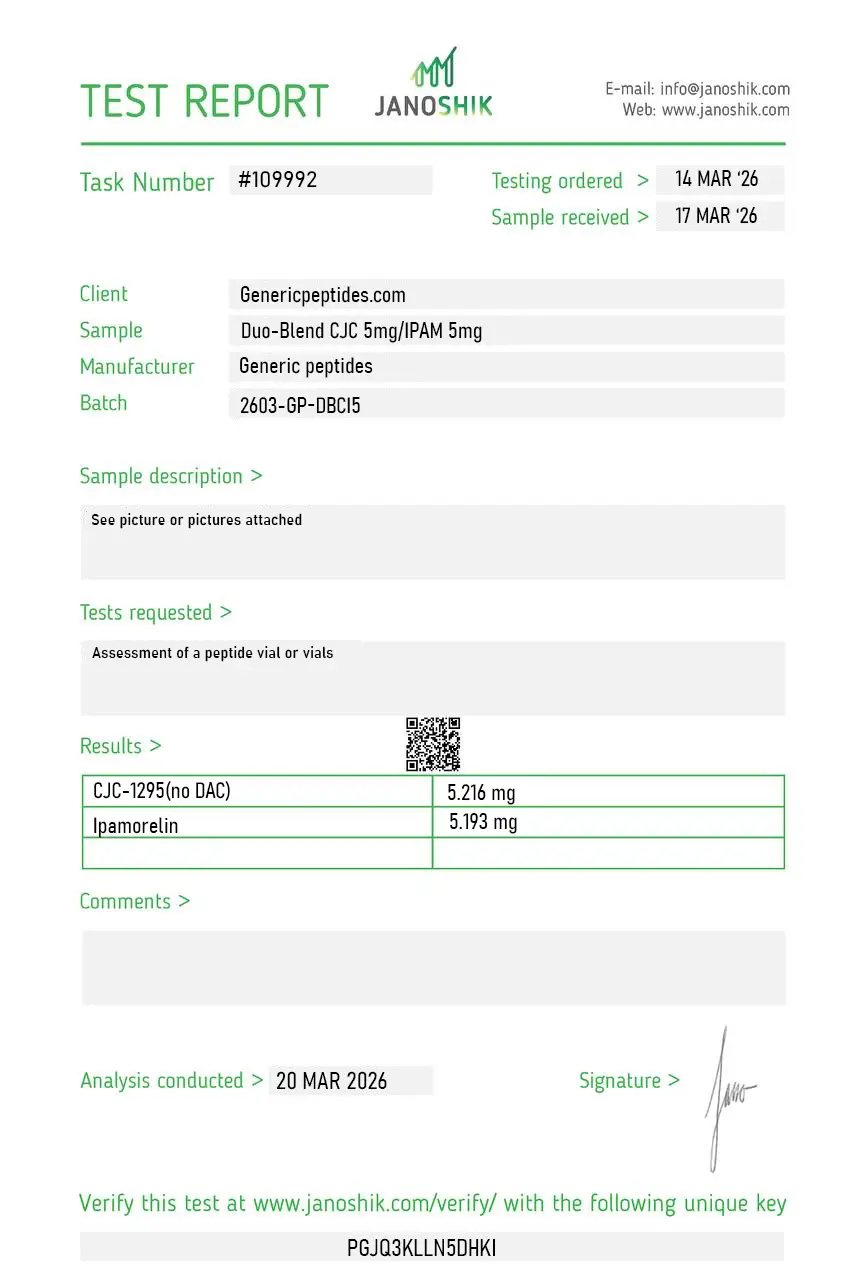
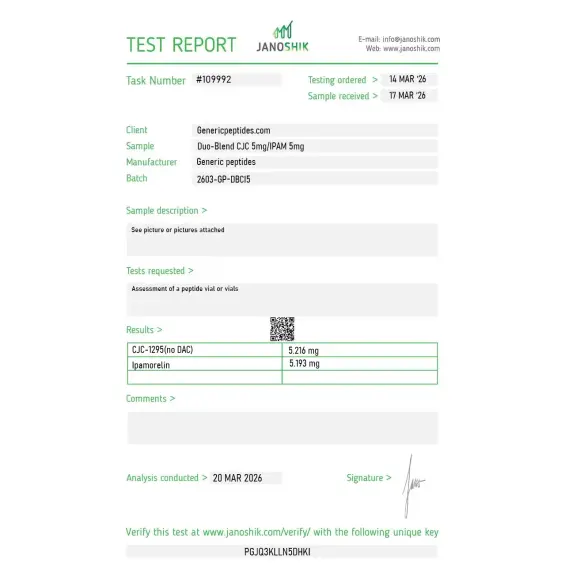
An independent lab test report is available for Duo-Blend CJC 5mg / IPAM 5mg. The certificate provides batch-level verification details, including measured content, purity result, analysis date, and report documentation.
Workflow. That's the honest reason — running parallel arms across conditions and one reconstitution instead of two adds up over a long protocol. The ratio held to spec on the COAs across the orders we've placed.
Switched here after our previous source had batch-to-batch drift in the component ratio — you'd get 5.4 of one and 4.6 of the other instead of an even split, which quietly skews any synergy experiment. The ratio on these COAs has stayed close to 1:1 across four orders. That consistency is the entire reason I moved.
The thing that separates a good blend from a bad one is whether the COA reports each component separately or just gives you a single "blend purity" number that hides everything. This one broke out both peptides — CJC at one figure, Ipamorelin at another. That's the documentation that matters for a co-formulated product. Star off because it didn't include the chromatogram showing the two peaks resolved, which I'd want for a mixture.
We run this blend alongside the two standalone components and the DAC variant of CJC — a parallel-arm design comparing the co-formulation against the individual peptides. Having all the SKUs from one catalog removes supplier as a variable. The blend slotted in matching the standalone behavior, which is what you'd hope.
Confirmed before ordering that the CJC component was specifically the No-DAC version — modified GRF (1-29), roughly thirty-minute half-life — and not the DAC variant, since the blend description didn't make it screaming obvious. Support clarified within hours: No-DAC. That distinction completely changes the pharmacokinetics, so it's worth chasing down before you order.
Tested it at higher concentration than usual during method development — 2 mg/mL, held clear at 4°C across 72 hours, no precipitation from either component. That stability margin matters when you're trying to minimize dilution variability in a synergy experiment. Both peptides stayed in solution.
The point of a blend is convenience and this delivered it — single vial, single reconstitution, two peptides at a known ratio. We use the GHRH-plus-GHRP combination because the synergistic pulsatile release in preclinical models is stronger than either alone, and having them pre-mixed at a verified ratio saves the pipetting error of combining two stocks.
References the GHRH-plus-GHRP synergy rationale on the listing, which is the actual scientific basis for co-formulating these two — Bowers' early combination work established that the two receptor pathways potentiate each other. Nice to see the mechanism stated rather than just "stack for gains" framing. Material consistent across our pulsatile-release assays.
Have been running the same blend protocol for about 14 months now, originally from a different vendor, switched here when the previous source started having batch-to-batch variability in the component ratio. The ratio on the COAs from this supplier has held to spec across the four orders I've placed.
The two peptides activate completely separate receptor pathways on the same pituitary cells. CJC-1295 binds GHRH receptors and activates the cAMP-PKA cascade. Ipamorelin binds GHS-R1a (the ghrelin receptor) and triggers Gq-mediated calcium signaling. Hitting both pathways simultaneously produces a GH release roughly 3-5 times larger than either pathway activated alone — that's the textbook definition of receptor synergy.
Pulse pattern, mostly. CJC-1295 DAC produces sustained GH elevation across 6-8 days through albumin binding. The CJC-1295/Ipamorelin blend produces sharper pulses that mimic natural GH release more closely. Researchers studying physiological GH biology often prefer the blend; researchers studying chronic exposure use the DAC version.
Yes — that selectivity is its main claim to fame. Earlier ghrelin mimetics like GHRP-2 and GHRP-6 caused cortisol spikes and prolactin elevation alongside GH release. Ipamorelin was specifically engineered to bind GHS-R1a without significantly activating those off-target hormonal responses. That's why it became the preferred ghrelin mimetic for clean GH research.
Two-peptide blends have two failure points — sequence integrity for each peptide plus ratio accuracy between them. Cheap synthesis routes can compromise either or both. Some suppliers underdose the more expensive component, others use degraded peptide that lost activity before blending. Without third-party testing, the only signal you have is sourcing reputation.
The two compounds were developed separately in the 1990s and 2000s. CJC-1295 came out of ConjuChem; Ipamorelin was developed by Novo Nordisk. The combination as a research and clinical tool emerged in the late 2000s and 2010s, particularly through compounding pharmacy and integrative medicine practice before the 2023 FDA restrictions.
Yes, both. WADA prohibits CJC-1295 and Ipamorelin under category S2 (Peptide Hormones, Growth Factors, Related Substances). Combined administration doesn't change that classification. Athletes subject to drug testing should avoid both compounds regardless of how they're obtained.
You'll see it sold as "CJC-1295 + Ipamorelin," "CJC/Ipa," "GHRH + GHRP combo," and sometimes "Mod GRF 1-29 + Ipamorelin" — the last being the most chemically accurate since the CJC-1295 component is typically the no-DAC version. Different vendors use different conventions; the underlying chemistry is the same.
Growth hormone axis pharmacology and pituitary signaling research lead by volume. Body composition and metabolic research use it as a model for studying coordinated GH/IGF-1 elevation. There's also active work in aging-related GH decline, sleep architecture (GH peaks during slow-wave sleep), and recovery research.
Selectivity. GHRP-2 produces strong GH release but also significantly elevates cortisol and prolactin. Ipamorelin binds the same receptor (GHS-R1a) but with much cleaner downstream signaling — minimal cortisol or prolactin effects at standard research concentrations. That's why it became the preferred research tool when clean GH activation was the experimental goal.
Most GH peptide research uses single-compound activation — either GHRH analog alone or ghrelin mimetic alone. This blend is one of the few combinations where the synergistic activation has been studied as the explicit research target rather than as an incidental effect. The dual-receptor coordination is the experimental design, not a side note.
Researchers who have established the CJC-1295/Ipamorelin combination as a baseline often expand their GH axis research to examine compounds that add complementary mechanisms or allow direct pharmacokinetic comparison. Mod GRF (1-29) (CJC-1295 without DAC) is the most direct comparison — swapping the long-acting DAC-tagged backbone for the short-acting version allows researchers to isolate whether sustained vs pulsatile GH release drives different downstream outcomes while keeping the Ipamorelin component constant. GHRP-2 and GHRP-6 are older ghrelin mimetics that researchers substitute for Ipamorelin to compare receptor selectivity profiles — both produce stronger GH pulses but with more cortisol and prolactin activity, making them useful reference points for isolating Ipamorelin's cleaner selectivity. Sermorelin represents the unmodified GHRH 1-29 sequence without stability engineering — a physiological reference compound for researchers comparing natural vs modified GHRH analog pharmacology. Hexarelin is another ghrelin mimetic with the strongest GH-releasing potency in its class, sometimes examined alongside the blend in comparative GH secretagogue research.