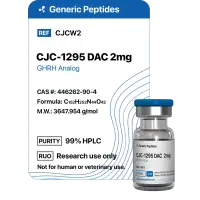
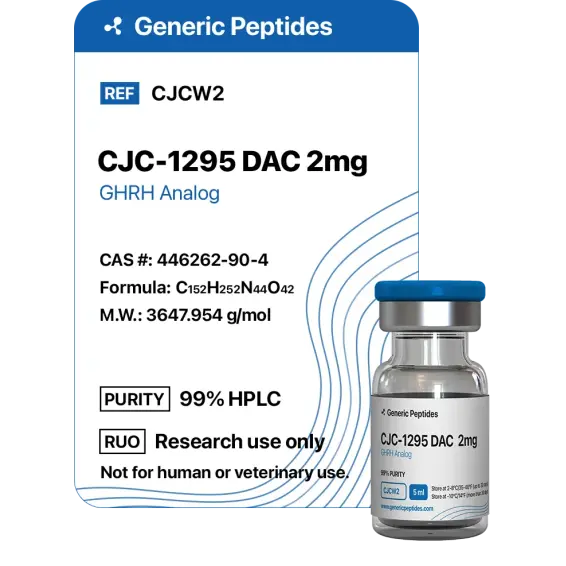
CJC-1295 DAC 2mg
Certificate of Analysis available
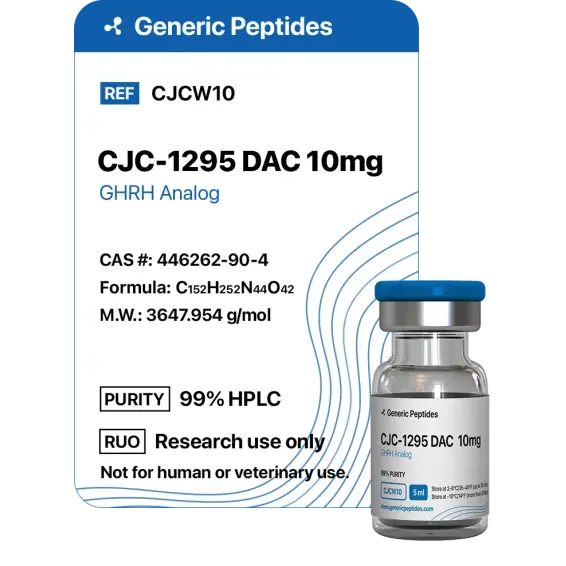




Most growth hormone–releasing peptides are out of your system in under an hour. CJC-1295 DAC stays active for up to eight days per injection. That single difference is why it became one of the most-discussed GH research peptides in the world — and why the regular CJC-1295 has stopped being interesting to most researchers who can choose.
CJC-1295 DAC is a synthetic 29-amino-acid GHRH analog — basically a re-engineered version of the natural growth hormone–releasing hormone your hypothalamus produces. The "DAC" stands for Drug Affinity Complex: a small molecular tag that lets the peptide grab onto serum albumin in the blood and ride along with it instead of getting cleared in minutes.
That single design choice changes everything. Native GHRH lives for about 7 minutes. CJC-1295 without DAC lasts about 30 minutes. Add the DAC, and the half-life jumps to roughly 6 to 8 days. In published human research, a single injection raised plasma GH levels 2- to 10-fold for 6+ days and IGF-1 by 0.5- to 3-fold for up to 11 days. Multi-dose protocols kept IGF-1 elevated for 28 days. That's a different research tool entirely.
CJC-1295 was developed by ConjuChem, a Canadian biotech, in the mid-2000s. The team didn't invent a new peptide — they took the active 29-amino-acid fragment of GHRH (also called GRF 1-29, the same core sequence as Sermorelin) and made four targeted amino acid substitutions to resist enzymatic breakdown. Then they bolted on the DAC tag, a lysine-linked maleimidopropionic acid derivative that covalently bonds to albumin once injected.
The breakthrough wasn't the GHRH activity. That was already known. The breakthrough was making it last — turning a peptide that needed multiple daily injections into one that could be dosed weekly. That's the engineering that put CJC-1295 DAC on the map and kept it there.
The long half-life is the selling point. It's also the trade-off. Native GHRH releases growth hormone in pulses — that's how the body actually uses it. CJC-1295 DAC produces something closer to a constant elevated baseline, sometimes called a "GH bleed." Some researchers want exactly that for endocrinology studies. Others prefer non-DAC versions or shorter analogs like Tesamorelin specifically because pulsatile release is more physiologically realistic. There's no consensus on which approach wins. There's just two different research tools for two different questions.
Regulatory note: CJC-1295 (including the DAC version) was placed on the FDA's Category 2 bulks list in 2023, then removed from Category 2 in September 2024 after the original nominations were withdrawn. A PCAC review was scheduled to determine whether CJC-1295 and its DAC variants would be added to the Category 1 bulks list. As of May 2026, formal Category 1 listing has not been finalized — the compound sits in regulatory transition. WADA prohibits it for athletes in tested sports.
Here's what's specific to CJC-1295 DAC: the DAC modification is what makes the compound work. Without it, you have plain CJC-1295 (or Modified GRF 1-29), which has a 30-minute half-life and an entirely different research profile. Cheap synthesis routes routinely sell either an incomplete DAC linkage or simply the non-DAC version under the DAC label. Most buyers can't distinguish them without HPLC analysis. If you're studying long-acting GHRH activity and the DAC isn't intact, your data won't replicate published research.
Generic Peptides supplies research-grade CJC-1295 DAC for sale at 99% purity, manufactured in the USA. Domestic synthesis with full DAC conjugation verified — not just a label that says so.
Order CJC-1295 DAC for sale in the USA — 99% purity, full DAC conjugation, 8-day half-life intact.
Yes — CJC-1295 DAC is legally available in the United States as a research compound. It was removed from the FDA's Category 2 list in September 2024, and final compounding status is pending PCAC review. It's not FDA-approved for human use, and WADA prohibits it for tested athletes.
The peptide sequence is essentially the same — what differs is the DAC tag attached to it. CJC-1295 without DAC has a half-life around 30 minutes and produces pulsatile GH release. CJC-1295 DAC binds to albumin and lasts 6–8 days, producing sustained elevation rather than pulses. They're studied for completely different research questions.
Probably not. The DAC modification is the expensive, technically demanding part of the synthesis. Cheap suppliers routinely sell non-DAC CJC-1295 mislabeled as DAC, or use incomplete linkage chemistry that breaks down quickly. The price gap usually reflects what's actually in the vial.
Related but distinct. Sermorelin is the unmodified GRF 1-29 sequence. Modified GRF 1-29 has the four amino acid substitutions but no DAC. CJC-1295 DAC has both the substitutions and the DAC tag. All three target the same GHRH receptor, but their pharmacokinetics are completely different.
Sort of. CJC-1295 (free base, acetate) and CJC-1295 with DAC (free base, DAC acetate, DAC trifluoroacetate) were removed from Category 2 in September 2024 after nomination withdrawals. They are not currently restricted, but final inclusion on the Category 1 bulks list requires PCAC approval which remains pending as of May 2026. In the meantime, sales as a research compound continue legally.
Sources
Teichman SL et al. — "Prolonged stimulation of growth hormone (GH) and insulin-like growth factor I secretion by CJC-1295, a long-acting analog of GH-releasing hormone, in healthy adults." Journal of Clinical Endocrinology & Metabolism, 2006. Documents the 6-day GH elevation and DAC pharmacokinetics. https://pubmed.ncbi.nlm.nih.gov/16352683/
Alba M et al. — "Once-daily administration of CJC-1295, a long-acting GHRH analog, normalizes growth in the GHRH knockout mouse." American Journal of Physiology - Endocrinology and Metabolism, 2006. Supports the DAC mechanism and albumin-binding pharmacokinetics. https://journals.physiology.org/doi/full/10.1152/ajpendo.00201.2006
FDA — "Bulk Drug Substances Nominated for Use in Compounding Under Section 503A," updated 2024–2026. Documents CJC-1295 and CJC-1295 DAC removal from Category 2 effective September 27, 2024. https://www.fda.gov/media/94155/download
Lexology — "FDA removes certain peptide bulk drug substances from Category 2." Industry analysis of the September 2024 reclassification including specific CJC-1295 DAC variants. https://www.lexology.com/library/detail.aspx?g=2e55b76a-3173-4e04-beda-bf021202f18d
8-day half-life only matters if the DAC is actually attached. 99% purity, USA-made, conjugation verified.
CJC-1295 DAC ships as a white lyophilized powder in a sealed glass vial, freeze-dried to preserve its modified GHRH structure and extend its shelf life. With a few simple habits — cold, dark, dry — the sealed vial stays in perfect condition for its full shelf life. Here's exactly how to store it.
| Parameter | Details | Notes |
|---|---|---|
| Storage Temperature | Freezer at −20°C (−4°F) for long-term storage up to 24 months. Refrigeration at 2–8°C (36–46°F) is fine for short-term use up to ~3 months. | Original sealed vial in the freezer is the safest default. |
| Light Sensitivity | Yes — protect from direct light and UV exposure to prevent photodegradation. | Keep in the original box or an opaque, amber container. |
| Freezing | Allowed and recommended. −20°C is standard for long-term storage; −80°C extends stability further if available. | Freeze from the start if you won't use it within 3 months. |
| Signs of Degradation | Healthy powder is white to off-white and loose or cake-like. Watch for yellowing, browning, clumping, visible moisture, or a sticky texture. | Any color change, clumping, or moisture = discard the vial. |
| Common Mistakes | Leaving the vial at room temperature after delivery, storing in a frost-free freezer with temperature swings, or opening a cold vial and letting condensation form inside. | Put it in the freezer on arrival, and let sealed vials warm to room temperature before opening. |
Every order is processed quickly and shipped with full tracking. All products come directly from the official Generic Peptides supply chain — in original manufacturer packaging, carefully handled from warehouse to your door.
| Destination | Delivery Time | Notes |
|---|---|---|
| USA Domestic | 2–5 business days | Faster when local warehouse stock is selected at checkout |
| International | 10–15 business days | Tracking included; update frequency may vary by destination country |
| Order Processing | 24–48 business hours | Processing begins after payment confirmation |
| Tracking | Provided on all orders | Tracking number sent after dispatch; multiple warehouses may result in separate shipments |
This product is supplied through the official Generic Peptides distribution chain and shipped in original manufacturer packaging. Orders are packed securely to protect the contents during transit and to respect customer privacy as a standard practice.
Outer packaging is neutral and does not display product details on the exterior — a common approach to protect shipments from damage, tampering, and unnecessary exposure during delivery.
Every order includes full authenticity assurance: official Generic Peptides presentation, batch-linked lab documentation, and sealed original packaging — giving customers confidence in every purchase.
| Authenticity Feature | Details |
|---|---|
| Packaging | Original manufacturer packaging — sealed and unaltered |
| Lab Documentation | Batch-linked certificate of analysis available on request |
| Supply Chain | Sourced exclusively through official Generic Peptides distribution |
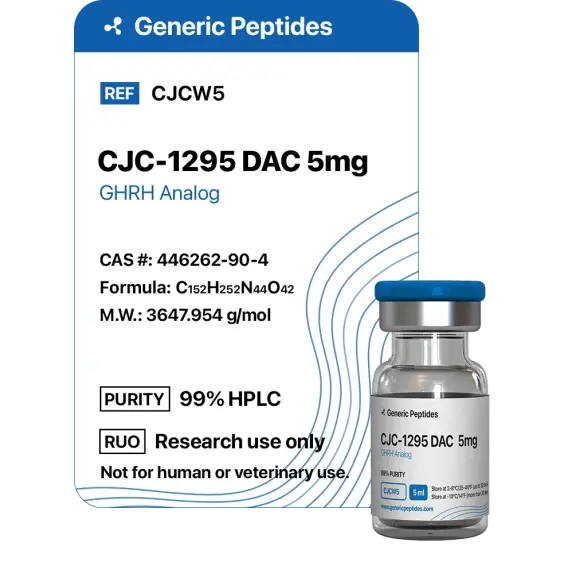
Independent lab test reports are available for CJC-1295 DAC 2mg, 5mg, and 10mg batches. Each certificate provides batch-level verification details, including measured content, purity result, analysis date, and report documentation.


Fourth order over the past 14 months. Analytical specs across all four COAs have lined up with the listed purity. The product page distinguishing the DAC version from Mod GRF (1-29) — particularly the half-life difference of roughly 8 days versus 30 minutes — was useful when justifying which compound to source for our specific protocol. Most suppliers conflate the two.
Ordered alongside Ipamorelin for a GHRH + GHRP comparison study. Useful that both compounds are available from the same supplier with consistent documentation standards. CJC-1295 DAC arrived properly sealed, COA matched specifications, and the vial labels included the maleimidopropionyl linker specification, which confirms it's the DAC version rather than the modified GRF fragment.
Material quality has been fine across two orders. Feedback is unrelated to the product — the shipping estimate said 3–5 business days, both orders took 8–10 days to arrive. International, so customs likely contributed. Reordering because the documentation has been consistent.
Ordered the 2mg vial for a GHRH receptor signaling study. Lyophilized peptide arrived properly sealed, COA matched the listed ≥99% HPLC purity, and vial labels included batch number, sequence reference, and the DAC modification specification. Reconstitution in bacteriostatic water was clean with no visible precipitation. Documentation was thorough. Will reorder.
Quality of the lyophilized material has been good across two orders. Four stars because the most recent COA wasn't initially on the product page for the batch I received — I had to request it from support. They sent it within a day. For CJC-1295 DAC specifically, where the DAC modification needs to be verifiable per batch, it would be cleaner if the latest certificate were always uploaded directly.
Solid documentation. The COA referenced the specific batch, included HPLC purity, mass spec confirmation, and storage instructions. Appreciated that the product page acknowledges the ConjuChem Phase II development history rather than presenting the compound as a fresh discovery — the regulatory context matters when explaining procurement to colleagues.
Third order. Material has been consistent — same purity profile, same packaging standard, same documentation format. The product page being explicit about the WADA Prohibited List status (S2 category) was useful context for our compliance documentation. Predictability across orders is the main reason I keep coming back.
Reliable handling of a compound where the modification matters. CJC-1295 DAC arrived with documentation that referenced the specific batch and confirmed the tetrasubstituted backbone (D-Ala², Gln⁸, Ala¹⁵, Leu²⁷) plus the DAC linker. Vial integrity was intact, COA values matched the stated specifications. Communication was prompt when I asked about lyophilization buffer composition before ordering.
Product itself has been good. The reason I'm at four stars rather than five is that the product page differentiates DAC from No-DAC in the description but the comparison would be more useful if it included the pharmacokinetic numbers directly — half-life, dosing frequency context, et cetera. I had to email support to confirm specifics that should be on the page. They answered within a day, but it's a friction point worth mentioning.
Second order. First one convinced me, this one confirmed it. Same speed, same quality of packaging, same everything. Consistency matters more than anything else to me and these guys have it.
Switched here from a previous source that had inconsistent labeling between the DAC and No-DAC versions. This supplier labels them distinctly and the COAs reference the specific modification, which removes ambiguity. CJC-1295 DAC has arrived properly sealed across three orders, documentation has been included with each shipment rather than requiring a follow-up request, and pricing is reasonable for the purity grade.
The peptide binds to GHRH receptors on somatotroph cells in the anterior pituitary, activating adenylyl cyclase and triggering the cAMP-PKA cascade that drives GH gene transcription and release. It works upstream — telling the pituitary to make and release more of its own GH rather than supplying GH directly. That distinction matters for any research focused on natural GH regulation.
Both are GHRH analogs, but Tesamorelin is FDA-approved for HIV-associated lipodystrophy and has a half-life closer to 30 minutes. CJC-1295 DAC has the 6-8 day half-life through albumin binding. Tesamorelin produces pulsatile GH release; CJC-1295 DAC produces sustained elevation. Different tools for different research questions.
Ipamorelin works through a completely different receptor — the ghrelin/GHS receptor — rather than the GHRH receptor that CJC-1295 DAC targets. Researchers studying synergistic GH release combine the two because hitting both receptors simultaneously produces a stronger response than either alone. The pairing is the most-cited GH peptide stack in the literature.
Published human studies show CJC-1295 DAC raises plasma IGF-1 by 0.5- to 3-fold for 9-11 days after a single injection. Multi-dose research kept IGF-1 elevated for up to 28 days. IGF-1 is the downstream effector of GH, so the IGF-1 response is what most researchers actually track when studying GH release dynamics.
The DAC modification is the technically demanding part — the lysine-linked maleimidopropionic acid moiety has to be conjugated correctly for albumin binding to work. Cheap synthesis produces incomplete linkage or skips it entirely, leaving you with non-DAC CJC-1295 sold under the DAC label. Without HPLC verification, the difference is invisible to buyers.
CJC-1295 was developed by ConjuChem, a Canadian biotech firm, in the mid-2000s. The first published human pharmacokinetic studies appeared in 2006. The compound was originally investigated as a treatment for growth hormone deficiency before research interest expanded into other applications.
Yes. WADA prohibits CJC-1295 (with or without DAC) for athletes subject to drug testing under category S2 (Peptide Hormones, Growth Factors, Related Substances). The 6-8 day half-life and prolonged IGF-1 elevation make it particularly relevant to anti-doping concerns.
DAC:GRF, CJC-1295 with Drug Affinity Complex, and CJC-1295 DAC acetate (the salt form most commonly sold). Without DAC, the compound is called CJC-1295 or Modified GRF 1-29. The CAS number for CJC-1295 (no DAC) is 863288-34-0; the DAC version has its own variants.
GHRH receptor pharmacology and growth hormone secretion dynamics lead by volume. There's also active work in body composition research, IGF-1 axis studies, and aging-related GH decline models. The long half-life makes it particularly useful for chronic-exposure research designs that would be impractical with shorter-acting GHRH analogs.
The albumin-binding DAC tag is unique in this category — no other commonly available GHRH analog uses the same chemistry. That single modification turns a minutes-half-life peptide into a days-half-life peptide, which fundamentally changes what kind of research designs are practical. Sustained-exposure studies that would require 50+ injections with native GHRH can be done with one weekly dose using DAC.
Researchers studying growth hormone secretagogue pharmacology consistently examine CJC-1295 DAC alongside compounds that target the GH axis through different receptor pathways or kinetic profiles. Ipamorelin is the most common pairing — CJC-1295 DAC activates the GHRH receptor while Ipamorelin activates the ghrelin receptor on the same pituitary somatotrophs; the two mechanisms are synergistic and their combination is the most-studied GH peptide stack in the research literature. GHRP-2 and GHRP-6 are older ghrelin mimetics that researchers compare directly with Ipamorelin to isolate receptor selectivity differences — both produce stronger GH pulses than Ipamorelin but with more off-target cortisol and prolactin activity. Mod GRF (1-29) (CJC-1295 without DAC) is the short-acting version of the same backbone — researchers studying pulsatile vs sustained GH release patterns often examine both to isolate the pharmacokinetic contribution of the DAC tag. Sermorelin represents the unmodified GHRH 1-29 sequence, useful as a physiological reference compound when comparing engineered analogs.