BPC-157 vs TB-500: Structure, Research Evidence and Identity Differences
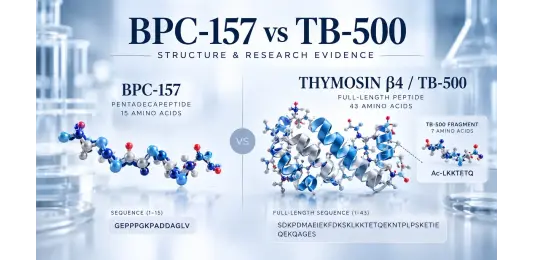
BPC-157 vs TB-500: Structure, Research Evidence and Identity Differences
BPC-157 and TB-500 are often discussed together in the context of muscle recovery research peptides, but they are not the same compound. Their amino-acid sequences, molecular sizes, biological research models, and evidence bases are different.
The most important point is identity. BPC-157 is a defined 15-amino-acid pentadecapeptide. "TB-500," by contrast, is a commercial name that has been used for more than one thymosin beta-4-related material. Some references use it for a seven-amino-acid fragment, while the Generic Peptides product page identifies its TB-500 research compound as full-length, N-terminally acetylated thymosin beta-4 (Tβ4), a 43-amino-acid peptide.
That distinction matters because research results should be linked to the exact molecule studied—not simply to a familiar product name.
BPC-157 vs TB-500 at a Glance
| Feature | BPC-157 | TB-500 / Thymosin Beta-4-Related Materials |
|---|---|---|
| Basic identity | Synthetic pentadecapeptide | Commercial label used for different Tβ4-related materials |
| Commonly reported sequence | GEPPPGKPADDAGLV | Depends on the material: full-length Tβ4 or the shorter Ac-LKKTETQ fragment |
| Length | 15 amino acids | 43 amino acids for full-length Tβ4; 7 amino acids for the acetylated fragment evaluated in the FDA briefing |
| Research context | Mainly cell and animal studies involving tissue-response, tendon, ligament, gastrointestinal, and vascular models | Full-length Tβ4 studies include actin regulation, cell migration, vascular biology, dermal models, and some human phase II research; evidence for the shorter TB-500 fragment is much more limited |
| Key identity check | Sequence, chemical form, molecular weight, and batch documentation | Exact sequence, N-terminal modification, salt form, molecular weight, and batch documentation |
| Interchangeability | Not interchangeable with TB-500 or Tβ4 | One TB-500-labelled material should not be assumed interchangeable with another |
What Is BPC-157?
BPC-157 is commonly described as a synthetic 15-amino-acid peptide associated with the body protection compound literature. Its reported sequence is:
Gly-Glu-Pro-Pro-Pro-Gly-Lys-Pro-Ala-Asp-Asp-Ala-Gly-Leu-Val
In abbreviated form, this is GEPPPGKPADDAGLV. The BPC-157 research peptide page lists this sequence and identifies the material as a research-use-only synthetic pentadecapeptide.
Research on BPC-157 has largely been conducted in laboratory and animal models. For example, a rat Achilles tendon-to-bone study measured functional, biomechanical, microscopic, and collagen-related endpoints after experimental injury. The findings are useful for generating research hypotheses, but an animal model does not establish human safety, effectiveness, or a validated clinical application.
The same evidence boundary applies to studies involving gastrointestinal, inflammatory, vascular, or cell-migration models. Different models can use different formulations, concentrations, endpoints, and experimental conditions. Results from one model cannot automatically be transferred to another material or research setting.
Human evidence remains limited. In its July 2026 briefing on BPC-157-related bulk substances, the U.S. Food and Drug Administration stated that available clinical safety information was insufficient to characterize a safety profile and that the available evidence did not establish effectiveness for the evaluated clinical use. The briefing also distinguished between BPC-157 free base and BPC-157 acetate, which are different chemical forms.
For a research comparison, the practical conclusion is straightforward: BPC-157 has a clearly reported 15-residue sequence, but its broad preclinical literature should not be presented as proof of a human outcome.
What Is TB-500?
"TB-500" is not a single universally defined molecular identity. The label can appear in connection with different thymosin beta-4-related materials, including:
- Full-length thymosin beta-4 (Tβ4): a 43-amino-acid peptide. The Generic Peptides TB-500 product page identifies the offered material as N-terminally acetylated full-length Tβ4.
- LKKTETQ: a seven-amino-acid sequence corresponding to residues 17–23 of Tβ4.
- Ac-LKKTETQ: the N-terminally acetylated form of that seven-amino-acid fragment.
These are not identical molecules. They differ in sequence length, chemical modification, molecular weight, and potentially in stability, binding behavior, metabolism, and biological activity.
The FDA's July 2026 briefing on TB-500-related substances is particularly useful because it describes the identity problem directly. The briefing evaluated seven-amino-acid TB-500 free-base and acetate forms and noted that the common name had been used for different salts and derivatives. It also explained that the pharmacological profile of the non-acetylated LKKTETQ fragment cannot simply be extrapolated to the N-acetylated TB-500 form.
This is why a product name alone is not enough for a reproducible study. A researcher should verify the exact sequence and modification, not just the label "TB-500."
Structure Differences: BPC-157 vs TB-500
The structural difference is larger than a simple variation in naming.
BPC-157 Is a Defined Pentadecapeptide
BPC-157 is described as a 15-residue sequence: GEPPPGKPADDAGLV. Its identity is usually stated in terms of that sequence, along with the relevant chemical form and analytical documentation.
TB-500 May Refer to a Fragment or a Full-Length Peptide
The seven-residue fragment commonly described in regulatory and analytical references is Ac-LKKTETQ. Full-length Tβ4 is substantially larger and contains the entire 43-residue sequence. The Generic Peptides product page specifies the full-length, N-terminally acetylated material.
Modifications Matter
An N-terminal acetyl group and a salt form are not cosmetic details. They can change a peptide's charge, physical properties, stability, analytical profile, and biological behavior. For that reason, evidence for unmodified LKKTETQ should not automatically be assigned to Ac-LKKTETQ, and evidence for a seven-residue fragment should not automatically be assigned to full-length Tβ4.
What Does the Research Evidence Show?
BPC-157: Broad Preclinical Interest, Limited Human Evidence
BPC-157 has been studied in several preclinical systems, including tendon and ligament models, gastrointestinal injury models, inflammatory models, and cell-based assays. The literature has reported signals involving tissue-response pathways, cell migration, vascular biology, and inflammatory mediators.
The strongest general description of this evidence is hypothesis-generating preclinical research. The studies do not provide a basis for promising a specific human recovery result, and they do not establish that different BPC-157 forms or products are equivalent.
Full-Length Tβ4: A Broader Clinical Research History
Full-length Tβ4 has a different research history. In addition to cell and animal studies involving actin regulation, cell migration, and wound-response biology, published human phase II studies have examined topical Tβ4 formulations in areas such as venous ulcers and dry-eye research.
For example, a randomized, placebo-controlled phase II study of Tβ4 in venous stasis ulcers enrolled 73 participants. The authors reported an acceptable safety profile in that study and described exploratory findings related to wound closure. That result belongs to the specific full-length Tβ4 formulation and study population; it should not be treated as evidence for every product sold under the TB-500 name.
A separate randomized phase II dry-eye study included 72 subjects. Its two primary endpoints were not statistically significant, although several secondary measures showed differences between groups. This is a useful example of why research summaries should report study design and endpoints rather than reducing a complex result to a simple "works" or "does not work" statement.
The Shorter TB-500 Fragment Has a Different Evidence Base
The shorter Ac-LKKTETQ fragment should be evaluated separately from full-length Tβ4. The FDA briefing noted a lack of human clinical safety data for the evaluated TB-500-related substances and emphasized that the identity, impurity, aggregation, and analytical documentation of a peptide can affect how confidently its evidence can be interpreted.
Therefore, full-length Tβ4 studies may be relevant background for a thymosin beta-4 research program, but they do not automatically validate a seven-amino-acid TB-500 fragment. The reverse is also true.
Why Identity and Documentation Matter in Peptide Research
Two materials can have similar marketing language while representing different chemical entities. Before comparing results or planning a laboratory study, researchers should match:
- the exact amino-acid sequence;
- N-terminal or C-terminal modifications;
- free-base versus salt form;
- molecular weight and formula;
- CAS or other identifier, where applicable;
- analytical method used for identity and purity;
- batch-specific documentation and impurity information.
An HPLC purity percentage is useful, but it does not by itself prove that two products have the same sequence, modification, salt form, or biological activity. The certificate and analytical data should be read alongside the study protocol and the material's stated identity.
BPC-157 vs TB-500: Which One Is Better Researched?
There is no scientifically sound single ranking because the names may refer to different materials and the studies use different models.
The evidence can be summarized more precisely:
- BPC-157: a defined 15-amino-acid peptide with a large preclinical literature and limited human evidence.
- Full-length Tβ4: a 43-amino-acid peptide with substantial preclinical research and a more developed human clinical research history in selected topical formulations.
- Short TB-500 fragment: a seven-amino-acid, N-acetylated Tβ4-related material whose identity and evidence base should be considered separately from full-length Tβ4.
That is why "BPC-157 vs TB-500" is best treated as a comparison of research identities and evidence levels—not as a universal performance or recovery ranking.
Research-Use Note
The BPC-157 research peptide and TB-500 research compound pages provide product-specific identity information and research-use labeling. Researchers comparing materials should review the current product specification and available batch documentation before using a peptide in a laboratory workflow.
For broader category browsing, see muscle recovery research peptides.
This article is for scientific and educational research context only. The products discussed are not presented as human or veterinary medicines, and this article does not provide dosing, administration instructions, or clinical recommendations.
Frequently Asked Questions
Are BPC-157 and TB-500 the Same Peptide?
No. BPC-157 is a 15-amino-acid pentadecapeptide. TB-500 is a commercial label used for different thymosin beta-4-related materials, including a seven-amino-acid acetylated fragment and, in some product listings, full-length acetylated Tβ4.
Is TB-500 the Same as Full-Length Thymosin Beta-4?
Not necessarily. The answer depends on the exact product identity. The Generic Peptides TB-500 page identifies its offered material as full-length, N-terminally acetylated Tβ4, while the FDA's 2026 briefing evaluated seven-amino-acid TB-500-related forms. The sequence and analytical documentation should decide the comparison.
Does Research on Tβ4 Prove the Same Result for TB-500?
No. Full-length Tβ4 and shorter TB-500-related fragments are different molecules. Findings from one form should not be transferred to another without direct supporting evidence.
What Is the Main Research Difference Between BPC-157 and TB-500?
BPC-157 research is dominated by cell and animal studies. Full-length Tβ4 has both preclinical research and a more developed history of selected human phase II studies. The shorter TB-500 fragment has a separate and more limited evidence base.
Why Should Researchers Check the Exact Sequence?
Because a shared commercial name does not guarantee a shared molecular identity. Sequence length, acetylation, salt form, purity, impurities, and aggregation can all affect whether a material matches the compound used in a published study.
Selected Sources
- FDA briefing document: BPC-157-related bulk drug substances
- FDA briefing document: TB-500-related bulk drug substances
- BPC-157 in a rat Achilles tendon-to-bone model — PubMed
- Thymosin beta-4 in a phase II venous-ulcer study — PubMed
- Thymosin beta-4 ophthalmic solution in a randomized phase II study — PMC