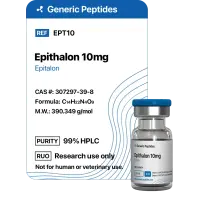
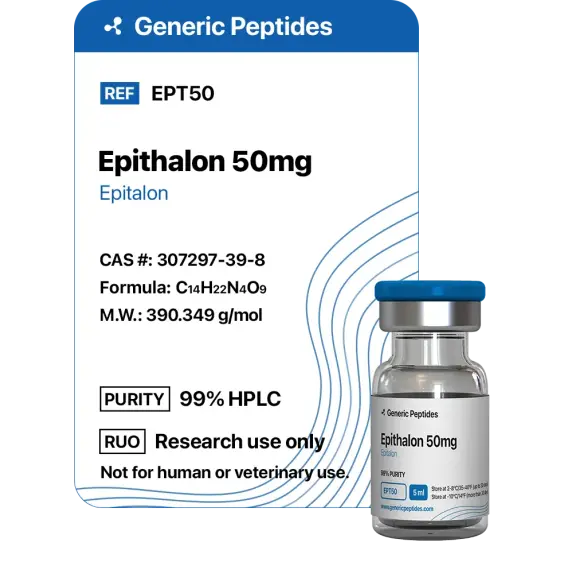
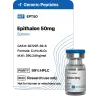
Epitalon 10mg
Certificate of Analysis available
A 2003 Russian study reported something most longevity researchers won't say in a sentence: a four-amino-acid peptide induced telomerase activity in human somatic cells — the cells in your body that normally don't make the enzyme that maintains telomeres. The compound was Epitalon. Whether the result holds up under modern Western replication is exactly why it remains one of the most-debated peptides in aging biology.
Epitalon (also spelled Epithalon) is a synthetic tetrapeptide — just four amino acids: Ala-Glu-Asp-Gly (AEDG). It was developed by Vladimir Khavinson and the St. Petersburg Institute of Bioregulation and Gerontology as a synthetic analog of epithalamin, a natural extract from the pineal gland. Epithalamin had been studied in Soviet research for decades. Epitalon is the bioactive fragment, simplified into a four-residue peptide that's stable enough to study cleanly.
Its primary research focus is telomerase activation and telomere lengthening. Telomeres are the protective caps at the ends of chromosomes. They shorten every time a cell divides. When they get critically short, cells stop dividing — that's cellular senescence, one of the established hallmarks of biological aging. Telomerase is the enzyme that can rebuild them. Most adult somatic cells have telomerase switched off. Epitalon, in published research, appears to switch it back on.
The 2003 study most often cited (Khavinson et al., Bulletin of Experimental Biology and Medicine) tested Epitalon on human fetal fibroblasts — cells that normally don't express telomerase at all. Treated cells showed measurable telomerase activity and continued dividing past the Hayflick limit, the natural cap on cell divisions. No signs of malignant transformation were reported. Subsequent animal research from Khavinson's group documented extended lifespan in rodents, reduced spontaneous tumor incidence in older animals, and restoration of melatonin production patterns in aged subjects toward more youthful baselines.
That last point matters. Epitalon was designed to mimic pineal gland activity, and the pineal gland produces melatonin — the master regulator of circadian rhythm. Animal data on melatonin restoration is part of why Epitalon shows up in sleep, circadian, and aging research, not just telomere studies. Whether it does any of this in humans at clinically meaningful scale remains genuinely open. Most of the research trail is preclinical, and most of it comes from one research group.
The honest version: Epitalon's research base is impressive in volume but uneven in source diversity. Khavinson's group has published continuously since the 1980s. Independent Western replication is more recent and less extensive. There are no large modern Phase 3 randomized controlled trials. Anyone selling Epitalon as a guaranteed life-extension intervention is going far beyond what the literature supports.
What's still defensible: Epitalon has one of the longest research trails of any compound currently discussed in longevity circles. The telomerase activation mechanism is specific, measurable, and consistent with the broader hallmarks-of-aging framework. For researchers studying cellular senescence, telomere biology, or geroprotective compounds, that's a legitimate foundation — even if the human translation question is still open.
Regulatory note: Epitalon was placed on the FDA's Category 2 bulks list in 2023. On April 22, 2026, the FDA removed Epitalon from Category 2 after the original nominations were withdrawn. A PCAC review is scheduled for July 23, 2026 to determine whether Epitalon will be added to the Category 1 bulks list. As of May 2026, it sits in regulatory transition — no longer formally restricted, not yet formally approved for compounding.
Here's what's specific to Epitalon: it's only four amino acids long. That makes it one of the cheapest peptides to synthesize in the entire research market — and that's exactly the problem. The barrier to entry for low-quality production is essentially zero, which means the market is flooded with budget Epitalon from synthesis routes that produce mixed peptide impurities. With a four-residue sequence (AEDG), there's not much room for error to be invisible: if the sequence is wrong by even one amino acid, you have a different compound that doesn't bind the way the literature describes.
Generic Peptides supplies research-grade Epitalon for sale at 99% purity, manufactured in the USA. Domestic synthesis with verified Ala-Glu-Asp-Gly sequence — the part that matters when the molecule is small enough for any error to ruin the experiment.
Order Epitalon for sale in the USA — 99% purity, verified AEDG sequence, manufactured domestically.
Yes — Epitalon is legally available as a research compound in the United States. As of April 22, 2026, it has been removed from the FDA's Category 2 list, with PCAC review scheduled for July 23, 2026 to determine its compounding status. It's not FDA-approved for human use.
Yes — same compound, two different transliterations of the original Russian name. Both spellings appear in scientific literature and on supplier sites. The amino acid sequence Ala-Glu-Asp-Gly (AEDG) identifies it unambiguously regardless of label.
That's what the published research says — Khavinson's 2003 study and subsequent papers documented telomerase activation and telomere lengthening in human fetal fibroblasts. The findings are real and peer-reviewed. What's still debated is how much of that translates to therapeutic effects in humans, since most of the work comes from one research group and large modern Western trials don't exist.
Epithalamin is a natural pineal gland extract — a complex mixture of peptides isolated from animal pineal tissue. Epitalon is the synthetic four-amino-acid peptide that Khavinson identified as the bioactive component. So Epithalamin is the source; Epitalon is the isolated active fragment, simplified for research use.
The four-amino-acid sequence makes Epitalon one of the cheapest peptides to synthesize, which means budget product is everywhere. The catch: cheap synthesis routinely produces sequence errors and peptide impurities that you can't see by looking at the vial. With a molecule this short, even one wrong residue gives you a different compound entirely.
Sources
Khavinson VKh, Bondarev IE, Butyugov AA — "Epithalon peptide induces telomerase activity and telomere elongation in human somatic cells." Bulletin of Experimental Biology and Medicine, 2003. The foundational study documenting telomerase activation in human fetal fibroblasts. https://pubmed.ncbi.nlm.nih.gov/14523538/
Anisimov VN, Khavinson VKh — "Peptide bioregulation of aging: results and prospects." Biogerontology, 2010. Reviews animal lifespan extension data and pineal regulation context. https://pubmed.ncbi.nlm.nih.gov/19898941/
Khavinson VKh — Multi-decade research overview from the St. Petersburg Institute of Bioregulation and Gerontology, including Epitalon's history as a synthetic analog of epithalamin. https://pubmed.ncbi.nlm.nih.gov/?term=khavinson+epitalon
FDA — "Bulk Drug Substances Nominated for Use in Compounding Under Section 503A," updated April 22, 2026. Documents Epitalon removal from Category 2 and the July 23, 2026 PCAC consultation. https://www.fda.gov/media/94155/download
Four amino acids. One sequence that has to be right. 99% purity, USA-made.
Epitalon ships as a white lyophilized powder in a sealed glass vial, freeze-dried to preserve its compact tetrapeptide structure (Ala-Glu-Asp-Gly) and extend its shelf life. With a few simple habits — cold, dark, dry — the sealed vial stays in perfect condition for its full shelf life. Here's exactly how to store it.
| Parameter | Details | Notes |
|---|---|---|
| Storage Temperature | Freezer at −20°C (−4°F) for long-term storage up to 24–36 months. Refrigeration at 2–8°C (36–46°F) is fine for short-term use up to ~6 months. | Original sealed vial in the freezer is the safest default. |
| Light Sensitivity | Yes — protect from direct light and UV exposure to prevent photodegradation. | Keep in the original box or an opaque, amber container. |
| Freezing | Allowed and recommended. −20°C is standard for long-term storage; −80°C extends stability further if available. | Freeze from the start if you won't use it within 3 months. |
| Signs of Degradation | Healthy powder is white and loose or cake-like. Watch for yellowing, clumping, visible moisture, or a sticky/damp texture — the acidic residues in Epitalon make it prone to absorbing humidity. | Any color change, clumping, or moisture = discard the vial. |
| Common Mistakes | Leaving the vial at room temperature after delivery, storing in a humid kitchen or bathroom, or opening a cold vial and letting condensation form inside. | Put it in the freezer on arrival, and let sealed vials warm to room temperature before opening. |
Every order is processed quickly and shipped with full tracking. All products come directly from the official Generic Peptides supply chain — in original manufacturer packaging, carefully handled from warehouse to your door.
| Destination | Delivery Time | Notes |
|---|---|---|
| USA Domestic | 2–5 business days | Faster when local warehouse stock is selected at checkout |
| International | 10–15 business days | Tracking included; update frequency may vary by destination country |
| Order Processing | 24–48 business hours | Processing begins after payment confirmation |
| Tracking | Provided on all orders | Tracking number sent after dispatch; multiple warehouses may result in separate shipments |
This product is supplied through the official Generic Peptides distribution chain and shipped in original manufacturer packaging. Orders are packed securely to protect the contents during transit and to respect customer privacy as a standard practice.
Outer packaging is neutral and does not display product details on the exterior — a common approach to protect shipments from damage, tampering, and unnecessary exposure during delivery.
Every order includes full authenticity assurance: official Generic Peptides presentation, batch-linked lab documentation, and sealed original packaging — giving customers confidence in every purchase.
| Authenticity Feature | Details |
|---|---|
| Packaging | Original manufacturer packaging — sealed and unaltered |
| Lab Documentation | Batch-linked certificate of analysis available on request |
| Supply Chain | Sourced exclusively through official Generic Peptides distribution |
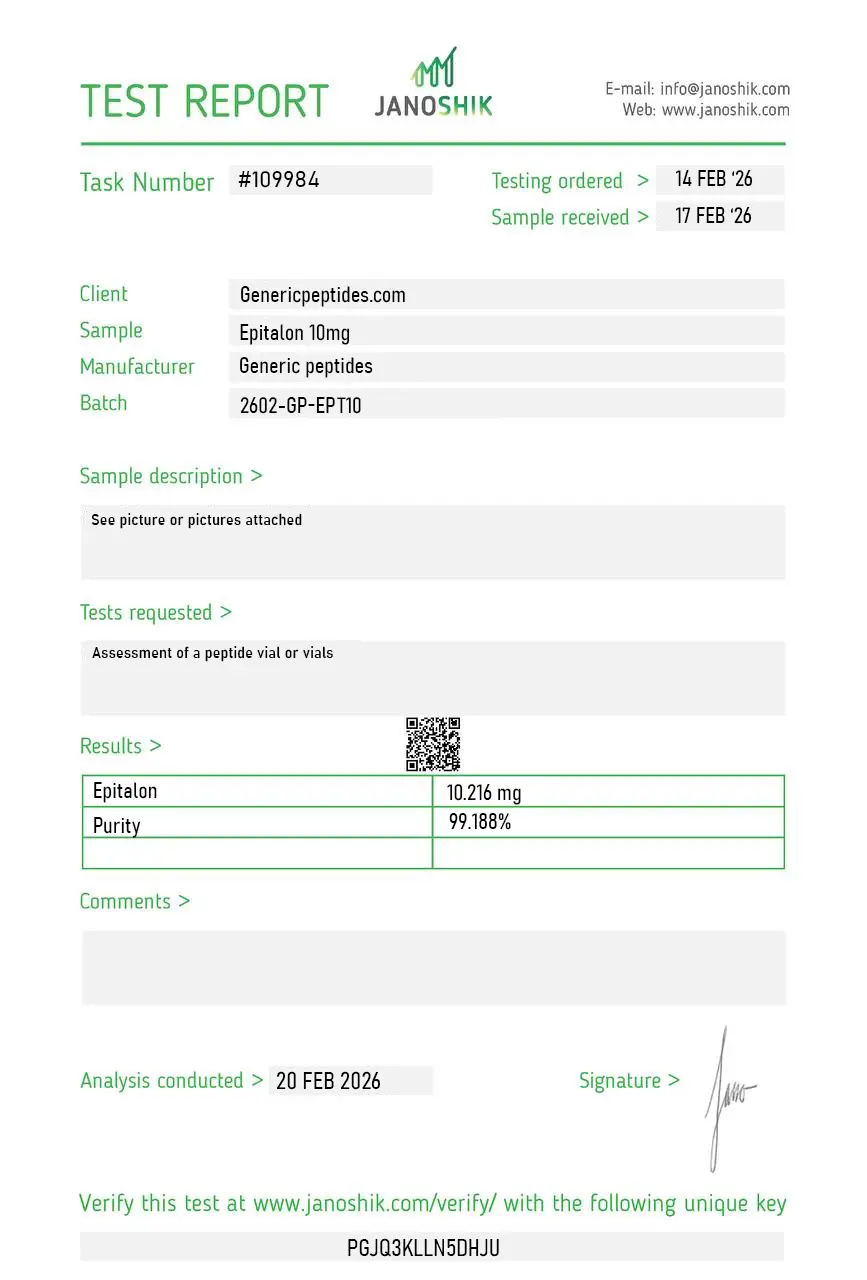
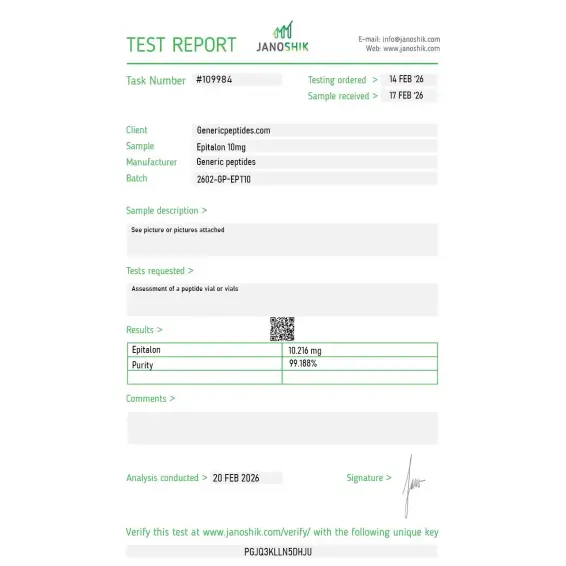
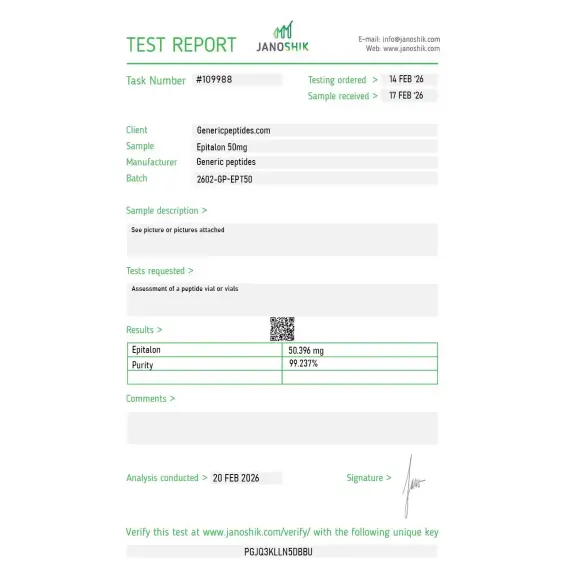
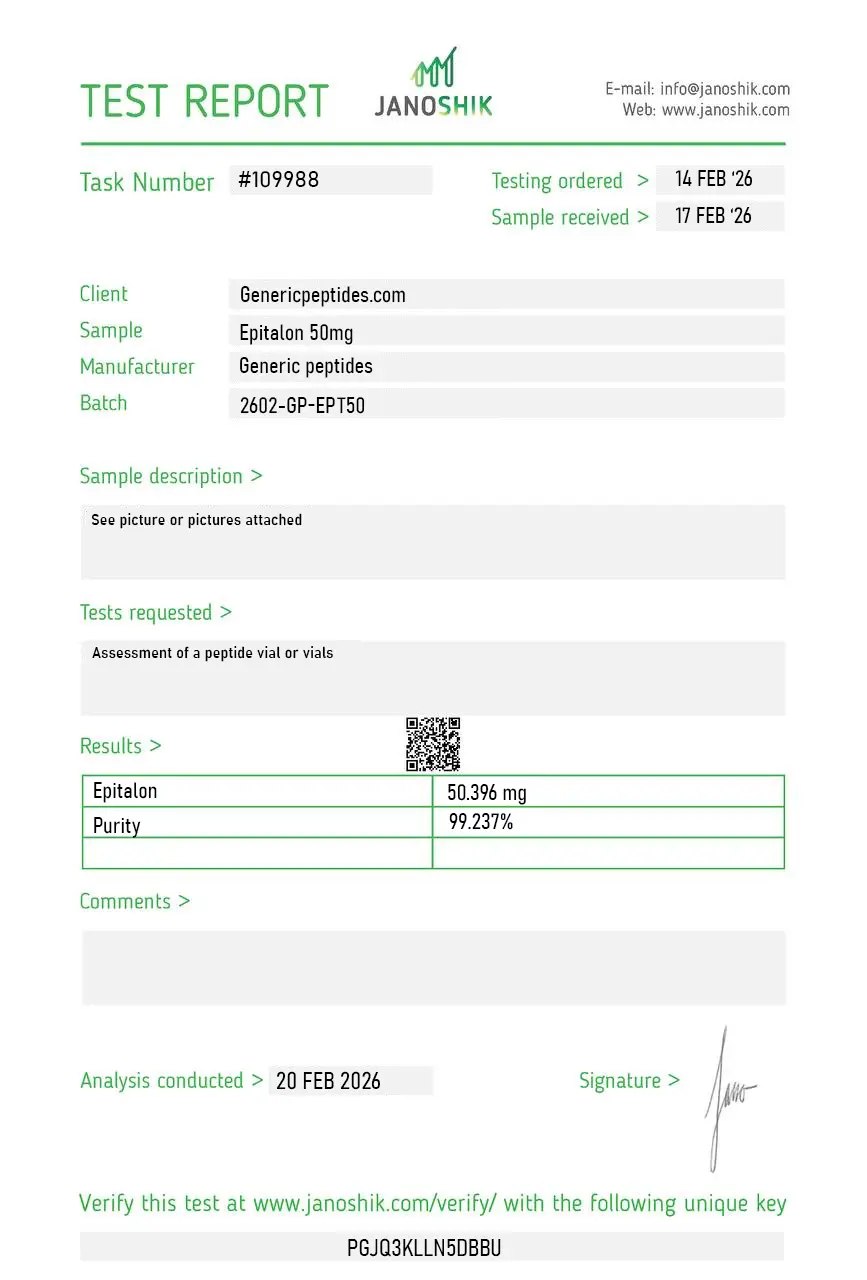
Independent lab test reports are available for Epitalon 10mg and 50mg batches. Each certificate provides batch-level verification details, including measured content, purity result, analysis date, and report documentation.
The thing I respect about the listing is it doesn't oversell the telomerase story. Epitalon's reputation rests almost entirely on one research program, and a vendor that frames it as the Khavinson-group hypothesis it is — rather than settled telomere science — is one I trust more, not less.
We source it alongside Thymalin — both Khavinson bioregulators, same research tradition — for a comparative project on that whole class. Getting them from one catalog with consistent handling keeps the comparison honest. The AEDG material has been steady across orders.
A four-residue peptide is about as small as these get, which makes it easy to synthesize cleanly but also easy to lose to adsorption at the trace concentrations we work at. The material was fine; we just switched to low-binding tubes early. Star off because for something this short the COA really ought to print the AEDG sequence outright rather than just the mass.
Tiny peptide, reconstitutes in seconds, no haze. We aliquot single-use out of habit with anything we run at low concentration. Held its activity in our assays across the working window. Unremarkable in the way I want a reagent to be.
Our standard pineal-peptide reference for the aging-research line. Repeated orders, consistent enough that batch variation hasn't entered our analysis. The Khavinson framework is unusual by Western standards but the compound is what it is and this one's been reliable.
Quick and painless. Order placed, confirmation received, parcel at my door. No nonsense. Exactly how online shopping should work but rarely does in this space.
The exact mechanism isn't fully resolved, but research suggests Epitalon upregulates expression of hTERT, the catalytic subunit of telomerase, through epigenetic modifications and gene regulatory pathways. The peptide may also influence pineal gland function and circadian gene expression, which connects telomerase activation to broader aging biology. The downstream observation — measurable telomerase activity in cells that normally don't express it — is well-documented in published research.
Most longevity-focused compounds work indirectly — through metabolism (NAD+ precursors), senolytics (clearing damaged cells), or growth factor regulation. Epitalon is unusual because it targets telomerase activation directly, which is one of the most fundamental aging mechanisms. That specificity is part of what makes it interesting and part of what makes it controversial — telomerase activation is a double-edged sword in aging research.
Animal studies have shown Epitalon can restore melatonin production in aged subjects toward patterns closer to younger animals. The pineal gland connection is direct — Epitalon is a synthetic version of a peptide originally extracted from pineal tissue. That's why Epitalon shows up in sleep, circadian rhythm, and aging research alongside its telomere applications.
At only four amino acids long, Epitalon is one of the cheapest peptides to synthesize, which has flooded the market with low-cost product. The problem: with a short sequence, peptide impurities and minor synthesis errors produce molecules that aren't actually Epitalon but look identical on a label. Verification requires HPLC analysis that most buyers don't have access to.
Epitalon was developed in the late 1980s and early 1990s by Vladimir Khavinson at the St. Petersburg Institute of Bioregulation and Gerontology. The peptide is a synthetic isolation of the active component of epithalamin, a pineal gland extract that had been studied in Soviet research since the 1970s. The published research trail spans more than four decades.
Epitalon is not specifically named on the WADA Prohibited List as of 2025. However, athletes subject to drug testing should consult their governing body's specific rules — anti-doping rules can include unspecified substances under broad categories like "other substances with similar chemical structure or biological effect."
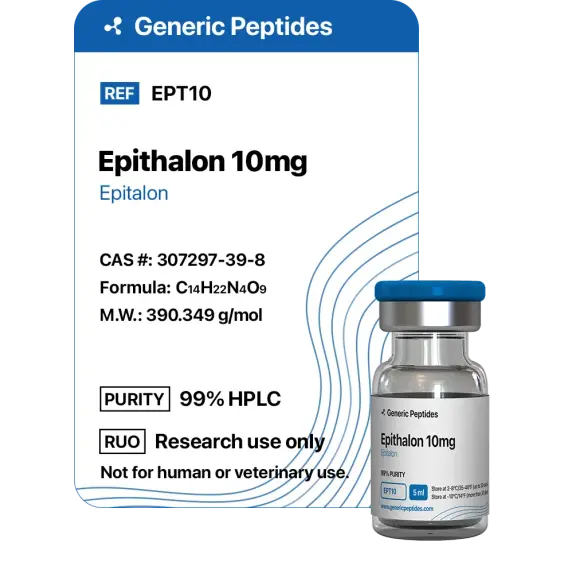
Epithalon (alternate transliteration), AEDG, Epitalone, and N-Acetyl-Epitalon (an acetylated variant with longer half-life). The amino acid sequence Ala-Glu-Asp-Gly identifies it unambiguously. CAS number 307297-39-8. Different names depending on whether the source is Russian, Western academic, or commercial.
Telomere biology and cellular aging research lead by volume. There's also active work in circadian biology, pineal gland function, and immune modulation in aged research models. Antioxidant pathway research and oxidative stress studies in aging contexts have continued through the 2010s and 2020s.
N-Acetyl-Epitalon (also called N-Acetyl-Epithalon) adds an acetyl group to the N-terminus of the standard Epitalon sequence. The modification is intended to extend the peptide's biological half-life and improve stability. The core mechanism — targeting telomerase and pineal regulation — is the same; the pharmacokinetics differ.
TA-65 is a small-molecule extract from the herb astragalus that has been associated with telomerase activation in some research. Epitalon is a synthetic peptide with a different chemical class entirely. Both have been studied for telomere effects, but the mechanisms aren't identical, and the published research bases differ substantially in source and methodology.
Researchers investigating peptide bioregulators, telomere biology, and longevity-focused aging research consistently examine Epitalon alongside compounds that target overlapping anti-aging mechanisms. Thymalin is the most natural pairing — the Khavinson group's foundational 6-year mortality study used both compounds together, and the two represent the thymus and pineal gland arms of the same peptide bioregulator research tradition. Thymosin Alpha-1 targets immune senescence through a different mechanism — TLR2/TLR9 activation rather than telomerase induction — but occupies the same anti-aging immune modulation research space. DSIP shares Epitalon's regulatory trajectory, appearing on the same July 2026 PCAC review agenda, and both are studied in the context of neuroendocrine aging and sleep-related longevity research. NAD+ addresses aging biology through a completely different pathway — cellular energy metabolism and sirtuin activation rather than telomere protection — but researchers studying comprehensive anti-aging models often examine both axes simultaneously. Semax is sometimes studied alongside Epitalon in neuroprotection research given both compounds' documented effects on neuronal survival and cognitive function in aging models.