BPC-157 After the July 2026 PCAC Review: Evidence and Regulatory Status
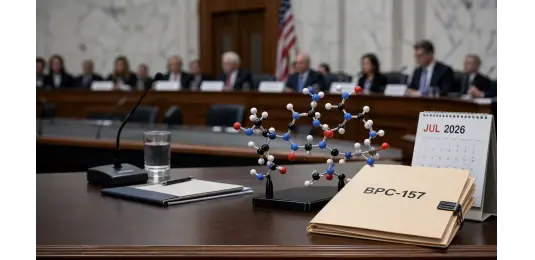
BPC-157 After the July 2026 PCAC Review: Evidence and Regulatory Status
Editorial disclosure: Generic Peptides sells peptides for laboratory research. This article discusses scientific evidence and a public FDA regulatory proceeding. It is not medical or legal advice. BPC-157 is not an FDA-approved drug.
BPC-157 has become one of the most discussed experimental compounds in recovery and tissue-repair research. Online claims commonly connect it with tendons, joints, muscle injury, inflammation, and gastrointestinal conditions.
The regulatory picture became more complicated on July 23, 2026.
FDA's Pharmacy Compounding Advisory Committee, or PCAC, reviewed BPC-157 free base and BPC-157 acetate for possible inclusion on the Section 503A Bulk Drug Substances List. FDA's scientific staff had recommended against adding either form. The advisory committee disagreed, voting 8–6, with one abstention, in favor of recommending BPC-157 for inclusion.
For a deeper review of the evidence, limitations, and regulatory context, read our
BPC-157 evidence and regulatory status guide
As of September 2026, BPC-157 remains an unapproved drug substance, and the advisory recommendation itself did not place BPC-157 on the 503A Bulks List. FDA would still have to act through its regulatory process before the legal status of compounding under section 503A changes. FDA describes advisory-committee recommendations as non-binding.
The July 2026 Decision at a Glance
| Question | Current answer |
|---|---|
| When did PCAC review BPC-157? | July 23, 2026 |
| Forms reviewed | BPC-157 free base and BPC-157 acetate |
| Use evaluated by FDA | Ulcerative colitis |
| FDA staff recommendation | Do not add to the 503A Bulks List |
| PCAC recommendation | Favorable |
| Reported vote | 8 yes, 6 no, 1 abstention |
| Is the PCAC recommendation binding? | No |
| Is BPC-157 FDA approved? | No |
| Did the vote immediately add BPC-157 to the 503A Bulks List? | No |
BPC-157 was one of seven substances reviewed during the same proceeding. The broader regulatory background is covered in our complete guide to the July 2026 FDA peptide meeting
FDA's own meeting materials make an important distinction: the proceeding concerned compounding, not a New Drug Application and not approval of BPC-157 as a treatment for ulcerative colitis, injury recovery, or any other condition.
Why Did FDA Review BPC-157 for Ulcerative Colitis?
For readers familiar with BPC-157 primarily through sports or injury-recovery discussions, the focus on ulcerative colitis may seem unexpected.
BPC-157 is a 15-amino-acid peptide whose early research was heavily connected with gastrointestinal tissue. Animal experiments have examined gastric injury, intestinal damage, fistulas, inflammation, blood vessels, and tissue repair.
In its July 2026 review, FDA noted that animal pharmacology studies reported effects in models involving gastric, hepatic, and colonic injury. Proposed explanations have included changes involving growth-factor signaling, inflammatory mediators, angiogenesis, and nitric-oxide pathways.
But FDA emphasized major limitations: the pharmacology was largely based on rodent experiments, dose-response relationships were not adequately established, the molecular targets remain uncertain, and the mechanism of action has not been definitively established.
That distinction matters. A biological effect in an animal model can justify further research, but it does not establish that a compound safely or effectively treats disease in humans.
Human Evidence Exists — but It Is Still Very Limited
One useful result of the 2026 review is that FDA provided a clearer picture of the human evidence than was available in many earlier summaries.
FDA identified a small randomized, double-blind, placebo-controlled study presented as a meeting abstract involving 53 people with mild-to-moderate ulcerative colitis. Participants received either a BPC-157 rectal preparation or placebo for two weeks.
FDA concluded that the study was not sufficient to establish effectiveness. Important methodological details were missing, including information needed to interpret the endpoint, statistical methods, eligibility criteria, and follow-up. FDA characterized the trial as small and exploratory.
Other reported human exposures have included small groups involving knee pain, interstitial cystitis, rectal administration in healthy participants, and a two-person intravenous pilot study. FDA summarized exposures including approximately 17 subjects receiving intra-articular administration for knee pain, 12 subjects in an interstitial-cystitis report, and two healthy subjects in the intravenous pilot.
Those numbers remain tiny compared with the evidence normally needed to establish the safety and efficacy of a therapeutic drug.
A 2025 systematic review of BPC-157 in orthopaedic sports medicine found 36 eligible studies, of which 35 were preclinical and only one was clinical. The authors concluded that the animal literature was substantially larger than the human evidence base.
A separate 2025 review reached a similar conclusion: despite substantial preclinical interest, rigorous human data remain extremely limited.
More recent sports-medicine literature published in 2026 has continued to describe human evidence for emerging injectable peptides as limited and insufficient to substantiate many of the recovery claims seen in commercial marketing.
The Registered Phase I Study Still Does Not Solve the Evidence Gap
BPC-157 also has a registered Phase I safety and pharmacokinetics study, NCT02637284, dating to 2015.
The ClinicalTrials.gov record currently lists the study's status as unknown. Results were submitted in 2016 but are not publicly posted on ClinicalTrials.gov, so the record does not provide a modern peer-reviewed dataset that can resolve questions about safety or pharmacokinetics.
This is one reason claims that BPC-157 has been thoroughly tested in humans go substantially beyond the available evidence.
FDA Raised More Than an Effectiveness Question
The July review was not simply a debate over whether BPC-157 "works."
FDA evaluates substances for the 503A Bulks List using several factors, including physical and chemical characterization, safety, effectiveness, and historical use in compounding.
For BPC-157, FDA's scientists concluded that both the free base and acetate forms were not sufficiently characterized for purposes of the review.
Among the issues were inconsistent naming, incomplete information concerning impurities and peptide aggregates, limited microbial and endotoxin characterization, and uncertainty surrounding characteristics relevant to different proposed dosage forms. FDA also noted that free base and acetate are distinct bulk drug substances and should not automatically be treated as interchangeable simply because both are commonly marketed under the name "BPC-157."
This is an important research-quality issue. A reported percentage purity by itself does not necessarily characterize every impurity, degradation product, aggregate, microbial contaminant, or chemical form present in a sample.
For a broader framework on evaluating supplier claims, documentation, and product quality, see our guide on how to choose a research peptide supplier
What Did FDA Say About Safety?
FDA concluded that the existing clinical information was insufficient to characterize the safety profile of BPC-157 free base or BPC-157 acetate.
The agency noted that published human studies were generally small, short, and provided limited safety monitoring. FDA also identified potential concerns about immunogenicity, particularly where peptide aggregation or peptide-related impurities could be relevant.
The nonclinical record was not completely reassuring either.
FDA highlighted 28-day repeat-dose studies in rats and dogs that produced signals potentially related to coagulation and liver-associated laboratory findings. Longer-duration repeat-dose studies were not available to determine whether those signals persisted or whether additional effects might emerge with longer exposure.
FDA also reviewed three adverse-event reports involving products containing BPC-157, including injection-site symptoms, shortness of breath, and pigment changes. Importantly, FDA stated that the reports were difficult to interpret because of confounding factors and did not establish that BPC-157 caused those events.
So the evidence does not justify saying either that BPC-157 has been shown to be broadly dangerous or that it has been shown to be broadly safe.
The more accurate conclusion is that important safety questions remain unresolved.
FDA Staff and PCAC Reached Different Conclusions
This is probably the most important part of the July 2026 meeting.
After reviewing the available evidence, FDA staff concluded that the balance of the criteria weighed against putting BPC-157 free base or BPC-157 acetate on the 503A Bulks List.
FDA cited four main problems: inadequate physicochemical characterization, limited information about historical compounding use, insufficient safety and immunogenicity information, and insufficient evidence to reach a conclusion about effectiveness for ulcerative colitis.
FDA therefore formally proposed that both forms not be included.
PCAC nevertheless voted in favor of recommending inclusion.
That disagreement is significant because it shows that the July outcome was not an FDA scientific finding that the existing evidence had suddenly become strong. Rather, the advisory committee weighed the evidence and policy considerations differently from FDA staff.
What the PCAC Recommendation Actually Means
A PCAC recommendation is advice to FDA.
It is not:
FDA approval of BPC-157; proof that BPC-157 treats ulcerative colitis; approval for tendon, muscle, joint, or recovery claims; or an immediate amendment of federal compounding rules.
FDA itself explains that advisory committees provide independent expert recommendations, but those recommendations are non-binding.
Under the 503A framework, the agency must ultimately determine which bulk drug substances appear on the regulatory list. FDA's current guidance explains that substances without an applicable USP/NF monograph and that are not components of approved drugs generally must appear on the 503A Bulks List to satisfy this pathway for compounding from bulk drug substances.
In other words, the July vote moved the discussion forward. It did not finish it.
What About BPC-157's Earlier Category 2 Status?
BPC-157 had previously appeared in FDA's Category 2, which contained nominated bulk substances that FDA identified as raising significant safety concerns under its interim policies.
In April 2026, FDA removed BPC-157 from that active category because the underlying nominations had been withdrawn and FDA planned to bring BPC-157 before PCAC.
That removal was procedural.
It was not equivalent to FDA determining that the previous safety concerns had disappeared, nor did it place BPC-157 into Category 1 or onto the final 503A Bulks List.
The July meeting then created the unusual situation that exists today: FDA staff recommended against inclusion, while its advisory committee recommended in favor.
The next meaningful development will be what FDA itself does with that recommendation.
BPC-157 and Competitive Sport
Separate from the FDA compounding process, BPC-157 remains relevant to anti-doping rules.
The 2026 World Anti-Doping Agency Prohibited List applies its S0 category to non-approved substances and prohibits covered substances at all times. BPC-157 has been treated under this framework, so competitive athletes subject to WADA rules should not interpret the PCAC recommendation as changing anti-doping status.
Researchers comparing compounds discussed in tissue-repair research may also want to review the evidence and regulatory context for TB-500, the thymosin beta-4 fragment
FDA compounding policy and WADA anti-doping rules are separate regulatory systems.
The Bottom Line
The July 2026 PCAC meeting produced a real but narrowly defined change in the BPC-157 regulatory story.
The committee recommended that the reviewed BPC-157 bulk drug substances be included on the 503A Bulks List, contrary to FDA staff's recommendation.
But the vote did not make BPC-157 an FDA-approved medicine, did not validate the broad recovery claims commonly made online, and did not erase the substantial gaps in human safety and effectiveness data.
The scientific picture remains uneven: there is a large body of animal and mechanistic research, a small amount of human evidence, and major unanswered questions involving clinical effectiveness, long-term safety, chemical characterization, impurities, aggregation, and route-specific exposure.
For researchers, the most important development from July may therefore be not that the evidence question was settled, but that FDA's review documented more clearly where the evidence is strong, where it is weak, and what future research would need to establish.
Sources
- FDA — July 23–24, 2026 Pharmacy Compounding Advisory Committee meeting. FDA meeting page
- FDA — BPC-157-related bulk drug substances presentation and scientific evaluation.
- FDA — Bulk Drug Substances Used in Compounding Under Section 503A. FDA 503A guidance and status page
- Regulatory Affairs Professionals Society — reporting of the July 23 PCAC vote.
- Vasireddi N. et al. — Emerging Use of BPC-157 in Orthopaedic Sports Medicine: A Systematic Review.
- McGuire F. et al. — Regeneration or Risk? A Narrative Review of BPC-157 for Musculoskeletal Healing.
- ClinicalTrials.gov — NCT02637284, PCO-02 Safety and Pharmacokinetics Trial.
- World Anti-Doping Agency — 2026 Prohibited List.