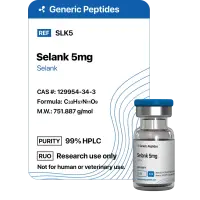
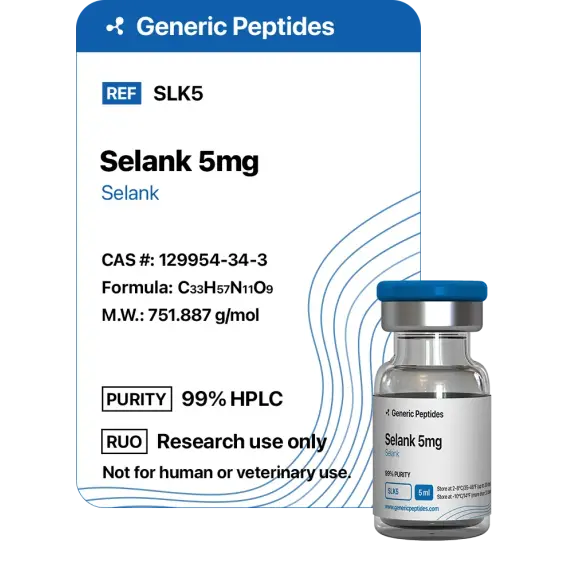
Selank 5mg
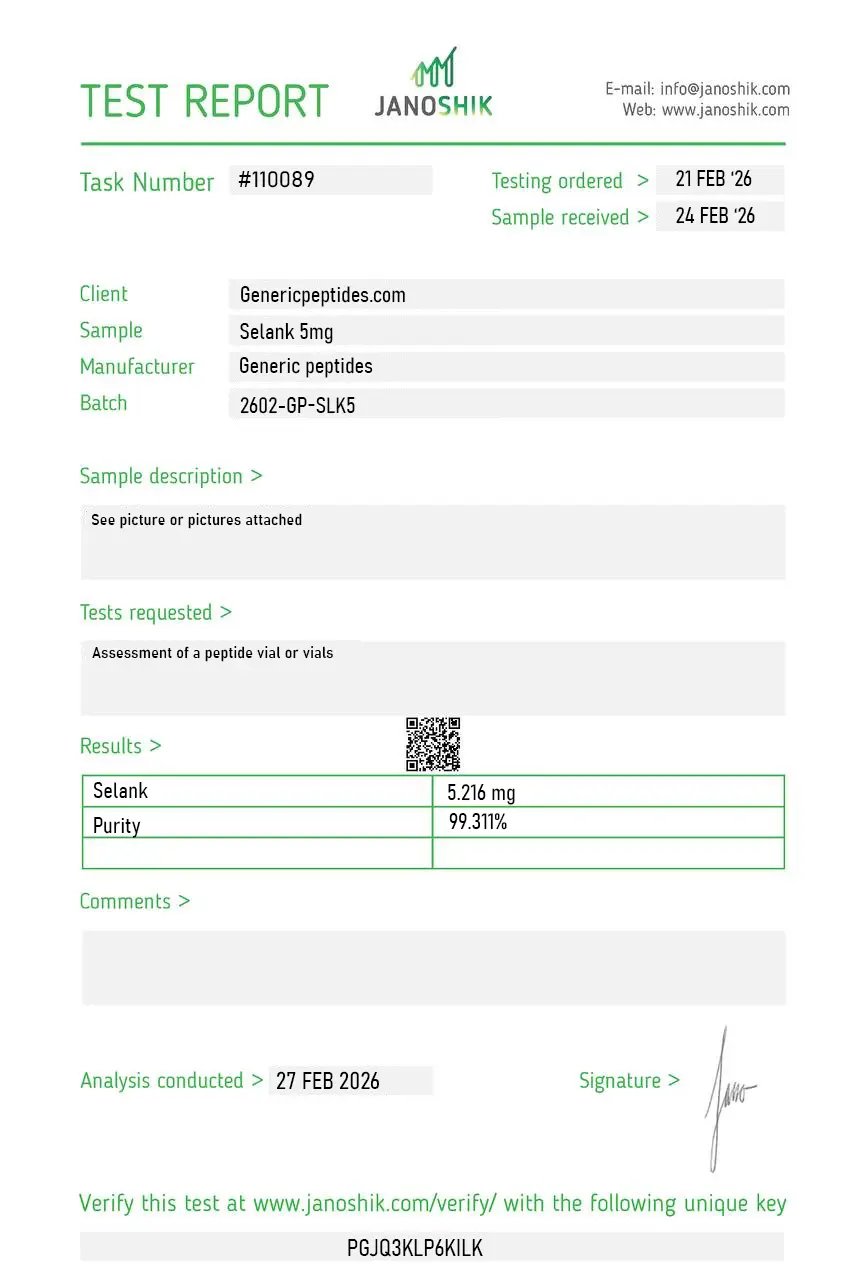
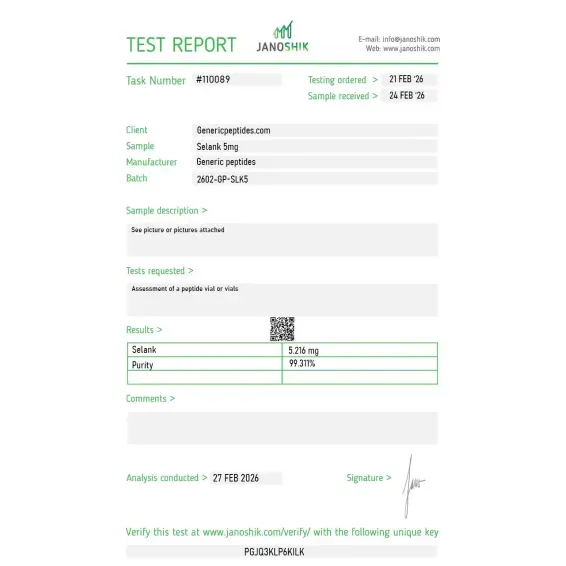
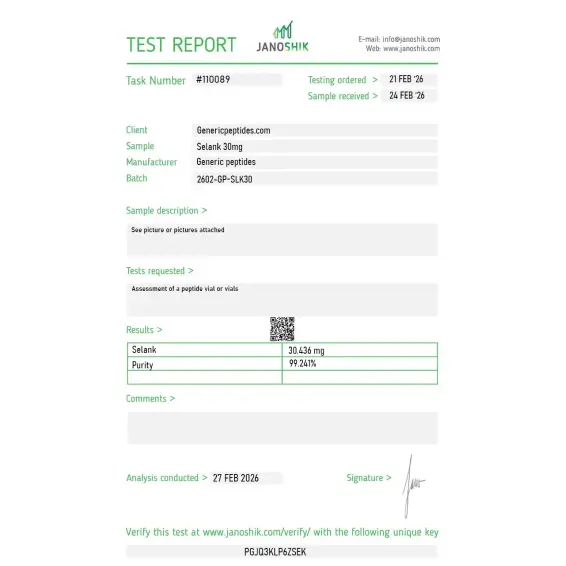
Certificate of Analysis available
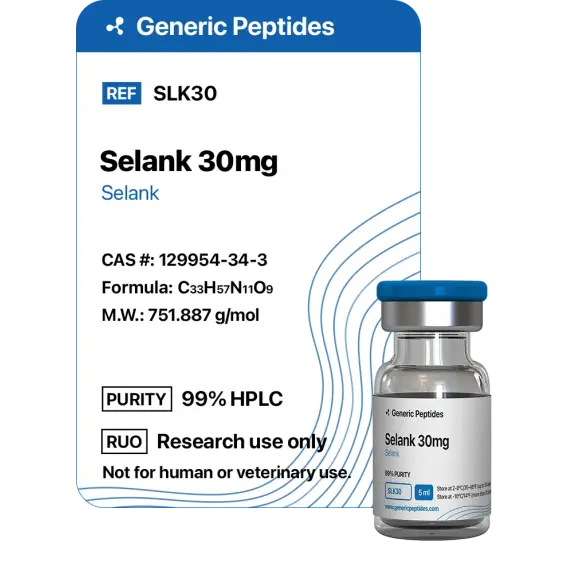
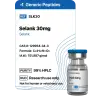
Russia approved Selank as a prescription anxiolytic in 2009. It's been on pharmacy shelves in Moscow for over a decade. Meanwhile in the West, it's a research peptide most people have never heard of, with a research literature you can barely access because half of it is published in Russian. The peculiar question Selank asks is: what if there's an anxiolytic that works without sedation, without addiction risk, and without the cognitive impairment that benzodiazepines produce? Russian research says yes. Western trials say "we'd need to run them ourselves."
Selank is a synthetic heptapeptide — seven amino acids in the sequence Thr-Lys-Pro-Arg-Pro-Gly-Pro (TKPRPGP). It was developed at the Institute of Molecular Genetics of the Russian Academy of Sciences in collaboration with the V.V. Zakusov Research Institute of Pharmacology, originally as a stabilized analog of tuftsin — a naturally occurring 4-amino-acid immunomodulatory peptide found in human immunoglobulin G heavy chains.
The engineering goal was specific: native tuftsin (Thr-Lys-Pro-Arg) has powerful biological effects but a half-life measured in seconds, making it impractical as a research or therapeutic tool. The Russian team added a Pro-Gly-Pro sequence to the C-terminus that protects against enzymatic degradation while preserving the active region. Selank's plasma half-life is still short — about 10 minutes after intranasal administration — but biological effects persist much longer due to downstream signaling and gene expression changes that continue after the peptide itself has cleared.
Most anxiolytic compounds target one neurotransmitter system. Benzodiazepines hit GABA. SSRIs hit serotonin. Buspirone hits 5-HT1A. Selank appears to simultaneously modulate multiple systems — GABAergic signaling, serotonin metabolism, BDNF expression, and enkephalin processing — without binding any of these receptors as a primary mechanism. The compound also influences cytokine balance (IL-6 expression and T-helper cell ratios) reflecting its tuftsin parentage.
Russian research has documented Selank's effects on hippocampal gene expression through cDNA microarray studies — Agniullin and Myasoedov's work showed measurable transcriptional changes in rat brains after Selank administration. The 2008 generalized anxiety disorder trial (Zozulia et al., 62 patients comparing Selank to medazepam) reported similar anxiolytic efficacy with the additional finding that Selank produced antiasthenic and psychostimulant effects that medazepam didn't. That cognitive-enhancing component is what makes Selank potentially distinct from conventional anxiolytics — most calm without dulling. Selank, the research suggests, calms while supporting cognitive function.
Here's the uncomfortable truth: most Selank research has been done by Russian institutions and published in Russian journals. Independent Western replication is genuinely limited. The compound has nearly four decades of research history but most of it concentrates in a handful of Moscow-based research groups, and English translation of the underlying clinical work is incomplete. That's not the same as saying the research is wrong — Russian peptide chemistry has been productive for decades — but it does mean Selank's evidence base is uneven in source diversity in ways that cleaner-pedigreed compounds aren't.
Selank is also not a sedative. The mechanism doesn't produce drowsiness or psychomotor impairment. That's actually the entire selling point — researchers studying anxiety models without confounding sedation effects find this useful. But it means Selank doesn't "feel" like a benzodiazepine, and anyone expecting that experience will be disappointed.
Regulatory note: Selank acetate (TP-7) was placed on the FDA's Category 2 bulks list in 2023, then removed from Category 2 on September 27, 2024 after the nominator withdrew the nomination. Unlike CJC-1295, Ipamorelin, and AOD-9604 — which were also removed from Category 2 in September 2024 and subsequently reviewed by PCAC in October and December 2024 — Selank's nomination was withdrawn without a PCAC referral. As of May 2026, Selank is not in Category 2 and has not been reviewed by PCAC. It cannot be compounded by 503A pharmacies absent Category 1 status. WADA's Prohibited List does not specifically name Selank as of 2025.
Here's a sourcing problem that's specific to Selank: it has an unusual amino acid composition with three proline residues out of seven total — proline is the only proteinogenic amino acid with a secondary amine in its backbone, which creates synthesis challenges most peptide chemists don't routinely handle well. Cheap synthesis routes produce peptides with sequence errors at the proline positions, incomplete deprotection, or impurity patterns that affect bioactivity. With most Selank research originating from Russian sources where Western analytical methods may not have been applied, sourcing reliability matters more here than for compounds with broader Western quality control infrastructure.
Generic Peptides supplies research-grade Selank for sale at 99% purity, manufactured in the USA. Domestic synthesis with all three proline positions verified — the part that determines whether your Selank actually has the structure that produces the effects published research describes.
Order Selank for sale in the USA — 99% purity, full TKPRPGP sequence verified, manufactured domestically.
Yes — Selank is legally available as a research compound in the United States. It was removed from FDA Category 2 on September 27, 2024 after the nominator withdrew the nomination. Unlike other peptides removed in the same batch, Selank was not subsequently referred to PCAC for review. As of May 2026, it is not on the Category 1 bulks list and cannot be compounded by 503A pharmacies. Not FDA-approved for human use in the US, though it's an approved prescription anxiolytic in Russia.
Selank is a synthetic 7-amino-acid analog of natural tuftsin. Tuftsin (Thr-Lys-Pro-Arg) is a 4-amino-acid endogenous peptide with strong biological activity but a half-life of seconds, making it impractical as a research tool. Selank adds a Pro-Gly-Pro extension that protects against rapid enzymatic degradation while preserving the active region. Same family, dramatically different stability.
Both are synthetic peptides developed by Russian research groups, but they have different parent molecules and different research applications. Semax is derived from ACTH and is studied for cognitive enhancement and neuroprotection. Selank is derived from tuftsin and is studied for anxiolytic and immunomodulatory effects. They're often discussed together but are distinct compounds with different mechanisms.
That's what the published research suggests. The 2008 Zozulia trial comparing Selank to medazepam found similar anxiolytic efficacy without the sedative or cognitive impairment effects associated with benzodiazepines. Russian research has consistently documented this profile across multiple studies. Whether the magnitude translates to Western clinical populations the same way remains an open research question.
Probably not at the same purity or with all three proline positions correctly synthesized. Selank's unusual proline-rich composition makes high-quality synthesis technically demanding. Cheap producers routinely deliver material with sequence errors, incomplete deprotection, or impurity patterns that compromise bioactivity. Without HPLC-MS verification specifically targeting the proline-rich region, the difference is invisible until your assay produces inconsistent results.
Sources
Zozulia AA et al. — "Efficacy and possible mechanisms of action of a new peptide anxiolytic selank in the therapy of generalized anxiety disorders and neurasthenia." 62-patient comparative trial vs medazepam. https://pubmed.ncbi.nlm.nih.gov/18454096/
Agniullin YV, Myasoedov NF et al. — "Changes in the Transcription Profile of the Hippocampus in Response to Administration of the Tuftsin Analog Selank." Documents hippocampal gene expression effects in rat models. https://pubmed.ncbi.nlm.nih.gov/?term=agniullin+selank+hippocampus
"Selank." Wikipedia summary documenting the heptapeptide structure, tuftsin lineage, Russian regulatory approval (2009), and immunomodulatory and anxiolytic mechanisms. https://en.wikipedia.org/wiki/Selank
FDA — "Bulk Drug Substances Nominated for Use in Compounding Under Section 503A," updated April 22, 2026. Documents Selank acetate removal from Category 2 (September 2024). https://www.fda.gov/media/94155/download
A peptide with three prolines that have to be exactly right. Russian research base. Western synthesis matters.
Selank ships as a white lyophilized powder in a sealed glass vial, freeze-dried to preserve its heptapeptide structure and extend its shelf life. With a few simple habits — cold, dark, dry — the sealed vial stays in perfect condition for its full shelf life. Here's exactly how to store it.
| Parameter | Details | Notes |
|---|---|---|
| Storage Temperature | Freezer at −20°C (−4°F) for long-term storage up to 24 months. Refrigeration at 2–8°C (36–46°F) is fine for short-term use up to ~3 months. | Original sealed vial in the freezer is the safest default. |
| Light Sensitivity | Yes — protect from direct light and UV exposure to prevent photodegradation. | Keep in the original box or an opaque, amber container. |
| Freezing | Allowed and recommended. −20°C is standard for long-term storage; −80°C extends stability further if available. | Freeze from the start if you won't use it within 3 months. |
| Signs of Degradation | Healthy powder is white to off-white and loose or cake-like. Watch for yellowing, clumping, visible moisture, or a sticky texture — the basic residues in Selank can attract humidity if the seal is broken. | Any color change, clumping, or moisture = discard the vial. |
| Common Mistakes | Leaving the vial at room temperature after delivery, storing in a humid kitchen or bathroom, or opening a cold vial and letting condensation form inside. | Put it in the freezer on arrival, and let sealed vials warm to room temperature before opening. |
Every order is processed quickly and shipped with full tracking. All products come directly from the official Generic Peptides supply chain — in original manufacturer packaging, carefully handled from warehouse to your door.
| Destination | Delivery Time | Notes |
|---|---|---|
| USA Domestic | 2–5 business days | Faster when local warehouse stock is selected at checkout |
| International | 10–15 business days | Tracking included; update frequency may vary by destination country |
| Order Processing | 24–48 business hours | Processing begins after payment confirmation |
| Tracking | Provided on all orders | Tracking number sent after dispatch; multiple warehouses may result in separate shipments |
This product is supplied through the official Generic Peptides distribution chain and shipped in original manufacturer packaging. Orders are packed securely to protect the contents during transit and to respect customer privacy as a standard practice.
Outer packaging is neutral and does not display product details on the exterior — a common approach to protect shipments from damage, tampering, and unnecessary exposure during delivery.
Every order includes full authenticity assurance: official Generic Peptides presentation, batch-linked lab documentation, and sealed original packaging — giving customers confidence in every purchase.
| Authenticity Feature | Details |
|---|---|
| Packaging | Original manufacturer packaging — sealed and unaltered |
| Lab Documentation | Batch-linked certificate of analysis available on request |
| Supply Chain | Sourced exclusively through official Generic Peptides distribution |
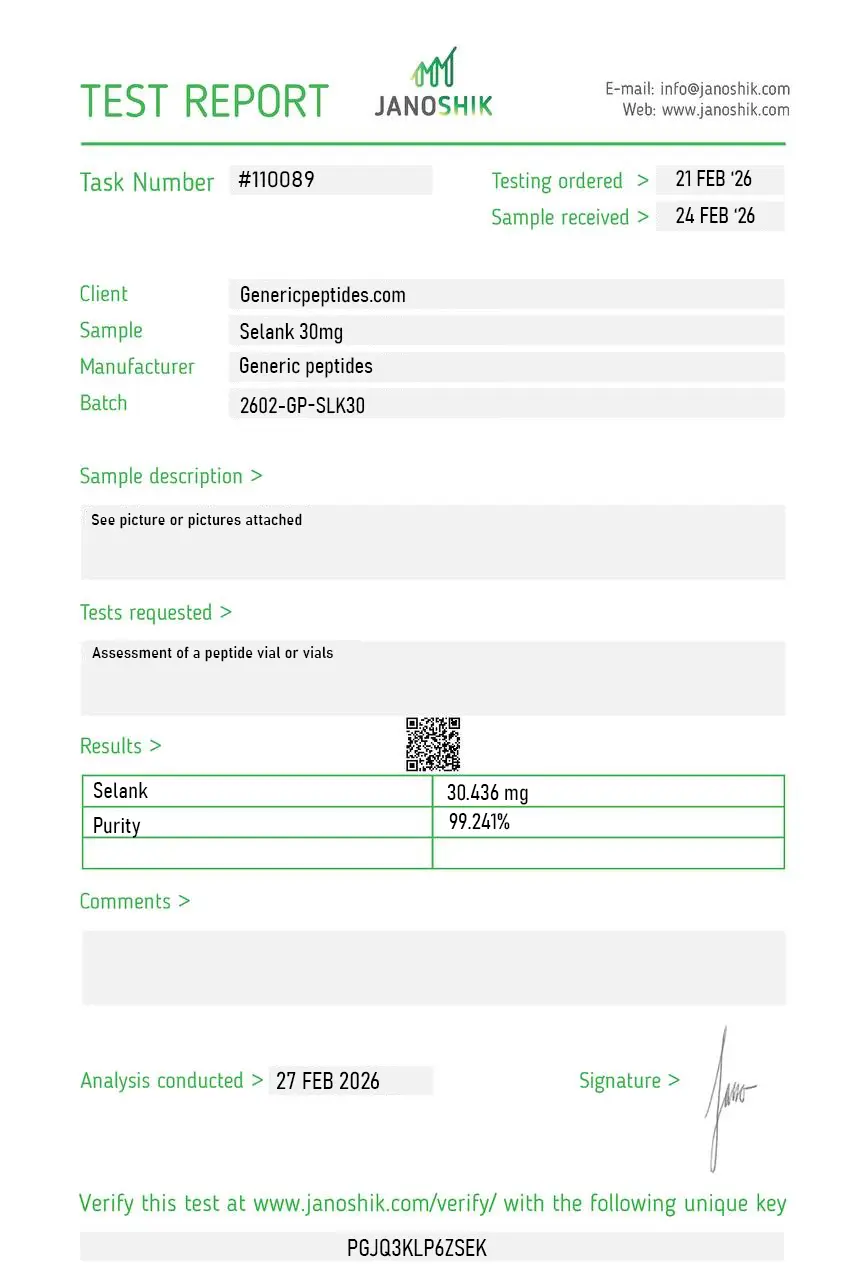
Independent lab test reports are available for Selank 5mg and 30mg batches. Each certificate provides batch-level verification details, including measured content, purity result, analysis date, and report documentation.
Najjar's original tuftsin work at Tufts in 1970 is the actual foundation here, and Selank is the stabilized derivative of that. The listing nods to the lineage. Star off only because the connection to native tuftsin could be made more explicit — a lot of buyers won't realize this is a tuftsin analog at all, and that heritage is the most legitimate thing about the compound.
Tuftsin-family pharmacology in our immunomodulation line. The compound is essentially tuftsin — the TKPR sequence from the IgG heavy chain — with a PGP extension protecting it from the rapid degradation native tuftsin suffers. Useful that the listing frames it that way rather than as a freestanding "anxiolytic peptide." Consistent across orders.
Decent for our work but I'll register a handling note — at the very dilute concentrations we use for some binding studies, this small polar peptide adsorbs noticeably to standard polypropylene. Switched to low-binding tubes and the losses stopped. Not the vendor's issue, just the nature of a seven-residue hydrophilic peptide at trace levels. Material itself was reliable.
Third reorder. Small heptapeptide, reconstitutes easily, nothing eventful.
The immunology angle interests me more than the neuro framing — tuftsin and its derivatives have a legitimate macrophage-and-NK-activation literature going back decades, separate from the anxiolytic claims. Selank gives a stabilized handle on that tuftsin-family immune activity. Material's held up across the conditions we've run.
We use Selank as a model compound for nasal-delivery pharmacokinetics, since it has a documented intranasal route in Russian clinical practice — that gives it a real-world delivery precedent most research peptides lack. Material's been consistent enough to anchor a small-peptide nasal-absorption characterization.
What I appreciated was the restraint in the listing — Selank gets pushed relentlessly in nootropics circles with cognitive-enhancement claims that outrun the evidence, and the product page just describes the peptide and its tuftsin origin without any of that. For a compound this hyped in certain communities, the plain framing was reassuring.
I'm picky about who I order from and even pickier about reordering. This is one of two suppliers I've stuck with long term. Communication is real, shipping is consistent, packaging holds up. That's the checklist and they tick all of it.
Stabilized tuftsin derivative, our standard reference, consistent batches over repeated orders. That's it.
The mechanism appears to involve simultaneous modulation of multiple neurotransmitter systems rather than direct receptor binding. Selank affects GABAergic signaling indirectly, modulates serotonin metabolism, influences BDNF expression, and affects enkephalin processing. The combination produces anxiolytic effects through pathways distinct from benzodiazepines, which is why the sedation and cognitive impairment side effects don't appear at standard research concentrations.
Different mechanisms entirely. Benzodiazepines bind GABA-A receptor sites and produce direct GABAergic enhancement, leading to anxiolytic effects but also sedation, cognitive impairment, and dependence potential. Selank doesn't bind GABA receptors directly but modulates the broader GABAergic system through different pathways, producing anxiolytic effects without the sedation or addiction profile that defines benzodiazepine pharmacology.
The 2008 Zozulia comparative trial documented "antiasthenic and psychostimulant effects" of Selank that the comparison drug medazepam didn't produce. Russian research has consistently described this dual profile — calming combined with cognitive support. The exact magnitude in Western populations remains less well characterized due to limited independent Western replication studies.
The peptide contains three proline residues out of seven amino acids — proline's secondary amine creates synthesis challenges that produce sequence errors at proline positions, incomplete deprotection, or impurity patterns when handled poorly. Many budget peptide producers don't routinely synthesize proline-rich peptides correctly. Detection of these defects requires HPLC-MS analysis targeting the specific proline positions.
Selank was developed at the Institute of Molecular Genetics of the Russian Academy of Sciences in cooperation with the V.V. Zakusov Research Institute of Pharmacology starting in the 1980s. The compound received Russian regulatory approval as an anxiolytic prescription drug in 2009 for generalized anxiety disorder and neurasthenia. The published research trail spans nearly four decades.
Selank is not specifically named on the WADA Prohibited List as of 2025. The compound's mechanism — modulating GABAergic, serotonergic, and BDNF systems without producing sedation or anabolic effects — keeps it outside standard anti-doping categories. Athletes subject to drug testing should consult their governing body's specific rules.
TP-7 (the Russian research designation), Selanc (alternate transliteration), and the chemical sequence Thr-Lys-Pro-Arg-Pro-Gly-Pro. CAS number 129954-34-3. The salt form most commonly sold is Selank acetate. Different naming conventions across literature, all referring to the same heptapeptide.
Anxiety research and stress response biology lead by volume — particularly preclinical models comparing Selank to benzodiazepines. There's also active work in immunomodulation (reflecting its tuftsin lineage), opioid system research (Selank affects enkephalin metabolism), and cognitive function studies. Recent research has explored its potential in opioid withdrawal models.
Selank is the synthetic stabilized analog of tuftsin (the natural 4-amino-acid immunomodulatory peptide). Semax is a separate compound from the same Russian research tradition but derived from ACTH rather than tuftsin. Tuftsin, Selank, and Semax represent a family of Russian-developed peptide research tools, but they're distinct molecules with different mechanisms and applications.
Most anxiolytic research compounds target a single neurotransmitter system — GABA, serotonin, or specific receptor subtypes. Selank's mechanism appears multi-system and indirect, producing anxiolytic effects through downstream modulation rather than direct receptor binding. That mechanistic profile is unusual and is what makes the compound interesting as a research tool — and what makes it difficult to compare directly with conventional anxiolytics.
Researchers investigating anxiolytic pharmacology, GABAergic modulation, and immunomodulatory neuropeptide biology consistently examine Selank alongside compounds that target overlapping or complementary CNS and immune pathways. Semax is the most natural pairing — both are synthetic heptapeptides developed by Russian research institutions for clinical CNS applications, both are administered intranasally, and both modulate overlapping neurotransmitter systems through different parent molecules; researchers studying the Russian neuropeptide research tradition almost always examine both compounds together to compare ACTH-derived cognitive effects against tuftsin-derived anxiolytic effects. DSIP shares the stress response and sleep regulation research space — researchers studying the neurochemical basis of anxiety, sleep quality, and stress resilience sometimes examine all three Russian CNS peptides simultaneously to map which pathway drives which behavioral outcome. MET5 is a natural complement given Selank's documented mechanism includes modulation of enkephalin degradation — Selank affects endogenous opioid tone by slowing MET5 breakdown, making direct MET5 research a useful mechanistic reference for understanding Selank's anxiolytic effects at the molecular level. Thymosin Alpha-1 occasionally appears in the same research context given Selank's tuftsin-derived immunomodulatory properties — both compounds affect T-cell function and cytokine balance, and researchers studying the immune-brain axis sometimes examine both simultaneously.