5-Amino-1MQ: NNMT Inhibitor Lacking Confirmed Human Clinical Trials
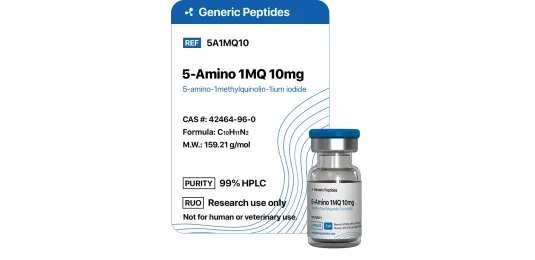
5 Amino 1MQ: Research Guide, Benefits, and How It Works
By Medical Team of Generic Peptides
Search for "5 amino 1mq benefits" and you'll find plenty of confident answers: rapid fat loss, more energy, a faster metabolism, muscle support for aging. What those pages almost never mention: not one of those benefits has been shown in a human being.
That doesn't make the compound fake. The science underneath is real, peer-reviewed, and genuinely clever. But as of October 2026, every data point behind 5-Amino-1MQ comes from mice or cells in a dish. Zero human clinical trials exist.
One more thing: the name and the vendors are misleading. 5-Amino-1MQ is not a peptide. It is a small synthetic molecule — a methylquinolinium salt — that came out of an academic medicinal chemistry program studying NNMT inhibitors [1].
Quick Answer
In mice and lab-grown cells, 5-Amino-1MQ blocks an enzyme called NNMT and reshapes how fat cells handle energy — producing weight loss, smaller fat cells, lower cholesterol, and strength gains in aged animals, all without cutting appetite. Those are the 5 amino 1mq benefits behind the search traffic. In humans, none of them are proven. As of October 2026, there are no clinical trials, no FDA approval, and no legal prescription or supplement pathway. It is sold strictly as a research chemical.
How 5-Amino-1MQ Works: Plugging a Metabolic Drain
Start with an enzyme: NNMT (nicotinamide N-methyltransferase), a protein that drives one specific chemical reaction. NNMT takes nicotinamide — a form of vitamin B3 that cells use to build NAD+, the molecule that helps turn food into usable energy — and converts it into 1-MNA, a dead-end product that is excreted.
Sounds harmless. It is not. In the fat tissue of obese animals, NNMT runs in overdrive. The reaction burns through two resources at once: nicotinamide, which starves NAD+ production, and SAM, the universal methyl donor cells need for jobs like switching genes on and off.
5-Amino-1MQ is a selective, membrane-permeable NNMT inhibitor. In plain terms: it enters cells and blocks that enzyme, keeping nicotinamide available for NAD+ synthesis and SAM available for methylation. In lab-grown fat cells, blocking NNMT raised NAD+ and SAM levels and reduced fat accumulation [2].
What sets it apart, though, is what it doesn't touch. In mice it did not change food intake — a fundamentally different strategy from GLP-1 drugs like semaglutide. The molecule itself weighs about 159 g/mol, putting it squarely in small-molecule territory — far from anything in a peptide information library.
Why "Research Use Only" Changes Everything
5-Amino-1MQ has no regulatory pathway to legal human use:
- It is not FDA-approved for any indication, and ClinicalTrials.gov lists no registered trial.
- It is not on the FDA's 503A or 503B bulk lists, so compounding pharmacies cannot legally prepare it.
- It is not a dietary supplement. It is fully synthetic and appears nowhere in the food supply.
- Suppliers, including us, sell it for laboratory research only, not for human or animal consumption.
Athletes, take note: 5-Amino-1MQ is not named on the 2026 WADA Prohibited List, but WADA's category S0, "Non-Approved Substances," covers any pharmacological substance without current approval for human therapeutic use [5]. As an unapproved investigational compound, it falls within that description, and S0 substances are prohibited at all times. "Not named on the list" does not mean allowed.
What the Studies Show — and What Forums Claim
Everything we actually know from published work fits in one table:
| Year | Model | Finding |
|---|---|---|
| 2017 | Chemistry screen | Quinolinium analogs identified as potent NNMT blockers; 5-Amino-1MQ IC50 ≈ 1.2 μM [1, 2] |
| 2018 | Obese mice, 11 days | Weight loss, less white fat, smaller fat cells, lower cholesterol — food intake unchanged [2] |
| 2021 | Obese mice + lower-calorie diet | Faster fat loss than diet alone; body composition normalized to lean-control levels [3] |
| 2024 | Aged mice | ~40% grip-strength gain alone, ~60% with exercise [4] |
IC50 is the concentration that blocks half the enzyme's activity — lower means more potent. μM means micromolar, a standard lab concentration unit. For a study-by-study review with the full numbers and conflicts of interest, see 5-Amino-1MQ: NNMT Inhibitor Research Guide.
That handful of rodent experiments is the entire basis for every 5 amino 1mq body composition claim you have ever seen. Mouse fat loss is real. Human fat loss is unstudied — no human pharmacology, nothing.
Forum anecdotes fill the gap with self-reports: mild stomach upset, transient fatigue, headaches, vague energy changes. These come from unverified users with gray-market powder of unknown purity, with no controls and no follow-up. They cannot tell you whether the compound works, and they cannot tell you whether it is safe.
Quality and Safety Gaps Researchers Should Know
- Purity claims need proof. "≥99% HPLC" on a label is a vendor statement unless a lot-specific certificate of analysis backs it up. Some labels even list "NNMT" — the enzyme — as the ingredient, which is a quality-control red flag. Our guide on how to read a research peptide COA explains what to look for.
- No long-term toxicology. The published animal studies ran for weeks, not years. No chronic toxicity or carcinogenicity data exist in any species.
- No interaction data. Interaction data for 5-Amino-1MQ do not exist — not "are reassuring," simply do not exist.
What the Internet Gets Wrong About 5-Amino-1MQ
"It's a peptide." It is a small-molecule salt sold alongside peptides. Shelf placement is not chemistry.
"It's basically a cheaper GLP-1." Semaglutide works mainly by reducing appetite. In mice, 5-Amino-1MQ changed body weight without touching food intake — a different mechanism entirely, and one with zero human evidence behind it.
"Studies show 40% strength gains." In aged mice. Transferring a mouse effect size to a human body is not science.
"It's natural, so it's safe." It is a fully synthetic compound with no presence in food and no established safety profile.
This pattern — exciting mouse data inflated into human promises — is common among gray-market metabolic compounds like AICAR. The hype cycle never waits for human trials.
Where We Stand: A Real Mechanism, Zero Human Proof
5-Amino-1MQ is a real, peer-reviewed molecule — a selective NNMT inhibitor with consistent results across several mouse studies. It has never been given to a human in a published trial, cannot be legally prescribed, compounded, or sold as a supplement in the US, and falls under WADA's S0 category in sport. Any 5 amino 1mq research guide that skips those facts is marketing dressed as education. The mechanism is real. The evidence is preclinical. Right now, that's the full story.
FAQ
Is 5-Amino-1MQ a peptide?
No. It is a small synthetic molecule (5-amino-1-methylquinolinium, a methylquinolinium salt), not a chain of amino acids. Peptide vendors sell it, which is where the mislabeling started.
Is 5-Amino-1MQ FDA-approved or legal?
It is not FDA-approved for any use, has no human trials on record, and is not on the FDA's compounding lists. It is sold as a research chemical labeled not for human consumption, and it does not qualify as a dietary supplement.
Does 5-Amino-1MQ work for weight loss?
In obese mice, it reduced weight and fat mass with no change in food intake. In humans, nobody knows. There are no published human data.
What are the side effects of 5-Amino-1MQ?
Unknown. No human safety data exist. Online reports mention mild GI upset, fatigue, and headaches, but these are unverified anecdotes tied to unregulated products. Animal studies have lasted weeks, not years; long-term effects are unstudied.
Is 5-Amino-1MQ the same as NMN or NAD+ supplements?
No. NMN and NR supply raw material to build NAD+. 5-Amino-1MQ blocks the enzyme NNMT so existing raw material is not drained away. Same pathway, opposite strategy — and 5-Amino-1MQ has no human trials.
Is 5-Amino-1MQ banned in sports?
It is not named on the 2026 WADA Prohibited List, but it falls within category S0, "Non-Approved Substances," which covers pharmacological substances without approval for human therapeutic use. S0 substances are prohibited at all times.
References
For research use only. Not for human consumption. This content is for informational purposes and is not medical advice.
[1] Neelakantan H, Wang HY, Vance V, et al. Structure-activity relationship for small molecule inhibitors of nicotinamide N-methyltransferase. J Med Chem. 2017;60(12):5015–5028. PMID: 28548833. doi:10.1021/acs.jmedchem.7b00389
[2] Neelakantan H, Vance V, Wetzel MD, et al. Selective and membrane-permeable small molecule inhibitors of nicotinamide N-methyltransferase reverse high fat diet-induced obesity in mice. Biochem Pharmacol. 2018;147:141–152. PMID: 29155147. doi:10.1016/j.bcp.2017.11.007
[3] Sampson CM, Dimet AL, Neelakantan H, et al. Combined nicotinamide N-methyltransferase inhibition and reduced-calorie diet normalizes body composition and enhances metabolic benefits in obese mice. Sci Rep. 2021;11(1):5637. PMID: 33707534. doi:10.1038/s41598-021-85051-6
[4] Dimet-Wiley AL, Latham CM, Brightwell CR, et al. Nicotinamide N-methyltransferase inhibition mimics and boosts exercise-mediated improvements in muscle function in aged mice. Sci Rep. 2024;14(1):15554. PMID: 38969654. doi:10.1038/s41598-024-66034-9
[5] World Anti-Doping Agency. The 2026 Prohibited List: S0 Non-Approved Substances. wada-ama.org.