How to Read a Research Peptide COA: HPLC, LC-MS, Lot Numbers, and Purity Explained
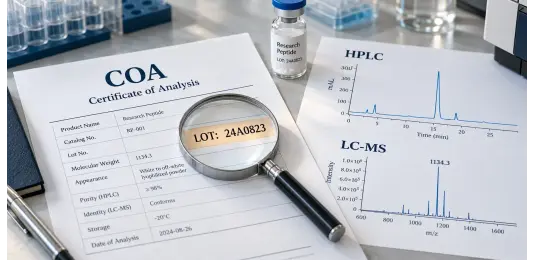
How to Read a Research Peptide COA: HPLC, LC-MS, Lot Numbers, and What Purity Does Not Prove
A Certificate of Analysis can help you evaluate a research peptide batch. Here is how to read the document without confusing a purity result with proof of safety, efficacy, or regulatory approval.
A Certificate of Analysis, usually called a COA, is one of the most useful documents to review when comparing research peptide suppliers.
It can show what material was tested, which batch was tested, what analytical methods were used, and whether the reported results met the stated specifications.
But a COA is not a safety certificate. It does not prove that a product is approved for human use, effective in people, or suitable for injection.
The most important skill is learning to read beyond the largest number on the page — usually a claim such as "99% purity."
Quick Answer
A useful research peptide COA should include:
- the exact product name and molecular form;
- a matching lot or batch number;
- test dates and report identification;
- analytical methods such as HPLC or LC-MS;
- reported results and acceptance criteria;
- the name of the testing laboratory or manufacturer;
- storage, retest, or expiration information when applicable.
HPLC commonly provides information about relative chromatographic purity. LC-MS can support molecular identity by comparing the observed mass with the expected mass.
Neither test, by itself, proves clinical safety, efficacy, sterility, or suitability for human use.
1. Start With Identity, Not the Purity Number
Before reading the purity result, confirm exactly what material the COA describes.
A peptide name may not tell the whole story. Different products can have related names but different molecular structures, sequences, modifications, fragments, salts, or conjugates.
The COA may need to identify details such as:
- full-length peptide or peptide fragment;
- acetylated or otherwise modified form;
- salt or counterion;
- conjugated or non-conjugated form;
- DAC or non-DAC version;
- free base or another molecular form.
This distinction matters because two products with similar names may not be analytically interchangeable.
For example, the term "TB-500" is often used in online discussions to describe a specific peptide fragment, while full-length thymosin beta-4 is a different molecule. The exact identity and molecular form should be clear on the documentation. Our article on TB-500 and thymosin beta-4 explains why this distinction matters.
A COA that only says "peptide" or uses a broad product nickname is difficult to evaluate. The document should identify the material specifically enough that a researcher can compare it with the vial label, product description, and expected molecular characteristics.
2. Match the COA to the Exact Lot
A COA is most useful when it is connected to the exact batch being reviewed.
Look for a lot number, batch number, or manufacturing code on both:
- the COA;
- the vial, container, or product label.
Those identifiers should match.
A product page may describe a general specification, but a lot-specific COA provides information about a particular production batch. Without a matching lot number, it becomes difficult to know whether the report actually applies to the material being purchased.
Also review:
- manufacturing date;
- testing date;
- release date;
- retest date or expiration date, if provided;
- storage conditions;
- report number or document identifier.
A document with no batch number, no testing date, or no clear connection to the product should be treated cautiously.
A QR code can make a document easier to access, but the code itself is not evidence of quality. The underlying report still needs to contain meaningful lot-specific information.
3. What HPLC Purity Actually Means
High-performance liquid chromatography, or HPLC, is one of the most common analytical techniques used to evaluate peptide purity.
In a typical reverse-phase HPLC method, components in a sample are separated as they move through a chromatography column. The resulting chromatogram shows peaks at different retention times.
The relative area of the main peak and other detected peaks can be used to estimate chromatographic purity.
This is where claims such as "99% HPLC purity" usually come from.
The number can be useful, but it needs context. A result such as "≥99% by HPLC" generally means that the material met a stated relative chromatographic purity specification under that particular method.
It does not automatically mean:
- 99% of the vial's total weight is the desired peptide;
- the peptide's identity has been fully confirmed;
- the material is sterile;
- endotoxins are absent;
- the material is safe for human use;
- the product will produce a particular biological effect.
When reviewing an HPLC result, look for:
- the HPLC mode, such as reverse-phase HPLC;
- the column or method description;
- detector information or wavelength;
- retention time;
- main peak and impurity peaks;
- the acceptance criterion;
- the actual reported result;
- a chromatogram or peak table when available.
A purity percentage without any method information is much less informative than a result supported by a defined analytical procedure.
For additional context, see the FDA guidance on analytical procedures and methods validation.
4. What LC-MS Adds
Liquid chromatography–mass spectrometry, or LC-MS, combines chromatographic separation with mass analysis.
The mass spectrometry portion measures the mass-to-charge characteristics of detected ions. Researchers can compare the observed molecular mass with the expected mass for the compound being tested.
This can provide useful support for identity.
For modified peptides, the expected mass should account for relevant modifications, terminal groups, conjugates, or counterions. The observed result may also be affected by ionization and adduct formation, which is why the interpretation should be made in the context of the stated method.
LC-MS is complementary to HPLC:
- HPLC helps separate and estimate relative chromatographic purity.
- Mass spectrometry helps assess whether the observed molecular mass is consistent with the expected compound.
A mass match is valuable, but it does not automatically prove that every part of a peptide sequence is correct. It also does not replace testing for sterility, endotoxins, residual solvents, or other quality attributes.
The strongest documentation makes clear which analytical question each test is intended to answer. The USP peptide standards resource describes the role of complementary analytical methods in peptide quality evaluation.
5. Look for the Rest of the Quality Picture
A COA may include additional results depending on the material, laboratory scope, and intended research application.
Appearance
This may describe the material as a lyophilized powder or solution and may report color, clarity, or visible particles.
Appearance is a basic observation. It cannot confirm identity or purity by itself.
Water Content
Water content may be measured using a method such as Karl Fischer analysis. This can be relevant for lyophilized materials because moisture may affect stability and measured composition.
Residual Solvents
If solvents were used during manufacturing or purification, a residual-solvent test may provide information about remaining solvent levels.
Assay or Content
An assay may address the amount of active material in a sample. This is conceptually different from chromatographic purity. A sample can have a high relative purity result while still requiring separate evaluation of total content or concentration.
Counterion or Salt Form
Some peptides are supplied with a counterion or in a specific salt form. If relevant, the COA should make the molecular form clear.
Microbial, Bioburden, Endotoxin, or Sterility Testing
These tests should be listed explicitly if performed. A high HPLC purity result does not establish sterility or the absence of endotoxins.
Not every COA needs to contain every possible test. The relevant question is whether the document clearly explains what was tested, how it was tested, and what the result means.
6. Read the Laboratory and the Method
The document header can be just as important as the result table.
Look for:
- laboratory or manufacturer name;
- testing location;
- report number;
- test method or method version;
- analyst or reviewer information;
- test and approval dates;
- laboratory credentials or accreditation, if provided;
- contact information for verification.
A third-party laboratory report may provide useful additional information, but the presence of a laboratory logo alone does not prove that the document is authentic or that the test covered every relevant quality attribute.
Likewise, a manufacturer-issued COA is not automatically meaningless. It can still be useful when it is specific to the lot, explains the analytical methods, and reports actual results against defined specifications.
The goal is transparency, not simply a particular document format.
7. What a COA Can and Cannot Prove
A COA can help answer:
- What material was tested?
- Which lot was tested?
- What methods were used?
- What results were reported?
- Did the sample meet the stated specifications?
A COA cannot answer:
- Will the material work in humans?
- Is it clinically safe?
- Is it approved by the FDA?
- What dose should a person use?
- Is it appropriate for injection?
- Is it sterile unless sterility testing is explicitly reported?
- Is the product stable beyond the stated storage or retest conditions?
- Does the result apply to a different lot?
The FDA distinguishes analytical questions such as identity, strength, quality, purity, and potency. These are related, but they are not interchangeable.
Similarly, a requirement for a valid COA in a specific pharmaceutical or compounding framework does not mean that every research product carrying a COA is an approved medicine. Documentation and regulatory approval are separate issues. The FDA's overview of bulk drug substances used in compounding under Section 503A is an example of a specific regulatory context, not blanket approval of research products.
8. Common COA Red Flags
A document deserves closer review when it contains one or more of the following:
- no lot or batch number;
- a lot number that does not match the product label;
- no test date;
- no analytical method;
- only a large "99% purity" claim;
- no identity testing;
- no distinction between related molecular forms;
- the same report reused for multiple batches;
- no actual result, only "passed";
- a "sterile" claim without a listed sterility method or specification;
- no laboratory or issuing organization identified;
- a report that appears generic or copied;
- a QR code with no accessible underlying data;
- product names that do not match across the label, product page, and COA.
One red flag does not automatically prove that a product is fraudulent. It does mean that the available documentation is not strong enough to support a confident evaluation without further clarification.
A Simple Research Peptide COA Checklist
| What to check | Stronger documentation | What it does not prove |
|---|---|---|
| Product identity | Exact name, form, modification, or fragment | Clinical suitability |
| Lot number | COA number matches the vial or container | Correct chain of custody after testing |
| HPLC | Method, result, acceptance criteria, and chromatogram or peak table | Sterility or human safety |
| LC-MS | Observed mass compared with expected mass | Complete biological characterization |
| Additional tests | Clearly identified water, solvents, assay, or microbiological results | That every possible impurity was tested |
| Laboratory | Identified issuer, dates, and report details | Independent regulatory approval |
| Storage information | Conditions and retest or expiration information when relevant | Stability outside those conditions |
| Intended use | Clear research-only positioning | Approval for human use |
How to Compare Two COAs
If two suppliers offer similar products, compare the documents rather than comparing only the purity percentage.
Ask:
- Does each COA identify the exact molecular form?
- Does the lot number match the material being offered?
- Are HPLC and LC-MS methods described?
- Are actual results reported?
- Are the acceptance criteria visible?
- Is the testing date clear?
- Are relevant additional tests included?
- Can the issuing laboratory or manufacturer be identified?
A document showing "99% purity" but no lot number or method provides less useful information than a document with a slightly different headline number but clear identity, testing procedures, and batch traceability.
Why COAs Matter for Research Materials
Research buyers often need to compare materials before starting an experiment. A well-prepared COA makes that evaluation more efficient because it puts analytical information next to the product rather than leaving the buyer to rely only on marketing language.
This is one part of a broader supplier review that can also include:
- product identity and labeling;
- research-only positioning;
- catalog organization;
- manufacturing and sourcing information;
- available documentation;
- shipping and fulfillment practices.
Our guide on how to choose a research peptide supplier covers those wider purchasing considerations.
FAQ
Is 99% HPLC purity enough?
No. It is one analytical result. It does not independently confirm identity, sterility, endotoxin status, clinical safety, or efficacy.
Should the lot number on the COA match the vial?
Yes. Matching identifiers help connect the reported test result to the specific batch being reviewed.
Does every peptide COA need LC-MS?
Not necessarily. The value of a COA depends on the material, analytical strategy, and documentation quality. If LC-MS is not included, the supplier should still explain how identity was evaluated.
Can a COA prove that a peptide is sterile?
Only if sterility testing is explicitly listed with a method and result. HPLC purity alone cannot establish sterility.
Does a COA mean that a peptide is FDA-approved?
No. A COA is an analytical document. It does not establish FDA approval or authorization for human use.
What should I do if the COA and product label use different names?
Pause and request clarification. The difference may reflect a fragment, salt, modification, or simple labeling error, but it should be resolved before the documents are treated as matching.
The Bottom Line
A good research peptide COA is specific, lot-linked, method-transparent, and realistic about what its results mean.
Start with identity. Confirm the lot number. Read the HPLC method instead of focusing only on the headline purity percentage. Use LC-MS as complementary identity information. Check whether additional tests are relevant and explicitly reported.
Most importantly, keep the scope clear: a COA helps document the quality characteristics of a tested research batch. It is not a shortcut around regulatory requirements, clinical evidence, or professional medical advice.
Related reading
- How to Choose a Research Peptide Supplier in 2026
- What Are Peptides? What They Actually Do
- TB-500 and Thymosin Beta-4: Why Identity Matters