CJC-1295 and Ipamorelin: Why Researchers Pair These Peptides
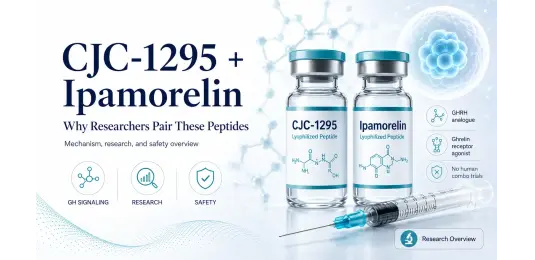
CJC-1295 and Ipamorelin: Why Researchers Pair These Peptides
Reading Time: 8 mins
This article is for general education only and does not replace medical advice from a licensed healthcare professional.
The Short Answer
CJC-1295 (a GHRH analogue) and Ipamorelin (a ghrelin-receptor agonist) hit two different receptors on the same pituitary cell. In theory, that can produce supra-additive GH release. The mechanism is plausible—but no human trial has ever tested it. Meanwhile, FDA documents flag deaths in an ipamorelin study and cardiovascular reactions for CJC-1295. The gap between the internet's promises and the evidence is vast.
How CJC-1295 and Ipamorelin Work
Growth hormone release isn't a single switch. The pituitary somatotroph responds to at least two strong stimulants: GHRH (growth hormone-releasing hormone), which triggers GH production and secretion, and ghrelin, the hunger hormone that pushes out ready-made GH through a separate receptor.
CJC-1295 is a synthetic, chemically modified analogue of GHRH. Two forms exist—and mixing them up is one of the most common errors in peptide discussions:
- CJC-1295 with DAC (Drug Affinity Complex): A long-acting version that binds circulating albumin. Its half-life stretches to roughly 6–8 days, producing sustained GH elevation.
- CJC-1295 without DAC (mod GRF 1-29): An acute-acting analogue with a half-life of about 30 minutes. It gives a sharp GH pulse, closer to the body's natural rhythm.
Ipamorelin is a pentapeptide that selectively binds the ghrelin receptor (GHS‑R1a). First characterised by Novo Nordisk (Raun et al., 1998), it triggers pituitary GH release without raising cortisol, prolactin, or ACTH in animal studies—and without the hunger spike of natural ghrelin. Early human pharmacokinetics (Gobburu et al., 1999) confirmed robust GH release in volunteers, with peak concentrations at 30–40 minutes post-injection.
CJC-1295 is a GHRH analogue; Ipamorelin is a GHRP (growth hormone-releasing peptide, via the ghrelin receptor). They knock on two different doors of the same cell.
Why Pair Them?
The CJC-1295/Ipamorelin combination targets both receptor pathways at once. Imagine the pituitary cell with two volume knobs—one for GHRH, one for ghrelin. Turn both up, and the GH output may be larger than the sum of each alone.
Somatostatin, the body's natural GH brake, adds a second layer. Ghrelin-receptor agonists partially oppose that brake, potentially amplifying GHRH-driven pulses. In theory, Ipamorelin provides an acute spike (peak ~30–40 minutes), while CJC-1295—especially the DAC form—maintains a background elevation that lasts for days. The result: smoother, higher average GH output.
This is a coherent story built on receptor pharmacology, animal data, and extrapolation. No human trial has tested it.
What the Human Data Actually Shows
Separate the peptides, and the evidence is thin. Combine them, and it's nonexistent.
For CJC-1295, one Phase 1 randomised, double-blind, placebo-controlled study (Teichman et al., 2006) found dose-dependent GH increases of 2‑ to 10‑fold and sustained IGF‑1 elevation for 9–11 days per DAC injection. The trial lasted at most 49 days, enrolled a small group, and wasn't designed to measure body composition or long-term safety. No efficacy trial followed.
Ipamorelin's human data are limited to a pharmacokinetic modelling study (Gobburu et al., 1999) and a Phase II trial for postoperative ileus that was discontinued without regulatory approval.
The combination: zero published human trials. There are no controlled data on muscle mass, fat loss, sleep, or safety—only anecdotes. Transformation photos can't prove causation.
Safety Signals and the Regulatory Record
Limited human exposure doesn't mean clean. It means poorly characterised—and sometimes alarming.
FDA advisory committee documents note "serious adverse events… including death when ipamorelin was administered intravenously," while also stating insufficient safety data for other injectable routes. For CJC-1295, the FDA cited increased heart rate, systemic vasodilatory reaction (flushing, headache, sudden blood-pressure drops), and immunogenicity.
Both peptides were removed from the FDA's Category 2 list in 2024 after nominators withdrew, but that didn't make them compoundable. As of August 2026, the FDA's Pharmacy Compounding Advisory Committee voted against including them on the 503A Bulks List, and they have not been added to Category 1. Neither has ever held an FDA-approved new drug application.
Beyond the peptide-specific red flags, raising GH for extended periods carries the well-documented risks of GH therapy: fluid retention, joint and muscle pain, carpal tunnel symptoms, and a possible push toward insulin resistance. Long-term cancer and cardiovascular risks from sustained GH elevation remain unstudied. Chest pain, severe shortness of breath, significant swelling, new or worsening numbness, or signs of severe high blood sugar require urgent medical attention.
Compounding the problem, peptides sold as "research chemicals" aren't made to pharmaceutical standards. Purity, sterility, and dosing aren't independently verified. Many products are explicitly labelled "for laboratory research use only"—as you'd see on a research peptide supplier's website listing CJC‑1295 DAC and Ipamorelin. The gap between that label and the human dosing schemes circulating online is a glaring red flag.
Ipamorelin vs Sermorelin
The regulatory contrast reveals the distance between these peptides and anything with actual human safety data.
| Feature | Ipamorelin | Sermorelin | |---|---|---| | Class | GHRP (ghrelin receptor agonist / GHS‑R1a) | GHRH analogue (1–29 amino acid fragment) | | Receptor | Ghrelin receptor (GHS‑R1a) | GHRH receptor | | Selectivity | High; minimal rise in cortisol, prolactin, or ACTH in animal models | Broader pituitary effects possible | | Half‑life | ~2 hours | ~11–12 minutes | | Dosing frequency (unofficial) | Once to twice daily | Daily, sometimes multiple times | | FDA status | Not FDA‑approved | Previously FDA‑approved (Geref, discontinued) | | Appetite effect | Minimal, based on animal selectivity data | Not strongly associated |
Sermorelin's prior approval gave it a human safety record Ipamorelin lacks, but it's no longer available. Meanwhile, tesamorelin (Egrifta) is the only FDA‑approved GHRH analogue on the market—approved exclusively for reducing visceral fat in HIV‑associated lipodystrophy. It proves a GHRH analogue can pass regulatory hurdles, but only for a narrow indication under tight medical supervision.
Unofficial Protocols: A Warning, Not a Recipe
No dose, schedule, or cycle length for CJC-1295 and Ipamorelin has ever been validated in a clinical trial—individually or together. The numbers that circulate online are not evidence‑based. None come from an FDA‑reviewed study with safety monitoring. Anyone considering any GH‑related intervention should consult a physician who can discuss approved alternatives and weigh known risks against the total lack of proven benefit for unapproved peptides.
What the Internet Gets Wrong
- "They're FDA‑approved." False. Neither peptide has ever received FDA approval or a compounding pathway.
- "The combo has been proven in human studies." No human trial has tested CJC-1295 with Ipamorelin. The synergy is a hypothesis, not a clinical fact.
- "It's natural because it stimulates your own GH." Both are chemically modified. CJC-1295 has four amino acid substitutions; Ipamorelin contains non‑natural amino acids. They are synthetic substances.
- "All CJC-1295 is the same." The DAC and no-DAC forms behave like different drugs. The 8‑day half-life versus the 30‑minute half-life creates vastly different exposure profiles and risks.
- "Selective GH release means no side effects." Selectivity refers to stress-hormone pathways. It doesn't protect against fluid retention, joint pain, insulin resistance—or the documented deaths and cardiovascular reactions flagged by the FDA.
- "It's legal for athletes because it's not a steroid." Both are explicitly banned by WADA (2026 Prohibited List, S2 category) in and out of competition.
- "If a wellness clinic offers it, it's regulated and safe." Clinic use doesn't equal regulatory approval. Compounding these peptides for human use is not legally permitted.
A Hypothesis Without Proof
Pairing CJC-1295 and Ipamorelin has genuine receptor biology behind it. The problem isn't the idea—it's the enormous distance between a clever mechanism and the complete absence of human combination data, backed by a regulatory reality that runs counter to the hype. What's on the table isn't a therapy; it's an untested hypothesis linked to compounds with troubling safety signals.
Frequently Asked Questions
Is CJC-1295/Ipamorelin FDA approved? No. Neither peptide has ever received FDA approval or a legal compounding pathway.
What are common ipamorelin side effects? From limited data, facial flushing and headache. More seriously, FDA documents note deaths in an intravenous ipamorelin study (causality unclear) and reports of hypokalemia and hyperglycemia. Known GH‑therapy risks—fluid retention, joint pain, insulin resistance—remain possible but poorly studied.
What is the standard ipamorelin dosage? There is no standard. No dose has been established in a clinical trial. Online figures are not evidence‑based.
Why do bodybuilders use Ipamorelin and CJC-1295? They hope to raise GH and IGF‑1 for muscle growth, fat loss, and recovery. All such uses are off‑label and unapproved, and any perceived benefit comes from anecdote, not controlled trials.
How does Ipamorelin differ from Sermorelin? Ipamorelin acts on the ghrelin receptor; Sermorelin acts on the GHRH receptor. Sermorelin was once FDA‑approved (now discontinued), giving it a larger human safety record. Ipamorelin shows higher selectivity for GH in animal models but has never been approved.
What does the research actually say about the CJC-1295/Ipamorelin stack? No published human studies test the two together. The proposed synergy rests on receptor pharmacology and animal data—not clinical proof of body-composition changes or long‑term human safety.
Can I buy CJC-1295 and Ipamorelin legally? Many online vendors sell them as "research chemicals" not intended for human use. Purchasing them this way is legally distinct from obtaining an FDA‑approved medication, and compounding for human use is not permitted. Importation or sale for human consumption violates federal regulations.
Is it safe for athletes to use these peptides? Beyond health unknowns, both substances are prohibited by WADA at all times. Athletes subject to testing risk sanctions, disqualification, and loss of eligibility.