Tesamorelin Peptide: What the Research Shows (2026)
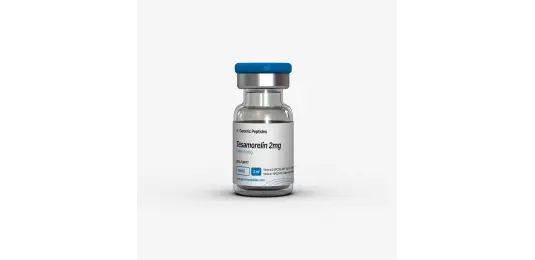
Tesamorelin Peptide: What the Research Shows (2026)
By Medical Team of Generic Peptides
Quick answer. Tesamorelin is a synthetic 44-amino-acid analog of growth hormone–releasing hormone (GHRH). A small chemical modification at its N-terminus makes it resistant to the enzyme that normally degrades GHRH within minutes, so it stimulates the pituitary for longer than the native hormone. It is one of the few GHRH analogs with a large clinical trial record: two Phase III studies in adults with HIV-associated lipodystrophy and a 12-month trial in HIV-associated fatty liver disease. In the United States it is an FDA-approved prescription product for one specific indication; the research-grade peptide sold for laboratory use is a different, non-pharmaceutical material.
This article summarizes what tesamorelin is, how it works, what the published studies measured, where it stands with regulators in 2026, and what a researcher should look for on a certificate of analysis.
What Tesamorelin Is
Native human GHRH is a 44-residue peptide released by the hypothalamus. Its biologically active region is the first 29 amino acids, which is why many research GHRH analogs, such as sermorelin and MOD GRF 1-29, are 29-residue fragments.
Tesamorelin keeps the full 44-residue sequence of human GHRH (1-44) and adds a trans-3-hexenoic acid group to the N-terminal tyrosine. That single modification is the point of the molecule. Native GHRH is cleaved between residues 2 and 3 by dipeptidyl peptidase-4 (DPP-4) and has a plasma half-life measured in minutes. The hexenoyl group blocks that cleavage site while preserving binding to the GHRH receptor. The original Egrifta label reported a half-life of about 26 minutes in healthy adults and 38 minutes in adults with HIV; the labels for the current formulations give shorter values, about 8 minutes (Egrifta SV) and 11 minutes (Egrifta WR) in healthy subjects. Tesamorelin therefore remains a short-acting peptide.
Molecular weight is about 5,136 Da. The peptide was developed by ConjuChem and later commercialized by Theratechnologies under the brand name Egrifta.
Mechanism of Action
Tesamorelin binds the GHRH receptor on somatotroph cells in the anterior pituitary. Receptor activation raises intracellular cyclic AMP, which triggers synthesis and pulsatile release of endogenous growth hormone (GH). GH in turn stimulates hepatic production of insulin-like growth factor 1 (IGF-1).
Two features of this mechanism matter for interpreting the research:
- It works through the pituitary, not around it. Unlike recombinant GH (somatropin), which delivers exogenous hormone directly, a GHRH analog depends on functional somatotrophs and remains subject to negative feedback from IGF-1 and somatostatin. In clinical studies this produced GH pulses within the physiological pattern rather than a sustained elevation.
- The downstream effects are GH/IGF-1 effects. Changes in visceral fat, liver fat, and lipids reported in tesamorelin trials are interpreted as consequences of restored GH signaling, which is why the trial populations were adults with documented GH-axis disturbance.
What the Research Shows
The clinical literature on tesamorelin is unusually deep for a GHRH analog. The table below summarizes the main studies by model and primary outcome.
| Study | Model | What was measured | Key finding |
|---|---|---|---|
| Falutz et al., 2007, NEJM [1] | Clinical, Phase III, 412 adults with HIV lipodystrophy, 26 weeks | Visceral adipose tissue (VAT) by CT | VAT decreased ~15% vs. placebo; IGF-1 rose; trunk fat and waist circumference fell |
| Falutz et al., 2010, JCEM [2] | Pooled analysis of two Phase III trials, 816 adults, 52 weeks | VAT, lipids, safety | VAT reduction sustained through 52 weeks in continued treatment; VAT returned toward baseline after discontinuation |
| Stanley et al., 2014, JAMA [3] | Clinical, 50 adults with HIV and abdominal fat, 6 months | VAT and hepatic fat (MR spectroscopy) | VAT reduction accompanied by lower liver fat in responders |
| Stanley et al., 2019, Lancet HIV [4] | Clinical, 61 adults with HIV and hepatic steatosis, 12 months | Hepatic fat fraction, fibrosis markers | Hepatic fat fraction fell by an absolute 4.1% (≈37% relative reduction) vs. no change on placebo; fewer participants progressed in fibrosis score |
| Fourman et al., 2020, JCI Insight [5] | Clinical substudy with liver biopsy and transcriptomics | Hepatic gene expression | Treatment associated with down-regulation of lipogenic and inflammatory gene sets in liver tissue |
| Preclinical pharmacology (label summary) [6] | In vitro and animal | Receptor binding, GH release, PK | Hexenoyl modification confers DPP-4 resistance; GH response preserved |
A few points stand out when reading these studies together.
The effects were specific to visceral and hepatic fat. Subcutaneous fat and total body weight changed little. This matches the GH/IGF-1 mechanism, which preferentially mobilizes visceral lipid stores, and it is why the data should not be generalized to "fat loss" in a broad sense.
The effects were reversible. In the pooled Phase III data, participants who switched from tesamorelin to placebo after 26 weeks saw visceral fat return toward baseline by week 52 [2]. The research describes an ongoing physiological effect, not a lasting change.
All human data come from one population. Every randomized trial enrolled adults with HIV infection and lipodystrophy or steatosis. A Phase II trial in non-HIV fatty liver disease (NCT03375788) has been registered [7], but published results in other populations remain limited. Claims that extend tesamorelin findings to healthy adults, athletes, or general aging go beyond the evidence.
Safety findings in the trials
Across the Phase III program, the most frequently reported adverse events versus placebo were joint pain, injection-site reactions, peripheral edema, and muscle pain [1, 2]. Because the mechanism raises IGF-1, trials monitored IGF-1 and glucose metabolism; small increases in fasting glucose and HbA1c were observed in some participants [2, 6]. These are observations from the clinical record, reported here for completeness, not guidance of any kind.
Regulatory Status in 2026
Tesamorelin's regulatory position is distinct from most research peptides, and it is worth stating precisely.
- FDA-approved prescription drug. Egrifta (tesamorelin for injection) was approved by the FDA on November 10, 2010, for the reduction of excess abdominal fat in HIV-infected adults with lipodystrophy [6]. It is not approved for any other indication, including weight loss.
- Newer formulations. A more concentrated formulation, Egrifta SV, was approved in 2018, and a further formulation, Egrifta WR, received FDA approval in March 2025 and became commercially available later that year [8, 9].
- Compounding. Tesamorelin was not among the peptides placed in Category 2 of the FDA's bulk drug substances evaluation in September 2023, and it was not part of the July 2026 Pharmacy Compounding Advisory Committee (PCAC) review that covered BPC-157, TB-500, and others. Its status therefore differs from GHRH analogs such as MOD GRF 1-29 and CJC-1295 DAC, which received unfavorable PCAC votes in December 2024.
- Sport. The World Anti-Doping Agency lists GHRH analogs, including tesamorelin, under class S2 of the Prohibited List [10].
For researchers, the practical implication is simple: the pharmaceutical product and the research-grade peptide are different materials with different legal frameworks. Research-grade tesamorelin is supplied for laboratory use only and is not a substitute for, or an alternative to, the approved drug.
Tesamorelin vs. Sermorelin vs. MOD GRF 1-29
These three GHRH analogs are often confused. The differences are structural and pharmacokinetic.
| Tesamorelin | Sermorelin | MOD GRF 1-29 | |
|---|---|---|---|
| Sequence | GHRH (1-44) | GHRH (1-29) | GHRH (1-29) with 4 substitutions |
| Key modification | N-terminal trans-3-hexenoyl group | None | D-Ala2, Gln8, Ala15, Leu27 |
| DPP-4 resistance | Yes (blocked cleavage site) | No | Yes (D-Ala at position 2) |
| Approximate half-life | ~8–11 min (current labels); 26–38 min (original formulation) | ~6–7 min (Geref label) | Limited published PK |
| Human clinical trial record | Two Phase III + Phase II liver studies | Approved 1997, withdrawn from market 2008; smaller trials | No independent human trials |
| 2026 US status | FDA-approved drug (specific indication) | Previously approved, discontinued | Research only; unfavorable PCAC vote 2024 |
Sermorelin is the unmodified 29-residue fragment and the oldest of the three. MOD GRF 1-29 achieves enzyme resistance through amino-acid substitutions rather than an N-terminal cap. Tesamorelin is the only one with a current pharmaceutical approval and the largest body of controlled human data. For a fuller comparison of the 29-residue analogs, see the sermorelin research guide and the CJC-1295 DAC explainer.
Reading a Tesamorelin Certificate of Analysis
Because tesamorelin is a 44-residue peptide with a non-standard N-terminal modification, its COA deserves closer attention than that of a short, unmodified peptide.
- Mass spectrometry. The observed molecular weight should match the hexenoylated sequence (≈5,136 Da), not unmodified GHRH (1-44) (≈5,040 Da). A ~96 Da deficit would indicate the modification is missing, which would remove the DPP-4 resistance that defines the molecule.
- HPLC purity. Long peptides accumulate more deletion and truncation impurities during synthesis. A chromatogram showing a single dominant peak with the method conditions listed is the minimum; purity of 98% or higher is typical for research-grade material from a well-run synthesis.
- Net peptide content. A 44-residue sequence has multiple basic residues that bind trifluoroacetate counter-ions after purification. The gross vial weight can overstate peptide content by 10–30%, so look for net peptide content or separate water and TFA figures.
- Lot traceability. Lot number, date of analysis, and storage conditions should be printed on the certificate and match the vial.
Generic Peptides posts a lot-specific COA for each batch of research-grade tesamorelin so these values can be checked before ordering. Our general guide to reading a research peptide COA covers each test in more depth.
Open Questions in the Research
- Non-HIV populations. Whether the visceral- and hepatic-fat findings reproduce in adults without HIV is the subject of ongoing work; published controlled data are still limited.
- Durability. All trials showed reversal after discontinuation. Long-term outcome data (cardiovascular events, liver histology over years) are not available.
- Mechanistic specificity. Transcriptomic work suggests effects on hepatic lipogenesis and inflammation pathways, but the relative contributions of GH versus IGF-1 signaling remain under study.
FAQ
Is tesamorelin the same as sermorelin?
No. Both are GHRH analogs, but tesamorelin is the full 44-residue sequence with an N-terminal hexenoyl modification that confers DPP-4 resistance; sermorelin is the unmodified 29-residue fragment. Both are short-acting in plasma.
What was tesamorelin studied for?
The randomized trials studied reduction of visceral abdominal fat and, later, liver fat in adults with HIV-associated lipodystrophy. These are the only populations with controlled human data.
Is tesamorelin FDA-approved?
Yes, as a prescription product (Egrifta) for a single indication: excess abdominal fat in HIV-infected adults with lipodystrophy. Research-grade tesamorelin is a separate, non-pharmaceutical material supplied for laboratory use only.
Why does the molecular weight on a COA matter for tesamorelin?
The N-terminal modification adds about 96 Da. If mass spectrometry shows the unmodified mass, the sample lacks the feature that distinguishes tesamorelin from native GHRH.
Does tesamorelin research apply to weight loss in general?
No. The trials measured visceral and hepatic fat in a specific clinical population; total body weight changed little, and effects reversed after discontinuation.
For research use only. Not for human consumption. This content is for informational purposes and is not medical advice.
References
[1] Falutz J, Allas S, Blot K, et al. Metabolic effects of a growth hormone–releasing factor in patients with HIV. N Engl J Med. 2007;357(23):2359–2370. PMID 18057338.
[2] Falutz J, Mamputu JC, Potvin D, et al. Effects of tesamorelin (TH9507), a growth hormone–releasing factor analog, in HIV-infected patients with excess abdominal fat: a pooled analysis of two multicenter, double-blind placebo-controlled phase 3 trials with safety extension data. J Clin Endocrinol Metab. 2010;95(9):4291–4304. PMID 20554713.
[3] Stanley TL, Feldpausch MN, Oh J, et al. Effect of tesamorelin on visceral fat and liver fat in HIV-infected patients with abdominal fat accumulation: a randomized clinical trial. JAMA. 2014;312(4):380–389. PMID 25038357.
[4] Stanley TL, Fourman LT, Feldpausch MN, et al. Effects of tesamorelin on non-alcoholic fatty liver disease in HIV: a randomised, double-blind, multicentre trial. Lancet HIV. 2019;6(12):e821–e830. PMID 31611038.
[5] Fourman LT, Billingsley JM, Agyapong G, et al. Effects of tesamorelin on hepatic transcriptomic signatures in HIV-associated NAFLD. JCI Insight. 2020;5(16):e140134. PMC7455119.
[6] U.S. Food and Drug Administration. EGRIFTA (tesamorelin for injection) prescribing information, NDA 022505. Approved November 10, 2010.
[7] ClinicalTrials.gov. Tesamorelin effects on liver fat and histology in HIV (and non-HIV NAFLD). NCT03375788.
[8] Theratechnologies. Press release: FDA approves EGRIFTA WR. March 25, 2025.
[9] Theratechnologies. Press release: Commercial availability of EGRIFTA WR in the United States. September 2025.
[10] World Anti-Doping Agency. The Prohibited List 2026, Section S2: Peptide hormones, growth factors, related substances and mimetics.