CJC-1295 No DAC: Short-Acting GHRH Analog After the 2024 PCAC Vote
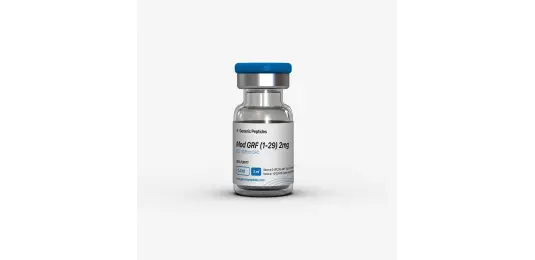
MOD GRF 1-29 (CJC-1295 No DAC): Complete Research Guide
By Medical Team of Generic Peptides
Quick answer. MOD GRF 1-29, also sold as CJC-1295 without DAC, is a 29-amino-acid analog of the active fragment of growth hormone–releasing hormone (GHRH). Four amino-acid substitutions protect it from the enzymes that destroy native GHRH within minutes; its half-life in humans has not been reported in peer-reviewed studies [12]. It is the same peptide backbone as CJC-1295 DAC but without the albumin-binding "Drug Affinity Complex" that extends the DAC version to about a week. Like sermorelin and tesamorelin, it works by stimulating the pituitary's own growth hormone release rather than supplying hormone directly. There are no published clinical trials of MOD GRF 1-29 itself; the human data come from the DAC version and from sermorelin. In December 2024 an FDA advisory committee voted against adding CJC-1295 in any form to the compounding bulks list, so MOD GRF 1-29 remains a research-use-only compound in the US.
This guide explains the molecule and its naming, the mechanism, what the related studies show, the 2026 regulatory picture, and what to check on a MOD GRF 1-29 certificate of analysis.
What MOD GRF 1-29 Is
Native human GHRH is 44 residues long, but its first 29 residues carry full receptor activity. That fragment, GHRH(1-29)-NH2, is sermorelin. Sermorelin's weakness is stability: dipeptidyl peptidase-4 (DPP-4) cleaves it between residues 2 and 3 within minutes of entering plasma [1], and other sites are prone to oxidation and deamidation.
In the 1980s and 1990s, peptide chemists at several groups systematically substituted residues in GHRH(1-29) to fix these weaknesses [2–4]. Four changes proved most useful and are combined in the "tetrasubstituted" analog that the research market calls MOD GRF 1-29:
| Position | Native residue | Substitution | Purpose |
|---|---|---|---|
| 2 | Ala | D-Ala | Blocks DPP-4 cleavage at the Ala2–Asp3 bond |
| 8 | Asn | Gln | Prevents deamidation of asparagine |
| 15 | Gly | Ala | Stabilizes the α-helix, improving receptor affinity |
| 27 | Met | Leu | Removes the methionine that oxidizes during storage |
The result is a 29-residue amidated peptide of about 3,368 Da, with the sequence Tyr-D-Ala-Asp-Ala-Ile-Phe-Thr-Gln-Ser-Tyr-Arg-Lys-Val-Leu-Ala-Gln-Leu-Ser-Ala-Arg-Lys-Leu-Leu-Gln-Asp-Ile-Leu-Ser-Arg-NH2.
Why it is called "CJC-1295 no DAC"
ConjuChem (Montreal) took this same tetrasubstituted peptide and attached a maleimidoproprionic acid linker (the Drug Affinity Complex, DAC) at a 30th lysine residue. In circulation the DAC reacts with albumin, tethering the peptide to a long-lived carrier and extending its half-life to roughly 6–8 days [5]. That conjugate is CJC-1295 (with DAC). The bare peptide without the linker was informally named "CJC-1295 without DAC," and later "Modified GRF (1-29)" or MOD GRF 1-29 in the research market. The two names describe the same molecule.
Mechanism of Action
MOD GRF 1-29 binds the GHRH receptor on pituitary somatotrophs. Receptor activation raises cyclic AMP and triggers synthesis and release of growth hormone (GH), which in turn drives hepatic production of IGF-1. Because the peptide acts upstream of the pituitary, GH release remains pulsatile and subject to negative feedback from IGF-1 and somatostatin.
Three features follow from the pharmacology:
- Short, pulsatile action. Without the albumin-binding linker, MOD GRF 1-29 is expected to be cleared far faster than the DAC conjugate and to produce a brief GH pulse rather than the sustained GH and IGF-1 elevation seen with CJC-1295 DAC [5, 6]. Its human pharmacokinetics have not been published [12].
- Dependence on an intact pituitary. As with every GHRH analog, the response requires functional somatotrophs; it is absent in GHRH-receptor-deficient models.
- Synergy with GHRPs. GHRH-receptor agonists and ghrelin-receptor agonists (ipamorelin, GHRP-2, GHRP-6) act on different receptors and release GH through additive-to-synergistic pathways in human pharmacology studies of the parent compounds [7]. This is the rationale behind the many "CJC/ipamorelin" blends on the research market, including our Duo-Blend.
What the Research Shows
There are no published controlled studies of MOD GRF 1-29 as a standalone compound. The evidence base consists of structure–activity work on GHRH analogs, the clinical program for CJC-1295 DAC (which contains the same peptide), and the sermorelin literature.
| Study | Model | What was measured | Key finding |
|---|---|---|---|
| Frohman et al., 1989, J Clin Invest [1] | In vitro and human plasma | Enzymatic degradation of GHRH | DPP-4 cleaves GHRH at Ala2–Asp3; explains the short half-life and the rationale for D-Ala2 |
| Lance et al., 1984, Biochem Biophys Res Commun [2] | In vitro (rat pituitary cells) and animal | GH release by substituted GRF(1-29) analogs | D-Ala2 and other substitutions produced analogs with several-fold higher potency than native GRF(1-29) |
| Campbell et al., 1991, Peptides [3] | In vitro | Receptor binding and GH release of GRF analogs and fragments | Correlated helix-stabilizing substitutions (e.g., Ala15) with binding and activity |
| Teichman et al., 2006, JCEM [5] | Clinical, Phase I/II, healthy adults, CJC-1295 with DAC | GH and IGF-1 over days to weeks | Single doses raised GH 2–10-fold for ≥6 days and IGF-1 1.5–3-fold for 9–11 days; half-life 5.8–8.1 days |
| Ionescu & Frohman, 2006, JCEM [6] | Clinical, healthy adults, CJC-1295 with DAC | GH pulsatility by frequent sampling | GH secretion remained pulsatile during continuous GHRH-receptor stimulation |
| Walker, 2006, Clin Interv Aging [8] | Review (sermorelin) | Clinical use of GHRH(1-29) | Summarizes sermorelin's approval history and physiology; short half-life limits its action |
What this means in practice:
The half-life difference is the whole story. The DAC trials show what the peptide does at the receptor; the DAC is why the effect lasts a week. Without it, MOD GRF 1-29 is best understood as an enzyme-stabilized sermorelin: a short-acting GHRH signal whose human pharmacokinetics have never been measured in a published study [12].
No efficacy endpoints for MOD GRF 1-29 exist. Claims about body composition, recovery, or sleep in people are extrapolated from GH physiology or from other molecules. Where a study is cited for MOD GRF 1-29, it is almost always the Teichman DAC trial.
Safety observations are inherited. The published CJC-1295 DAC studies in healthy adults reported no serious adverse reactions [5]. CJC-1295 DAC development ended after a participant died during a 2006 Phase II study in HIV-associated visceral obesity; the cause and any link to the drug were not established in public reports [13]. In its 2024 review of all CJC-1295 forms, the FDA's main stated concern was immunogenicity, and animal studies it reviewed showed dose-dependent injection-site irritation [9, 10].
Regulatory Status in 2026
The FDA treats CJC-1295 with and without DAC as one substance family.
- Before September 2024. CJC-1295 was listed in Category 2 of the FDA's interim policy for 503A bulk drug substances, the group of substances that may present significant safety risks [10].
- September 2024. Removed from Category 2 (effective September 27, 2024) after the nominators withdrew their nomination, and referred to the advisory committee [14].
- December 4, 2024. The Pharmacy Compounding Advisory Committee reviewed CJC-1295 free base, acetate, and DAC forms (alongside ipamorelin, AOD-9604, and others) and voted against placing any form on the 503A Bulks List: 0–13 for CJC-1295 free base and each DAC form, 1–12 for CJC-1295 acetate [9].
- 2026. CJC-1295 was not among the peptides re-examined at the July 2026 PCAC meeting. Its status is unchanged: no lawful compounding pathway in the US.
- Sport. GHRH analogs, including CJC-1295 in both forms, are prohibited at all times under WADA section S2.2.4, which names CJC-1295 [11].
For researchers, MOD GRF 1-29 is a research-use-only reagent. Its position differs from tesamorelin, which is an approved drug, and from sermorelin, which was approved and later withdrawn for commercial reasons.
MOD GRF 1-29 vs. CJC-1295 DAC vs. Sermorelin
| Sermorelin | MOD GRF 1-29 | CJC-1295 DAC | |
|---|---|---|---|
| Sequence | GHRH(1-29)-NH2 | GHRH(1-29)-NH2 with 4 substitutions | Same as MOD GRF + Lys30-DAC linker |
| Molecular weight | ~3,358 Da | ~3,368 Da | ~3,647 Da |
| DPP-4 resistance | No | Yes | Yes |
| Half-life in humans | Minutes (rapid DPP-IV cleavage) [1] | Not reported in human studies [12] | 5.8–8.1 days [5] |
| GH release pattern | Single short pulse | Single, larger pulse | Sustained elevation with preserved pulsatility |
| Human clinical data | Yes (approved 1997, withdrawn 2008) | None as a standalone compound | Phase I/II (Teichman 2006) |
| 2026 US status | Previously approved; discontinued | Research only; PCAC vote against (2024) | Research only; PCAC vote against (2024) |
For a side-by-side comparison of the two forms — structure, half-life, human data and how to tell them apart on a COA — see CJC-1295 DAC vs No DAC. Our CJC-1295 DAC explainer covers the conjugate in more detail; the sermorelin guide covers the unmodified fragment.
Reading a MOD GRF 1-29 Certificate of Analysis
The four substitutions are what distinguish MOD GRF 1-29 from sermorelin, and a COA should prove they are present.
- Mass spectrometry. The expected mass is ≈3,368 Da. Sermorelin is ≈3,358 Da, a difference of only ~10 Da, so the certificate should state the resolution of the instrument and ideally confirm sequence by MS/MS or amino-acid analysis. A mass near 3,647 Da would indicate the DAC conjugate, a different product.
- Chirality. D-Ala at position 2 is not visible in mass alone. A supplier confirming the tetrasubstituted sequence should be able to state the source of the D-alanine building block or provide chiral amino-acid analysis.
- HPLC purity. A 29-residue synthesis accumulates deletion sequences; a chromatogram with method conditions and purity of 98% or higher is typical for research grade. Oxidation is less of a concern than for sermorelin because Met27 has been replaced.
- Net peptide content. The sequence carries several basic residues (Arg, Lys) that bind TFA counter-ions; the certificate should give net peptide content or water and TFA values.
- Lot traceability. Lot number, analysis date, and storage conditions must match the vial.
Generic Peptides publishes a lot-specific COA for research-grade MOD GRF 1-29. For a general walkthrough, see how to read a research peptide COA.
Open Questions in the Research
- Standalone pharmacokinetics. The ~30-minute half-life is inferred from structure and from analog studies; a published human PK study of the unconjugated peptide does not exist.
- Comparative potency vs. sermorelin. In vitro data suggest several-fold higher receptor potency; head-to-head in vivo data are limited to older animal work.
- Long-term GH-axis stimulation. As with all GHRH analogs, the consequences of chronic pulsatile GH elevation on IGF-1-sensitive tissues have not been studied for this molecule.
FAQ
Is MOD GRF 1-29 the same as CJC-1295?
It is the same 29-residue peptide as CJC-1295 without the DAC linker. "CJC-1295 DAC" adds an albumin-binding group that extends the half-life in humans to about a week. "CJC-1295 no DAC" and "MOD GRF 1-29" are two names for the unconjugated peptide.
How does MOD GRF 1-29 differ from sermorelin?
Both are GHRH(1-29) amides. MOD GRF 1-29 has four amino-acid substitutions (D-Ala2, Gln8, Ala15, Leu27) that block enzymatic degradation and oxidation, giving it greater stability and potency in cell and animal studies.
Has MOD GRF 1-29 been tested in humans?
Not as a standalone compound. Human data exist for CJC-1295 with DAC (which contains the same peptide) and for sermorelin.
What did the FDA decide about CJC-1295?
On December 4, 2024, the FDA's Pharmacy Compounding Advisory Committee voted against adding CJC-1295 in any form, including the no-DAC peptide, to the 503A compounding list. It was not reconsidered in 2026 and remains research-use-only.
How can a COA distinguish MOD GRF 1-29 from sermorelin?
The masses differ by only ~10 Da, so look for a high-resolution mass spectrum, sequence confirmation, and a statement of the four substitutions. Purity and lot data alone cannot tell the two apart.
References
For research use only. Not for human consumption. This content is for informational purposes and is not medical advice.
[1] Frohman LA, Downs TR, Heimer EP, Felix AM. Dipeptidylpeptidase IV and trypsin-like enzymatic degradation of human growth hormone-releasing hormone in plasma. J Clin Invest. 1989;83(5):1533–1540. PMID 2565342.
[2] Lance VA, Murphy WA, Sueiras-Diaz J, Coy DH. Super-active analogs of growth hormone-releasing factor (1-29)-amide. Biochem Biophys Res Commun. 1984;119(1):265–272. PMID 6231028.
[3] Campbell RM, Lee Y, Rivier J, Heimer EP, Felix AM, Mowles TF. GRF analogs and fragments: correlation between receptor binding, activity and structure. Peptides. 1991;12(3):569–574. PMID 1656403.
[4] Felix AM, Heimer EP, Mowles TF, et al. Synthesis and biological activity of novel growth hormone releasing factor analogs. In: Marshall GR, ed. Peptides: Chemistry and Biology (Proceedings of the 10th American Peptide Symposium). ESCOM; 1988:465–467.
[5] Teichman SL, Neale A, Lawrence B, Gagnon C, Castaigne JP, Frohman LA. Prolonged stimulation of growth hormone (GH) and insulin-like growth factor I secretion by CJC-1295, a long-acting analog of GH-releasing hormone, in healthy adults. J Clin Endocrinol Metab. 2006;91(3):799–805. PMID 16352683.
[6] Ionescu M, Frohman LA. Pulsatile secretion of growth hormone (GH) persists during continuous stimulation by CJC-1295, a long-acting GH-releasing hormone analog. J Clin Endocrinol Metab. 2006;91(12):4792–4797. PMID 17018654.
[7] Bowers CY, Reynolds GA, Durham D, Barrera CM, Pezzoli SS, Thorner MO. Growth hormone (GH)-releasing peptide stimulates GH release in normal men and acts synergistically with GH-releasing hormone. J Clin Endocrinol Metab. 1990;70(4):975–982. PMID 2108187.
[8] Walker RF. Sermorelin: a better approach to management of adult-onset growth hormone insufficiency? Clin Interv Aging. 2006;1(4):307–308. PMID 18046908.
[9] U.S. Food and Drug Administration. Pharmacy Compounding Advisory Committee meeting, December 4, 2024: briefing document and final summary minutes (CJC-1295 free base, acetate, DAC forms).
[10] U.S. Food and Drug Administration. Certain bulk drug substances for use in compounding that may present significant safety risks. fda.gov. Content current as of April 22, 2026.
[11] World Anti-Doping Agency. The 2026 Prohibited List: S2.2.4 Growth hormone-releasing factors.
[12] Dominikowski A, Rękoś Z, Olejarz M, et al. The emerging landscape of performance-enhancing peptides modulating GH-IGF1 axis: bridging the gap between clinical evidence and patient self-administration. Front Endocrinol (Lausanne). 2026;17:1822475. PMID 42395176.
[13] Bernard EJ. Lipodystrophy study halted after patient death. aidsmap. July 31, 2006; ClinicalTrials.gov NCT00267527 (terminated).
[14] Reed Smith. FDA removes certain peptide bulk drug substances from Category 2 of interim 503A bulks list and sets dates for PCAC review. Mondaq. October 4, 2024.
Related reading
- CJC-1295 DAC vs No DAC: Half-Life and Research
- CJC-1295 DAC: Long-Acting GHRH Analog After Halted Development
- Sermorelin (GHRH 1-29): FDA 503A Status and Compounding Access
- Tesamorelin: What the Research Shows
- CJC-1295 and Ipamorelin: Why Researchers Pair These Peptides
- How to Read a Research Peptide COA