CJC-1295 and Ipamorelin: What the Research Shows
CJC-1295 and Ipamorelin: What the Research Shows
By Medical Team of Generic Peptides
Quick answer. CJC-1295 and ipamorelin are two different peptides that raise growth hormone (GH) through two different receptors. CJC-1295 is a growth hormone–releasing hormone (GHRH) analog; ipamorelin is a ghrelin-receptor agonist. Blends of the two usually contain the short-acting form of CJC-1295 without DAC, also called MOD GRF 1-29. Each peptide has its own small set of human studies. The combination itself has never been tested in a published clinical trial. Neither peptide is FDA-approved, and both are prohibited in sport.
This article explains what a CJC-1295 ipamorelin blend contains, why the two are paired, what each component's research shows, and where the evidence stops. It does not cover use in people.
What Is the CJC-1295 Ipamorelin Blend?
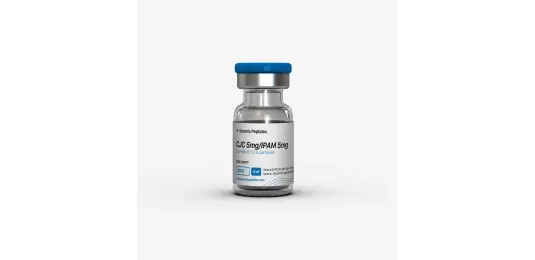
A CJC-1295/ipamorelin blend is a single lyophilized vial containing both peptides, usually in equal amounts by weight. Generic Peptides supplies one as the CJC-1295/ipamorelin Duo-Blend for laboratory research. The two components are very different molecules.
| CJC-1295 (no DAC) / MOD GRF 1-29 | Ipamorelin | |
|---|---|---|
| Class | GHRH analog | Ghrelin-receptor (GHS-R1a) agonist |
| Size | 29 amino acids, four substitutions | 5 amino acids |
| Molecular weight | ≈3,368 Da | ≈712 Da |
| Receptor | GHRH receptor | Growth hormone secretagogue receptor |
| Human data | None published for this form alone | PK study in healthy men; Phase 2 trial in postoperative ileus |
| FDA status | Not approved | Not approved |
Which CJC-1295 Is in the Blend: No DAC
The name "CJC-1295" covers two molecules. The original CJC-1295 carries a Drug Affinity Complex (DAC) that binds albumin and stretches its half-life to about six to eight days. Blends are typically made with the version without DAC, which is the tetrasubstituted GRF(1-29) sequence known as MOD GRF 1-29. It acts over a short window, closer to that of ipamorelin. Our comparison of CJC-1295 DAC vs No DAC covers the difference in detail.
A label that only says "CJC-1295" does not tell you which form is in the vial. Mass spectrometry does: the two forms differ by about 280 Da.
How CJC-1295 and Ipamorelin Work Together
Pituitary somatotrophs, the cells that make GH, carry both receptors. Each peptide acts on one of them.
- CJC-1295 (GHRH receptor). Binding raises cyclic AMP inside the cell. This triggers GH release and supports new GH synthesis.
- Ipamorelin (ghrelin receptor). Binding raises intracellular calcium through a different signaling route. It also triggers GH release.
The idea of pairing the two pathways comes from a 1990 study by Bowers and colleagues. In healthy men, a GH-releasing peptide (GHRP-6) given together with GHRH produced a larger GH response than either one alone, more than the sum of the two. The authors read this as evidence that the two act through independent mechanisms. Later work with other GHRPs, such as hexarelin given with GHRH to healthy volunteers, found similar synergy.
Two cautions apply. First, the Bowers study used GHRP-6 and native GHRH, not ipamorelin and CJC-1295. Figures such as "10 times more GH" that circulate online for this specific blend are not drawn from a published study of it. Second, GH release under both peptides remains pulsatile and subject to somatostatin and IGF-1 feedback. The combination amplifies pulses; it does not create a constant GH level.
What Human Studies Exist on CJC-1295 + Ipamorelin
There is no published clinical trial of CJC-1295 and ipamorelin given together. The human evidence comes from studies of each component, and some of it comes from the DAC form rather than the form used in blends.
CJC-1295 Studies
- Teichman et al., 2006. Healthy adults received single or repeated doses of CJC-1295 with DAC. Mean GH rose 2- to 10-fold for six days or more, and IGF-1 stayed elevated for 9–11 days. The estimated half-life was 5.8–8.1 days.
- Ionescu and Frohman, 2006. In healthy men, CJC-1295 with DAC raised baseline (trough) GH about 7.5-fold while natural GH pulses continued.
- Phase 2 trial, 2006. ConjuChem stopped a 12-week trial of CJC-1295 with DAC in people with HIV-associated visceral obesity after a participant died. A link to the drug was not established publicly.
For CJC-1295 without DAC, the form used in blends, no human pharmacokinetic study has been published. A 2026 review in Frontiers in Endocrinology noted that its human half-life has not been reported.
Ipamorelin Studies
- Raun et al., 1998. In rats and swine, ipamorelin released GH with potency similar to GHRP-6. Unlike GHRP-6 and GHRP-2, it did not raise ACTH or cortisol in swine. This selectivity is the reason ipamorelin became the GHRP of choice in blends.
- Gobburu et al., 1999. In 40 healthy men given ipamorelin intravenously, the half-life was about 2 hours, and each dose produced a single GH peak.
- Beck et al., 2014. A Phase 2 trial in 114 patients after bowel surgery tested ipamorelin as a gut-motility agent. Time to first tolerated meal did not differ significantly from placebo.
What This Means for the Blend
The research supports the mechanism behind the pairing. It does not show what the blend does in people. Claims about body composition, recovery, sleep or aging attributed to "CJC-1295 ipamorelin benefits" come from extrapolation and user reports, not from trials of the combination.
CJC-1295 No DAC vs DAC in an Ipamorelin Blend
Researchers choose the form according to the question:
- No DAC (MOD GRF 1-29). Short-acting, giving a discrete GHRH signal that can be timed together with ipamorelin. This is why blends use it.
- DAC. Long-acting, giving continuous GHRH receptor exposure for days. Pairing it with a short-acting GHRP mixes two very different time courses.
The DAC form has the only published human pharmacokinetic data. The no-DAC form has the better match to ipamorelin's time course but no published human data of its own.
CJC-1295 Ipamorelin Side Effects: What Was Recorded
Because the combination has no clinical trial, there is no side-effect record for the blend itself. What is known comes from the component studies:
- CJC-1295 with DAC (Teichman 2006): the authors described the peptide as safe and relatively well tolerated in healthy adults, with no serious adverse reactions.
- Ipamorelin (Beck 2014): in the postoperative setting, the share of participants with any adverse event was similar with ipamorelin and placebo (87.5% vs 94.8%).
- GH/IGF-1 effects in general: raising GH and IGF-1 can affect glucose metabolism and fluid balance. These are class effects of the GH axis, not findings from blend studies.
The FDA's safety review of both peptides for compounding goes further. For CJC-1295 it cites reported serious adverse events including increased heart rate and systemic vasodilatory reactions. For ipamorelin it cites serious adverse events, including a death, when ipamorelin was given intravenously in studies of gastric motility. For both, it also notes limited safety data and a risk of immunogenicity, meaning possible immune reactions to the peptide or its impurities.
CJC-1295 and Ipamorelin: FDA, PCAC and WADA Status in 2026
Checked October 25, 2026.
FDA approval. Neither CJC-1295 (in any form) nor ipamorelin is an FDA-approved drug. Neither reached Phase 3 development.
Compounding. In September 2023 the FDA placed both peptides in Category 2 of its interim 503A bulks policy, which barred their use in compounding. Both were removed from 503A Category 2 effective September 27, 2024, after their nominations were withdrawn, and referred to the Pharmacy Compounding Advisory Committee (PCAC):
- Ipamorelin, October 29, 2024: the committee voted 0 in favor, 12 against, 1 abstaining on adding it to the 503A bulks list.
- CJC-1295, December 4, 2024: the committee voted against adding any form: 0 to 13 for the free base and the DAC forms, and 1 to 12 for the acetate.
Ipamorelin acetate also remains in Category 2 of the FDA's separate policy for 503B outsourcing facilities. Neither peptide was on the agenda of the July 2026 PCAC meeting. In October 2026 the FDA sent an "Interim Access Policy for Compounding Using Certain Peptides" to the White House for review; its content has not been published. See our report on the FDA peptide interim access policy.
Sport. The 2026 World Anti-Doping Agency Prohibited List names CJC-1295 as a GHRH analog and ipamorelin as a growth hormone secretagogue under section S2.2.4. Both are prohibited at all times.
Research-grade ipamorelin, MOD GRF 1-29 and CJC-1295 DAC are laboratory materials only.
Verifying a Two-Peptide Blend: COA Checks
A blend is harder to verify than a single peptide because two compounds share one vial. A batch-specific certificate of analysis should show:
- Two HPLC peaks. One for each peptide, with purity reported for each and the chromatogram included.
- Two confirmed masses. Mass spectrometry should find both expected molecular weights: about 3,368 Da for CJC-1295 without DAC and about 712 Da for ipamorelin. A mass near 3,647 Da would indicate the DAC form instead.
- Content per component. The stated amount of each peptide, ideally as net peptide content rather than gross vial weight.
Our guide to reading a research peptide COA explains each section.
FAQ
Is CJC-1295/ipamorelin FDA approved?
No. Neither peptide is an FDA-approved drug, and the combination has never been submitted for approval. Both peptides received unfavorable votes from the FDA's compounding advisory committee in 2024.
Has the CJC-1295 and ipamorelin combination been tested in humans?
Not in any published clinical trial. Human data exist for CJC-1295 with DAC and for ipamorelin separately. The no-DAC form used in most blends has no published human pharmacokinetic study.
Does a blend use CJC-1295 with or without DAC?
Most blends use CJC-1295 without DAC (MOD GRF 1-29), because its short action matches ipamorelin's. The label does not always say which form is present, so mass spectrometry on the COA is the reliable check.
Why combine a GHRH analog with a ghrelin-receptor agonist?
The two act through different receptors on the same pituitary cells. Human studies since 1990 have shown that stimulating both pathways together produces a larger GH response than either alone.
Is CJC-1295 ipamorelin banned in sport?
Yes. WADA lists both under S2.2.4 of its Prohibited List, and both are prohibited in and out of competition.
References
For research use only. Not for human consumption. This content is for informational purposes and is not medical advice.
[1] Bowers CY, Reynolds GA, Durham D, Barrera CM, Pezzoli SS, Thorner MO. Growth hormone (GH)-releasing peptide stimulates GH release in normal men and acts synergistically with GH-releasing hormone. J Clin Endocrinol Metab. 1990;70(4):975–982. PMID: 2108187.
[2] Teichman SL, Neale A, Lawrence B, Gagnon C, Castaigne JP, Frohman LA. Prolonged stimulation of growth hormone (GH) and insulin-like growth factor I secretion by CJC-1295, a long-acting analog of GH-releasing hormone, in healthy adults. J Clin Endocrinol Metab. 2006;91(3):799–805. PMID: 16352683.
[3] Ionescu M, Frohman LA. Pulsatile secretion of growth hormone (GH) persists during continuous stimulation by CJC-1295, a long-acting GH-releasing hormone analog. J Clin Endocrinol Metab. 2006;91(12):4792–4797. PMID: 17018654.
[4] ClinicalTrials.gov. A Phase 2 study to evaluate the efficacy and safety of CJC 1295 administered for 12 weeks in HIV infected patients with HIV associated visceral obesity. NCT00267527. Status: terminated.
[5] Bernard EJ. Lipodystrophy study halted after patient death. aidsmap. July 31, 2006.
[6] Dominikowski A, Rękoś Z, Olejarz M, Szczepanek-Parulska E, Domin R, Ruchała M. The emerging landscape of performance-enhancing peptides modulating GH-IGF1 axis: bridging the gap between clinical evidence and patient self-administration. Front Endocrinol (Lausanne). 2026;17:1822475. doi:10.3389/fendo.2026.1822475. PMID: 42395176.
[7] Raun K, Hansen BS, Johansen NL, et al. Ipamorelin, the first selective growth hormone secretagogue. Eur J Endocrinol. 1998;139(5):552–561. PMID: 9849822.
[8] Gobburu JV, Agersø H, Jusko WJ, Ynddal L. Pharmacokinetic-pharmacodynamic modeling of ipamorelin, a growth hormone releasing peptide, in human volunteers. Pharm Res. 1999;16(9):1412–1416. PMID: 10496658.
[9] Beck DE, Sweeney WB, McCarter MD; Ipamorelin 201 Study Group. Prospective, randomized, controlled, proof-of-concept study of the ghrelin mimetic ipamorelin for the management of postoperative ileus in bowel resection patients. Int J Colorectal Dis. 2014;29(12):1527–1534. doi:10.1007/s00384-014-2030-8.
[10] U.S. Food and Drug Administration. Certain bulk drug substances for use in compounding that may present significant safety risks. fda.gov.
[11] U.S. Food and Drug Administration. Pharmacy Compounding Advisory Committee, October 29, 2024: final summary minutes.
[12] U.S. Food and Drug Administration. Pharmacy Compounding Advisory Committee, December 4, 2024: final summary minutes.
[13] Office of Information and Regulatory Affairs. Interim Access Policy for Compounding Using Certain Peptides (RIN 0910-ZD94). reginfo.gov. Received October 14, 2026.
[14] Arvat E, Di Vito L, Gianotti L, et al. Mechanisms underlying the negative growth hormone (GH) autofeedback on the GH-releasing effect of hexarelin in man. Metabolism. 1997;46(1):83–88. PMID: 9005975.
[15] World Anti-Doping Agency. The 2026 Prohibited List: S2.2.4 Growth hormone-releasing factors. wada-ama.org.