Tirzepatide News in 2026: Research Updates, Trials, and Regulatory Developments
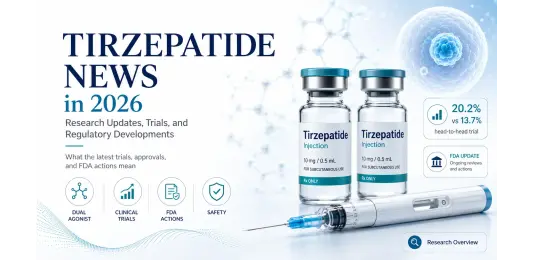
Tirzepatide News in 2026: Research Updates, Trials, and Regulatory Developments
Type "tirzepatide news" into a search bar in 2026 and two contradictory stories fight for the top spot. In one, the drug keeps winning: a head-to-head trial against semaglutide settled the potency argument, and approvals now stretch from pediatric type 2 diabetes to obstructive sleep apnea. In the other, US regulators are dismantling the compounded market that boomed during the shortage — and anything still sold as "generic tirzepatide" sits in legal limbo.
Both stories are true. Neither makes sense without the other. Here's what the numbers say — and what they still can't.
This article is for general education only and does not replace medical advice from a licensed healthcare professional.
Quick Answer
The headline tirzepatide news of 2026: a head-to-head trial confirmed it outperforms semaglutide on weight loss, the FDA moved to permanently shut down compounded copies, and the drug gained both a pediatric approval and a new multi-dose pen. Tirzepatide is the active molecule in two Eli Lilly brands — Mounjaro (type 2 diabetes) and Zepbound (weight management and obstructive sleep apnea). The specifics:
- The SURMOUNT-5 trial measured 20.2% average weight loss on tirzepatide versus 13.7% on semaglutide over 72 weeks.
- Mounjaro was approved for children aged 10 and up in December 2025; a multi-dose Zepbound KwikPen followed in February 2026.
- In April 2026, the FDA proposed permanently excluding tirzepatide from bulk compounding.
- May 2026 maintenance trials showed staying on a full dose held weight off through week 112; stepping down meant partial regain.
What Tirzepatide Is — and Why It Has Two Names
Tirzepatide is a synthetic peptide — a chain of 39 amino acids — that mimics two gut hormones released after eating: GLP-1 (glucagon-like peptide-1) and GIP (glucose-dependent insulinotropic polypeptide). Together, they prompt the pancreas to release insulin when blood sugar rises, slow how quickly the stomach empties, and signal fullness to the brain. Tirzepatide activates both receptors, making it a "dual agonist" — the leading explanation for why it outperforms drugs that target GLP-1 alone. A half-life of about five days allows once-weekly dosing.
Eli Lilly sells the identical molecule under two names, split only by approved use. Mounjaro (May 2022) treats type 2 diabetes, including in children 10 and older since December 2025. Zepbound (November 2023) covers chronic weight management and, since December 2024, moderate-to-severe obstructive sleep apnea in adults with obesity — the first drug ever approved for that condition.
The Trial Results That Actually Matter
SURMOUNT-1 remains the anchor: up to 20.9% average body-weight loss at 72 weeks on the highest dose, versus 3.1% on placebo. Its three-year extension delivered the bigger headline — in adults with prediabetes and obesity, tirzepatide cut the risk of developing type 2 diabetes by 94%.
SURMOUNT-5, published in the New England Journal of Medicine in May 2025, ended the "which is stronger" debate by putting 751 adults with obesity on tirzepatide or semaglutide head-to-head:
| Endpoint (72 weeks) | Tirzepatide | Semaglutide |
|---|---|---|
| Average weight loss | 20.2% | 13.7% |
| Lost ≥25% of body weight | 31.6% | 16.1% |
| Waist reduction | 18.4 cm | 13.0 cm |
Context worth keeping: semaglutide still holds the stronger completed heart-outcomes data (its SELECT trial showed a 20% drop in major cardiac events), while tirzepatide's equivalent outcomes trial is still running. The full three-way race — including retatrutide, an investigational triple agonist not expected to reach market before 2027 — is mapped in our semaglutide vs. tirzepatide vs. retatrutide comparison.
SURPASS-PEDS drove the pediatric approval: an average 2.2% drop in A1C (a three-month average of blood sugar) in patients aged 10 to 17. SYNERGY-NASH, a Phase 2 trial, found tirzepatide resolved MASH — a serious fatty-liver disease — without worsening liver scarring more often than placebo. Promising, but Phase 2 is not proof, and this is not an approved use.
The newest data arrived May 12, 2026. The SURMOUNT-MAINTAIN and ATTAIN-MAINTAIN trials asked what happens after the weight is gone. Staying on the maximum tolerated dose kept weight essentially stable through week 112; stepping down to 5 mg meant regaining about 5.6 kg on average. A separate arm switched patients to Foundayo (orforglipron), Lilly's once-daily oral GLP-1 pill — a different molecule, not tirzepatide — and those patients maintained all but about 5.0 kg of their prior loss on average. An oral maintenance route would matter for anyone weary of weekly injections, but a single-agonist pill is not a like-for-like swap for the dual agonist.
The FDA Dosing Schedule — and a New Pen
Searches for a "tirzepatide dosage chart" often land on forum spreadsheets. The only schedule with regulatory weight is the FDA label: treatment starts at 2.5 mg once weekly — a starter dose for building gastrointestinal tolerance, not for treatment — and can rise in 2.5 mg steps, no sooner than every four weeks, to a maximum of 15 mg.
| Weeks | Weekly dose |
|---|---|
| 1–4 | 2.5 mg (starter) |
| 5–8 | 5 mg (first therapeutic dose) |
| 9–12 | 7.5 mg |
| 13–16 | 10 mg |
| 17–20 | 12.5 mg |
| 21+ | 15 mg (maximum) |
Whether to escalate, hold, or step back belongs to the prescriber managing your care; the label only sets the guardrails. One concrete product change: on February 23, 2026, the FDA approved a multi-dose KwikPen for Zepbound, ending the single-dose-only era.
The Compounding Crackdown Is the Real Regulatory Story
During the shortage, compounded tirzepatide became a mass-market workaround through specialty pharmacies. That era is over. The FDA declared the shortage resolved on December 19, 2024, and the compounding grace periods closed in February and March 2025. On April 30, 2026, the agency went further, proposing to permanently exclude tirzepatide — along with semaglutide and liraglutide — from the list of substances large compounding facilities may use at all. The public-comment period closed July 30, 2026.
Two consequences matter. First, there is no FDA-approved generic tirzepatide — compounded versions were never equivalent to Mounjaro or Zepbound, and anything still marketed that way sits outside the shortage exemption, with unknown quality and safety. Second, the posture extends beyond weight-loss drugs: the agency has moved against unapproved peptides broadly this year, a pattern we also tracked in our coverage of the FDA's July 2026 KPV review.
Tirzepatide Side Effects: Common, Serious, and Often Confused
The common effects are gastrointestinal and cluster around dose increases: nausea (12–30% in trial data), diarrhea (13–24%), constipation (6–17%), vomiting (6–12%), plus abdominal pain, indigestion, belching, fatigue, injection-site reactions, hair loss, and reflux. Most are mild to moderate and fade with time — exactly why the label starts everyone at 2.5 mg.
The serious list is short but real. Tirzepatide carries the FDA's strongest caution, a boxed warning, about thyroid C-cell tumors. That finding comes from rodent studies, and whether it applies to humans is unknown — but the drug is contraindicated for anyone with a personal or family history of medullary thyroid carcinoma (a rare thyroid cancer) or MEN 2, the inherited syndrome linked to it. The label also flags pancreatitis, gallbladder disease, kidney injury, and low blood sugar when combined with insulin.
Severe, persistent abdominal pain — especially pain radiating to the back — warrants urgent medical care, not a forum post.
What the Internet Gets Wrong About Tirzepatide
- "Compounded tirzepatide is just the generic." There is no generic. Compounded products were never FDA-approved, and copies are no longer permitted post-shortage.
- "It's basically a stronger Ozempic." Ozempic is semaglutide, a single-agonist drug. Different molecule, different class.
- "Ozempic face" is a side effect. It's a media nickname for the facial fat loss that follows rapid weight loss from any cause — surgery, dieting, or any of these drugs.
- "Retatrutide is available now." Anything sold online under that name is an unapproved drug; the real molecule exists only in clinical trials.
- "The 20% figure is what you'll get." Those are controlled-trial averages achieved alongside structured lifestyle support. Individual results spread widely around the average.
Cost and Finding a Prescriber
There is no master directory behind "tirzepatide near me" searches. The legitimate routes are an endocrinologist, an obesity-medicine specialist, your primary-care physician, or a licensed telehealth service that prescribes only after an actual evaluation. On cost: list price runs about $1,086 a month; Lilly's self-pay channel sells single-dose vials for $299 to $449 depending on strength, with the KwikPen at $449; and commercially insured patients using the savings card can pay as little as $25.
Tirzepatide in 2026: Hard Evidence, Honest Unknowns, and a Closing Gray Market
The 2026 picture is a drug growing into its evidence: a decisive head-to-head win over semaglutide, a pediatric indication, a first-in-class sleep-apnea approval, and early answers on long-term maintenance — all while the gray market that once defined access is being shut down. The honest unknowns are what happens beyond three years of continuous use and what maintenance looks like for the average patient rather than the trial volunteer. Neither miracle nor menace, tirzepatide is a potent, well-studied medicine with real tradeoffs — best managed inside a doctor-patient relationship, not a group chat.
FAQ
Is tirzepatide a peptide? Yes — a synthetic chain of 39 amino acids mimicking the gut hormones GIP and GLP-1. For background on how peptide drugs differ from conventional pills, see our peptide information page.
Are Mounjaro and Zepbound the same thing? Same active ingredient, same manufacturer, same weekly dosing. They differ only in their FDA-approved uses: Mounjaro for type 2 diabetes, Zepbound for weight management and obstructive sleep apnea.
Is compounded tirzepatide still legal in 2026? Not as a copy of the brand drugs. The shortage exemption ended in early 2025, and the FDA has proposed permanently barring bulk compounding. Products still sold this way are unapproved and unverified.
What is the starting dose of tirzepatide? Per the FDA label, treatment begins at 2.5 mg once weekly for four weeks — a tolerability step, not a therapeutic dose. Every dosing decision belongs to the prescriber managing your care.
Is retatrutide available yet? No. It's an investigational triple agonist in Phase 3 trials, with a regulatory filing expected in late 2026 at the earliest. It cannot be legally prescribed or sold outside a trial.