How to Reconstitute Peptides: Complete Guide
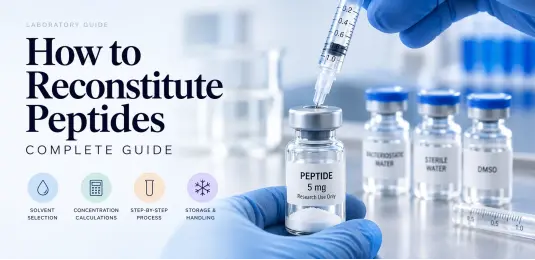
How to Reconstitute Peptides: Complete Guide
You've received a vial of lyophilized peptide. Before you begin, there is one rule worth remembering: every peptide is different.
A solvent that works well for one compound may be unsuitable for another. Solubility, stability, concentration, pH, and storage requirements can all vary with the peptide's sequence and formulation.
This guide explains the general principles of peptide reconstitution for laboratory research. For compound-specific instructions, always consult the product datasheet or technical documentation. Use the Certificate of Analysis (COA) to verify batch-specific information such as identity, purity, lot information, and peptide content.
If you need help with the calculations, use our Peptide Calculator. It converts common units and helps calculate the volume required for a target concentration.
What You Need
Before starting, gather the materials required by your laboratory protocol:
- Lyophilized peptide — the material supplied in the vial
- Appropriate solvent — selected for the specific peptide and assay
- Calibrated volumetric equipment — such as a suitable pipette
- Compatible tubes or vials — for preparation, aliquoting, and storage
- Alcohol swabs — when working with septum-sealed vials
- Appropriate personal protective equipment (PPE)
- Product datasheet and COA
Depending on the peptide, an appropriate solvent may include:
- sterile or laboratory-grade water
- an appropriate aqueous buffer
- dilute acetic acid for some basic peptides
- a dilute basic solution for some acidic peptides
- DMSO or another compatible organic solvent for some poorly water-soluble peptides
- bacteriostatic water when specifically appropriate for the material and intended application
There Is No Universal Peptide Solvent
This is one of the most important points in the entire process.
Peptide solubility depends on factors such as:
- amino acid sequence
- overall charge
- hydrophobicity
- terminal modifications
- salt form
- target concentration
- pH
- downstream assay conditions
Do not select a solvent simply because it worked for another peptide.
Bacteriostatic Water for Injection, for example, contains benzyl alcohol as a preservative. That does not make it a universal peptide solvent.
Always consider both peptide compatibility and the requirements of the downstream experiment.
Understanding the Vial Label
A peptide vial or accompanying documentation may show information such as:
- 5 mg or 10 mg — labeled peptide amount
- CAS number — chemical identifier
- Sequence — amino acid sequence
- Purity — commonly determined by HPLC
- Peptide content — where provided
- Lot or batch number
A highly pure peptide preparation can still contain counter-ions, residual moisture, or other non-peptide mass. When quantitative accuracy matters, review the batch documentation rather than relying only on the number printed on the vial.
Our guide to reading a research peptide COA explains the difference between HPLC purity, identity testing, lot information, and peptide content in more detail.
For example, the BPC-157 research peptide page includes product-specific identity information, sequence details, molecular characteristics, and research-use positioning. This is the type of information that should be reviewed before preparing a research stock.
The Basic Math
Reconstitution creates a solution with a known concentration.
The basic equation is:
Concentration (mg/mL) = peptide amount (mg) ÷ final solution volume (mL)
For example, if you have 5 mg of peptide and prepare a final volume of 2 mL:
5 mg ÷ 2 mL = 2.5 mg/mL
If an experiment requires 250 mcg (0.25 mg) from that 2.5 mg/mL stock:
0.25 mg ÷ 2.5 mg/mL = 0.1 mL
That is:
0.1 mL = 100 µL
Changing the solution volume changes the concentration, so calculate the target concentration before adding solvent.
For faster calculations, use our Peptide Calculator.
Step-by-Step Peptide Reconstitution
Step 1: Prepare Your Workspace
Work in a clean environment appropriate for your experiment.
Wash your hands, wear the required PPE, clean the work surface according to laboratory procedures, and gather everything you need before opening the peptide.
If the peptide has been stored cold, allow the closed vial to equilibrate to room temperature before opening it.
Lyophilized peptides are often hygroscopic. Opening a cold container can encourage moisture from the surrounding air to condense inside, potentially affecting peptide content and stability.
Step 2: Check the Product Documentation
Before adding anything to the peptide, confirm:
- recommended solvent
- target or maximum concentration
- solubility information
- storage requirements
- any sequence-specific handling precautions
Some peptides are readily water-soluble. Others require careful adjustment of pH or a compatible organic solvent.
If product-specific instructions are available, they take priority over general guidance.
Step 3: Prepare the Solvent
Using appropriate calibrated equipment, measure the volume required to achieve your target stock concentration.
Avoid choosing an arbitrary volume simply because it is commonly used elsewhere.
The appropriate volume depends on:
- the amount of peptide
- desired stock concentration
- solubility limit
- assay requirements
- solvent compatibility
If working with septum-sealed containers under aseptic conditions, disinfect the stopper and follow your laboratory's validated transfer procedure.
Step 4: Add the Solvent
Add the selected solvent carefully.
Where the vial design allows, introducing the liquid gently against the inside wall of the container can help minimize unnecessary foaming or agitation.
There is no benefit to rushing this step. The goal is simply to bring the peptide into solution while avoiding unnecessary physical or chemical stress.
Step 5: Allow the Peptide to Dissolve
Gentle swirling is often sufficient.
Avoid unnecessary vigorous agitation unless the product-specific protocol calls for it.
Some peptides dissolve almost immediately. Others can take considerably longer — occasionally hours rather than minutes.
If the material is slow to dissolve, do not automatically assume that it is damaged.
Possible reasons include:
- high peptide concentration
- hydrophobic sequence
- unsuitable pH
- inappropriate solvent
- aggregation
- precipitation
- incompatible buffer conditions
For some peptides, brief water-bath sonication or another validated dissolution technique may help. Avoid excessive heating.
If dissolution remains incomplete, review the technical documentation before changing solvents or conditions.
Special Considerations
Basic Peptides
Peptides with a predominantly positive charge may sometimes dissolve more readily under mildly acidic conditions.
A small amount of dilute acid, such as acetic acid, may be appropriate in some protocols before further dilution.
Follow product-specific recommendations whenever available.
Acidic Peptides
Peptides with a predominantly negative charge may sometimes require mildly basic conditions for initial dissolution.
The appropriate approach depends on the sequence, concentration, and downstream experiment.
Hydrophobic Peptides
Hydrophobic peptides can be considerably more difficult to dissolve in aqueous solutions.
When recommended, a small amount of a compatible organic solvent may be used to prepare the initial stock, followed by dilution with an appropriate aqueous medium or buffer.
Possible solvents in research protocols may include:
- DMSO
- DMF
- acetonitrile
- ethanol or other compatible alcohols
The final concentration of the organic solvent matters. Many biological assays, particularly cell-based systems, tolerate only limited amounts of organic solvent.
Always consider the solvent tolerance of the downstream experiment.
Oxidation-Sensitive Peptides
Peptides containing residues such as cysteine, methionine, or tryptophan may require additional care because they can be susceptible to oxidation.
Where relevant, follow product-specific recommendations regarding buffers, oxygen exposure, pH, and reducing conditions.
Label and Document the Solution
Once the peptide is dissolved, record what you prepared.
At minimum, a useful laboratory label should include:
- peptide name or identifier
- concentration
- solvent or buffer
- preparation date
- lot or batch number when relevant
For example:
Peptide X — 2.5 mg/mL — PBS — 6 Oct 2026 — Lot 12345
Good documentation prevents simple mistakes later, especially when several visually identical samples are stored together.
Peptide Storage After Reconstitution
There is no universal storage timeline for peptide solutions.
Stability can depend on:
- peptide sequence
- concentration
- solvent
- buffer composition
- pH
- temperature
- exposure to oxygen
- light
- repeated freezing and thawing
For broader practical information, you can also review our peptide storage and handling FAQ. Product-specific instructions should still take priority whenever available.
Lyophilized Peptides
For longer-term stability, many lyophilized peptides are stored frozen according to the supplier's specifications.
Short periods at room temperature may be acceptable for some peptides, including during shipping, but this should not be interpreted as universal long-term storage guidance.
Keep the material dry and follow the supplier's recommended storage temperature.
Peptides in Solution
Peptide solutions generally have a more limited shelf life than the corresponding lyophilized material.
Some can be kept refrigerated for short periods. Others are better divided into small aliquots and frozen.
Where freezing is appropriate, aliquoting reduces the need to repeatedly thaw the same stock.
Freeze–Thaw Cycles
Repeated freeze–thaw cycles are generally avoided because they can promote degradation, aggregation, or precipitation in susceptible peptide solutions.
If a frozen stock will be used repeatedly, preparing smaller working aliquots is often a better approach.
For long-term experiments, always use product-specific stability data when available.
Common Mistakes to Avoid
Assuming Every Peptide Dissolves the Same Way
It does not.
Solvent selection should be based on the properties of the peptide and the experiment.
Confusing Purity With Peptide Content
A peptide listed as 98% pure by HPLC is not necessarily 98% peptide by total solid mass.
Check the COA when accurate quantitative preparation matters. If you're unsure what the different analytical results mean, see our guide on how to read a research peptide COA.
Opening a Cold Vial Immediately
Cold lyophilized material can collect atmospheric moisture after opening.
Allow the closed container to equilibrate toward room temperature first.
Using an Arbitrary Solvent Volume
The volume should follow from the desired concentration and solubility of the peptide, not from a generic rule such as "always add 1 mL" or "always add 2 mL."
Forcing Dissolution
More agitation, heat, or solvent is not automatically better.
If a peptide does not dissolve as expected, investigate the reason before changing the preparation conditions.
Ignoring Downstream Solvent Compatibility
A solvent may dissolve the peptide successfully while interfering with the assay itself.
Always consider the final solvent concentration in the working solution.
Repeatedly Freezing and Thawing the Same Stock
When frozen storage is appropriate, aliquots can reduce repeated freeze–thaw exposure.
Poor Labeling
A clear vial of peptide solution usually looks exactly like another clear vial of peptide solution.
Label it when you prepare it — not later.
Concentration Examples
The following examples assume that the stated peptide amount is the amount used for the calculation. For precision work, adjust calculations according to net peptide content where appropriate.
| Peptide Amount | Final Volume | Concentration | Required Amount | Solution Volume |
|---|---|---|---|---|
| 2 mg | 1 mL | 2 mg/mL | 200 mcg | 100 µL |
| 5 mg | 2 mL | 2.5 mg/mL | 250 mcg | 100 µL |
| 5 mg | 3 mL | 1.67 mg/mL | 250 mcg | ≈150 µL |
| 10 mg | 2 mL | 5 mg/mL | 250 mcg | 50 µL |
| 10 mg | 3 mL | 3.33 mg/mL | 250 mcg | ≈75 µL |
For other combinations, use our Peptide Calculator.
Final Checklist
- Verified the peptide identity and product documentation
- Checked the COA where quantitative accuracy matters
- Selected an appropriate solvent and grade
- Confirmed solvent compatibility with the downstream assay
- Allowed a cold vial to equilibrate before opening
- Calculated the target stock concentration
- Used calibrated measuring equipment
- Avoided unnecessary vigorous agitation or heating
- Confirmed dissolution according to product specifications
- Labeled the solution with name, concentration, solvent, and date
- Stored the preparation according to peptide-specific guidance
- Completed the required laboratory records
Learn More About Peptide Research
If you're new to peptide terminology, our guide What Are Peptides? What They Actually Do explains peptide structure, terminology, research context, and the differences between various types of peptide compounds.
Researchers comparing different lyophilized materials can also browse our muscle recovery and regenerative peptide research category to review product-specific identity information and available research documentation.
The Bottom Line
Peptide reconstitution becomes much easier once you understand the principles behind it.
The important part is not memorizing one universal recipe — because there isn't one.
Know your material. Check its documentation. Choose the solvent deliberately. Calculate the concentration carefully. Give difficult peptides time to dissolve. Document what you prepared, and store it according to evidence rather than assumption.
For concentration and volume calculations, use our Peptide Calculator.