Same Name, Different Molecule: 5 Peptide Naming Traps Every Researcher Should Know
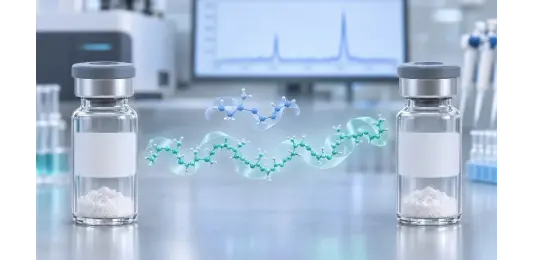
Same Name, Different Molecule: 5 Peptide Naming Traps Every Researcher Should Know
By Medical Team of Generic Peptides
In October 2026, a federal document did something the research-peptide market had never had: it spelled out, atom by atom, what six popular peptide names actually mean. Appendix B of the HHS enforcement discretion policy lists the amino acid sequence, molecular formula, molecular weight and salt form for BPC-157, TB-500, Semax, Epitalon, KPV and MOTS-c. Identity, the policy says, "includes but is not limited to amino acid sequence, chemical structure, molecular weight."
That matters beyond compounding pharmacies, because the market has been loose with names for years. Two vials with the same label can hold molecules that differ by a single counter-ion, or by 36 amino acids. Here are five of the most common traps, and how to tell which molecule you are looking at.
Trap 1: BPC-157 Acetate vs. BPC-157 Arginate
The name: BPC-157 is a synthetic chain of 15 amino acids (Gly-Glu-Pro-Pro-Pro-Gly-Lys-Pro-Ala-Asp-Asp-Ala-Gly-Leu-Val) modeled on a fragment of a protein found in gastric juice. Its free base has a molecular weight of 1,419.5 g/mol.
The trap: Peptides are rarely sold as a bare molecule. They come as a salt, meaning the peptide is paired with a counter-ion left over from synthesis and purification. For BPC-157 the common form is the acetate, where the partner is acetic acid. Some suppliers sell an "arginate," where the partner is the amino acid arginine, and market it as a different or more stable product.
Why it matters: The peptide chain is the same in both. The weight of the vial contents is not, because arginine is heavier than acetic acid, so the same milligram label can mean a different amount of actual peptide. Appendix B lists BPC-157 as the acetate (and free base) only; no arginate form appears in the document. The published animal research, such as the rat tendon studies, does not describe an arginate form either.
What to check: A certificate of analysis should state the counter-ion and ideally the net peptide content, not just purity. Purity tells you how clean the peptide is; net peptide content tells you how much of the vial is peptide rather than salt and water. Our BPC-157 research peptide page shows the batch COA for exactly this reason.
Trap 2: TB-500 vs. Thymosin Beta-4
The name: Thymosin beta-4 is a natural protein of 43 amino acids found in almost every cell. It binds actin, the scaffolding cells use to move, and has been studied in animal models of wound and heart repair. "TB-500" is a trade-style name that appeared in the research-chemical market.
The trap: This is the biggest one on the list. In many catalogs, "TB-500" is used for the full 43-amino-acid protein. But Appendix B defines TB-500 as something else entirely: Ac-Leu-Lys-Lys-Thr-Glu-Thr-Gln, a seven-amino-acid fragment with an acetyl cap, molecular weight 949.1 g/mol as the acetate. That fragment corresponds to residues 17 to 23 of thymosin beta-4, the part of the protein identified as its actin-binding site. The FDA's 2023 compounding review also looked at the fragment LKKTETQ, not the full protein.
Why it matters: A vial labeled TB-500 may hold a 949-dalton heptapeptide or a protein roughly five times heavier. They are not interchangeable in an experiment, and most of the well-known animal studies, including the 1999 wound-healing work and the 2004 study in Nature on cardiac repair, used the full-length protein.
What to check: Mass spectrometry settles it in one line of the COA. A monoisotopic mass near 889 Da (free base of the fragment) and a mass near 4,963 Da (full thymosin beta-4) are impossible to confuse. See our TB-500 research peptide page and the longer article on TB-500 and thymosin beta-4.
Trap 3: CJC-1295 With DAC vs. CJC-1295 Without DAC
The name: Both start from the same 29-amino-acid fragment of growth hormone-releasing hormone, modified at four positions to resist breakdown. In the scientific literature this modified fragment is called tetrasubstituted GRF(1-29); the market calls it MOD GRF 1-29 or "CJC-1295 without DAC."
The trap: The DAC (Drug Affinity Complex) is an extra chemical group that lets the peptide attach to albumin in the blood. With it, the molecule stays active for days; without it, for minutes. The letters "CJC-1295" get used for both, and the price difference between them is small enough that labels are sometimes careless.
Why it matters: The human data people quote online, such as the 2006 study in the Journal of Clinical Endocrinology & Metabolism showing sustained hormone release lasting days, come from the DAC version. Those results do not describe the short-acting molecule. Neither version appears in the HHS policy and neither is FDA-approved.
What to check: The two have different molecular weights, so again the mass spectrum on the COA is the answer. We keep them as separate products, CJC-1295 DAC and MOD GRF 1-29, and compare them in detail in CJC-1295 with and without DAC.
Trap 4: Semax vs. Selank
The name: Both are seven-amino-acid peptides developed at the Institute of Molecular Genetics in Moscow, both end with the same three residues (Pro-Gly-Pro) added for stability, and both are often listed side by side under "cognitive peptides." That is where the similarity ends.
The trap: Semax is Met-Glu-His-Phe-Pro-Gly-Pro. Its first four residues are a fragment (positions 4 to 7) of ACTH, the pituitary stress hormone. Selank is Thr-Lys-Pro-Arg-Pro-Gly-Pro. Its first four residues are tuftsin, a fragment of an antibody involved in immune signaling. Different parent molecules, different research literatures, different receptors of interest.
Why it matters: Only one of them is in the HHS policy. Appendix B lists Semax as a free base, molecular weight 813.9 g/mol. Selank is not in Appendix A at all. Studies on one are routinely cited as if they applied to the other, which they do not.
What to check: The sequence. Both are on our site as Semax and Selank, each with its own COA.
Trap 5: Epitalon vs. Epithalamin
The name: Epithalamin is an extract of bovine pineal glands, first described in 1973 by Russian researchers led by Vladimir Khavinson. It is a mixture of many peptides. Epitalon (also spelled Epithalon) is a synthetic tetrapeptide, Ala-Glu-Asp-Gly, designed in the 1990s to mimic the amino acid composition of that extract.
The trap: Because Epitalon was built to stand in for Epithalamin, the names get swapped freely, and older findings on the extract are presented as findings on the four-amino-acid molecule. A 2025 review in the International Journal of Molecular Sciences notes that the AEDG peptide was not even detected in a natural pineal extract until 2017.
Why it matters: Appendix B lists Epitalon as the acetate of the AEDG tetrapeptide, molecular weight 450.4 g/mol. The most-cited laboratory results, such as telomerase activation, come from cell-culture studies (human fibroblasts and HeLa cells), not from the extract and not from human trials.
What to check: A COA for Epitalon should show a four-residue sequence and a mass that matches it; see our Epithalon research peptide page.
How to Tell Which Molecule Is in the Vial
All five traps come down to the same three questions, and a good certificate of analysis answers each of them:
- What is the sequence? Confirmed by mass spectrometry: the measured mass must match the intended molecule, not a cousin.
- What is the salt form? Acetate, arginate, free base. The counter-ion changes the weight of the contents without changing the peptide.
- How much is actually peptide? Purity by HPLC tells you the peptide fraction is clean. Net peptide content tells you how much of the vial that fraction represents.
The HHS policy now asks compounders to verify identity with orthogonal methods and 100% sequence coverage. Research laboratories have every reason to hold their suppliers to the same bar. Our guide on how to read a research peptide COA walks through each line, and every batch sold by Generic Peptides ships with its own certificate.
The Bottom Line
A name on a vial is a label, not an identity. The same five letters can mean two different salts, two different lengths of the same protein, or two unrelated molecules that happen to share a suffix. Until the market standardizes its vocabulary, the sequence and the mass on the certificate of analysis are the only names that count.
Frequently Asked Questions
Is BPC-157 arginate the same as BPC-157 acetate?
The peptide chain is identical; the counter-ion is different (arginine vs. acetic acid). The weight per milligram and the stability claims differ, and only the acetate and free base appear in the HHS Appendix B specification.
Is TB-500 the same as thymosin beta-4?
Not necessarily. Thymosin beta-4 is a 43-amino-acid protein. The HHS policy defines TB-500 as a 7-amino-acid fragment of it (Ac-LKKTETQ). Many catalogs use "TB-500" for either, so the COA mass is the only reliable way to know.
What is the difference between CJC-1295 with and without DAC?
The DAC group lets the peptide bind albumin and act for days instead of minutes. Without DAC, the molecule is MOD GRF 1-29. Most published human data concern the DAC version.
Are Semax and Selank related?
Only by origin and by the shared Pro-Gly-Pro tail. Semax derives from a fragment of ACTH; Selank from tuftsin, an antibody fragment. Semax is in the HHS policy; Selank is not.
Is Epitalon the same as Epithalamin?
No. Epithalamin is a pineal gland extract containing many peptides. Epitalon is a single synthetic tetrapeptide (AEDG) designed to mimic the extract's amino acid composition.
References
[1] U.S. Department of Health and Human Services. Enforcement Discretion Policy Regarding 503A Compounding Using Certain Peptide Bulk Drug Substances, Appendix B. Federal Register, published October 30, 2026.
[2] U.S. Food and Drug Administration. Certain Bulk Drug Substances for Use in Compounding that May Present Significant Safety Risks (BPC-157; Thymosin beta-4 fragment LKKTETQ). 2023.
[3] Staresinic M, Sebecic B, Patrlj L, et al. Gastric pentadecapeptide BPC 157 accelerates healing of transected rat Achilles tendon and in vitro stimulates tendocytes growth. J Orthop Res. 2003;21(6):976–983.
[4] Goldstein AL, Hannappel E, Kleinman HK. Thymosin β4: actin-sequestering protein moonlights to repair injured tissues. Trends Mol Med. 2005;11(9):421–429.
[5] Sosne G, Qiu P, Goldstein AL, Wheater M. Biological activities of thymosin β4 defined by active sites in short peptide sequences. FASEB J. 2010;24(7):2144–2151.
[6] Bock-Marquette I, Saxena A, White MD, DiMaio JM, Srivastava D. Thymosin beta4 activates integrin-linked kinase and promotes cardiac cell migration, survival and cardiac repair. Nature. 2004;432(7016):466–472.
[7] Jetté L, Léger R, Thibaudeau K, et al. Human growth hormone-releasing factor (hGRF)1-29-albumin bioconjugates activate the GRF receptor on the anterior pituitary in rats: identification of CJC-1295 as a long-lasting GRF analog. Endocrinology. 2005;146(7):3052–3058.
[8] Teichman SL, Neale A, Lawrence B, et al. Prolonged stimulation of growth hormone (GH) and insulin-like growth factor I secretion by CJC-1295, a long-acting analog of GH-releasing hormone, in healthy adults. J Clin Endocrinol Metab. 2006;91(3):799–805.
[9] Volkova A, Shadrina M, Kolomin T, et al. Selank administration affects the expression of some genes involved in GABAergic neurotransmission. Front Pharmacol. 2016;7:31.
[10] Araj SK, Brzezik J, Mądra-Gackowska K, Szeleszczuk Ł. Overview of Epitalon—Highly Bioactive Pineal Tetrapeptide with Promising Properties. Int J Mol Sci. 2025;26(6):2691.