Semax vs Selank: Structure, Research and FDA Status
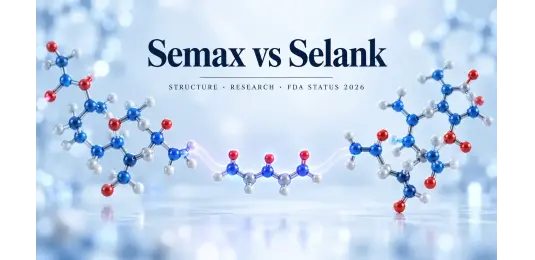
Semax vs Selank: Structure, Mechanisms and What Studies Compare
By Medical Team of Generic Peptides
Quick answer. Semax and Selank are two short synthetic peptides developed in Russia, and they are often mentioned together because they share the same design trick: a natural peptide fragment with a Pro-Gly-Pro tail added for stability. Semax is built on a fragment of ACTH and has been studied mainly in rat models of brain ischemia and in Russian clinical studies in ischemic stroke. Selank is built on tuftsin, an immune peptide, and has been studied mainly for anxiety-related and immune endpoints. Both are registered as medicines in Russia, neither is FDA-approved, and in 2026 their US compounding status differs: Semax was reviewed by an FDA advisory committee in July 2026, while Selank is on no FDA compounding list at all.
Semax and Selank at a Glance
| Feature | Semax | Selank |
|---|---|---|
| Sequence | Met-Glu-His-Phe-Pro-Gly-Pro | Thr-Lys-Pro-Arg-Pro-Gly-Pro |
| Parent peptide | ACTH(4-7) fragment | Tuftsin (Thr-Lys-Pro-Arg) |
| Formula | C37H51N9O10S | C33H57N11O9 |
| Molecular weight | ≈813.9 Da | ≈751.9 Da |
| Registered in Russia | Yes (ischemic stroke; optic nerve and other conditions) | Yes (anxiolytic) |
| Main research focus | Neurotrophins, brain ischemia models | Anxiety-related behavior, GABA-related genes, immune signaling |
| US status (Oct 2026) | Not FDA-approved; PCAC review July 2026 | Not FDA-approved; on no FDA compounding list |
| WADA 2026 list | Not named explicitly | Not named explicitly |
The Shared Design: A Natural Fragment Plus Pro-Gly-Pro
Both peptides come from the same Russian research tradition. Semax was designed by Igor Ashmarin's group, which summarized 15 years of work on it in 1997 [1]. Selank was designed at the Institute of Molecular Genetics of the Russian Academy of Sciences together with the Zakusov Institute of Pharmacology [8]. The idea was simple. Short regulatory peptides from the body are often active but break down quickly. Adding the tripeptide Pro-Gly-Pro to the C-terminus makes them more resistant to peptidases while keeping the activity of the original fragment.
For Semax, the starting point was ACTH(4-7), Met-Glu-His-Phe — a short piece of adrenocorticotropic hormone that researchers studied for its effects on the nervous system rather than on the adrenal glands. For Selank, the starting point was tuftsin, Thr-Lys-Pro-Arg, a fragment of the heavy chain of immunoglobulin G known for its effects on immune cells.
So the two peptides share a tail and a design philosophy, but their "heads" come from completely different systems: one from a stress hormone, one from an immune protein. That difference explains most of how their research programs diverged.
Semax: What the Research Looked At
Animal studies
Most mechanistic work on Semax was done in rats. The best-documented finding is its effect on brain-derived neurotrophic factor (BDNF). Dolotov and colleagues reported that Semax increased the expression of BDNF and its receptor, TrkB, in the rat hippocampus [2].
Later studies used rat models of stroke. After permanent occlusion of the middle cerebral artery, Semax changed the expression of neurotrophins and their receptors in brain tissue [3]. A genome-wide study in the same type of model found that Semax affected the expression of genes linked to immune response and blood vessel function in ischemic rat brain [4].
These are animal findings. They show that Semax acts on neurotrophin signaling in rodent brain tissue, not that the same happens in people.
Clinical studies in Russia
Semax is registered as a medicine in Russia in two concentrations: 1% for ischemic stroke, and 0.1% for optic nerve conditions and several other neurological indications, according to the Russian drug registry [5]. Russian clinical studies have examined it in patients at different stages of ischemic stroke [6] and looked at possible protective mechanisms during the acute period of stroke [7].
These trials were published mainly in Russian journals, were relatively small, and have not been independently replicated in large Western trials. That is the main limit on how far conclusions can go. Our full Semax guide covers its history and Russian registration in more detail.
Selank: What the Research Looked At
Animal studies
Selank's research program centered on anxiety-related behavior and on how the peptide interacts with the GABA system. In rats, Volkova and colleagues found that Selank changed the expression of a number of genes involved in GABAergic neurotransmission in the frontal cortex [8]. This is one reason Selank is often discussed in the same breath as anxiolytic drugs — but the study measured gene expression, not clinical anxiety.
Clinical studies in Russia
Selank is registered in Russia as an anxiolytic medicine [10]. Small Russian clinical studies have examined it in patients with anxiety-related conditions and neurasthenia [11]. Because tuftsin is an immune peptide, Selank was also studied for immune effects: Uchakina and colleagues examined immune markers in patients with anxiety-asthenic disorders [9]. As with Semax, these studies were not large, were published mainly in Russian, and have not been confirmed by independent Western trials. For a deeper profile, see our Selank guide.
Where Semax and Selank Overlap
The most interesting direct link between the two peptides is enzymatic. Kost and colleagues showed in human serum, in vitro, that both Semax and Selank inhibit enzymes that break down enkephalins — the body's own opioid peptides [12]. In theory, slowing enkephalin breakdown could contribute to effects on stress and pain signaling. In practice, this was a test-tube experiment, and it does not show how much of either peptide's activity in animals comes from this mechanism.
Beyond that, the overlap is mostly in background: same research tradition, same stabilizing tail, same regulatory history in Russia, and the same evidence gap in Western literature.
Where They Differ
Origin. Semax comes from a hormone fragment (ACTH); Selank from an immune peptide (tuftsin).
Research endpoints. Semax studies focus on neurotrophins, ischemia and recovery models. Selank studies focus on anxiety-related behavior, GABA-related gene expression and immune markers.
Russian indications. Semax is registered for ischemic stroke, optic nerve conditions and other neurological indications; Selank as an anxiolytic for anxiety states and related conditions.
US regulatory path. Semax went through a full FDA advisory review in 2026. Selank's nomination was withdrawn in 2024 (see below).
How Strong Is the Evidence?
It helps to be direct about this. Almost all clinical data on both peptides come from Russian research groups, often the same ones that developed them. The trials are small, many are not available in English, and few have been repeated by independent teams. Animal studies are more numerous and more detailed, but animal results often fail to carry over to humans.
That does not mean the research is worthless. It means Semax and Selank are best treated as research tools with an interesting but incomplete evidence base — which is exactly how researchers outside Russia work with them. The same caveat applies to much of the cognitive and neurological peptide literature, including DSIP.
US Regulatory Status in 2026
Neither Semax nor Selank is approved by the FDA for any use.
Semax. In September 2023, FDA placed Semax in Category 2 of its interim compounding policy — substances that may raise significant safety risks [13]. In April 2026, Semax was moved out of Category 2 ahead of an advisory review. On July 24, 2026, FDA's Pharmacy Compounding Advisory Committee (PCAC) voted 8–5 with one abstention to recommend Semax for the 503A bulks list for specific uses, which trade press reported as cerebral ischemia, migraine and trigeminal neuralgia [14]. A PCAC vote is advisory. As of October 2026, FDA has not added Semax to the 503A bulks list. Our news report on the July 2026 review covers the meeting in more detail.
Selank. Selank was also placed in Category 2 in September 2023 [13]. On September 27, 2024, FDA removed it after the nomination was withdrawn. Selank is now on none of FDA's compounding category lists, and it was not on the July 2026 or the announced February 2027 PCAC agendas. Being off the list does not mean it is approved or allowed for compounding — it means FDA currently has no pending evaluation of it.
WADA Status
Neither Semax nor Selank is named explicitly on the 2026 WADA Prohibited List. However, section S2 of the list covers corticotrophins and related substances with "e.g." wording, which means the examples are not exhaustive [15]. Since Semax is derived from ACTH, athletes and sports researchers should not read the absence of its name as a clearance. Anyone subject to anti-doping rules should consult their anti-doping organization.
Semax and Selank Together
Semax and Selank are often sold or discussed as a pair, and "selank semax blend" is a common search. However, we found no published study that tested the two peptides together in animals or humans. Each peptide's literature is separate. Any claim that the combination works better than either alone is not supported by published research.
What a COA Should Show for Each Peptide
Because the two peptides are short and similar in size, identity testing matters. A useful certificate of analysis should show:
- Mass spectrometry matching about 813.9 Da for Semax or about 751.9 Da for Selank. The ~62 Da difference is easy to resolve, so the spectrum should leave no doubt which peptide is in the vial.
- HPLC purity with the chromatogram, not only a percentage.
- The full sequence, written out.
- A lot number that matches the vial label.
Our guide on how to read a research peptide COA explains each section. Generic Peptides provides lot-specific COAs for research-grade Semax and research-grade Selank.
FAQ
What is the difference between Semax and Selank?
Both are seven-amino-acid peptides with the same Pro-Gly-Pro tail, but Semax is built on a fragment of ACTH and has been studied mostly in brain ischemia and neurotrophin models, while Selank is built on the immune peptide tuftsin and has been studied mostly for anxiety-related and immune endpoints.
Are Semax and Selank FDA approved?
No. Neither is FDA-approved. Semax was reviewed by FDA's compounding advisory committee in July 2026, which voted to recommend it for certain uses, but FDA has not acted on that vote. Selank is on no FDA compounding list.
Has anyone studied Semax and Selank together?
We found no published study that tested the two peptides in combination. Their research literatures are separate.
Are Semax and Selank approved anywhere?
Yes. Both are registered as medicines in Russia — Semax for ischemic stroke and optic nerve conditions, Selank as an anxiolytic.
How can I tell Semax and Selank apart on a COA?
By mass spectrometry: Semax is about 813.9 Da and Selank about 751.9 Da. The COA should also show the full sequence and an HPLC chromatogram.
References
For research use only. Not for human consumption. This content is for informational purposes and is not medical advice.
[1] Ashmarin IP, Nezavibat'ko VN, Myasoedov NF, et al. A nootropic adrenocorticotropin analog 4-10 — Semax (15 years experience in its design and study) [in Russian]. Zh Vyssh Nerv Deiat Im I P Pavlova. 1997;47(2):420–430. PMID 9173745.
[2] Dolotov OV, Karpenko EA, Inozemtseva LS, et al. Semax, an analog of ACTH(4-10) with cognitive effects, regulates BDNF and trkB expression in the rat hippocampus. Brain Res. 2006;1117(1):54–60. PMID 16996037.
[3] Dmitrieva VG, Povarova OV, Skvortsova VI, et al. Semax and Pro-Gly-Pro activate the transcription of neurotrophins and their receptor genes after cerebral ischemia. Cell Mol Neurobiol. 2010;30(1):71–79. PMID 19633950.
[4] Medvedeva EV, Dmitrieva VG, Povarova OV, et al. The peptide semax affects the expression of genes related to the immune and vascular systems in rat brain focal ischemia: genome-wide transcriptional analysis. BMC Genomics. 2014;15:228. PMID 24661604.
[5] Vidal Russian drug registry. Semax 0.1% (reg. LP-009449) and Semax 1% (reg. LP-010596): registered indications. vidal.ru.
[6] Gusev EI, Martynov MYu, Kostenko EV, et al. The efficacy of semax in the treatment of patients at different stages of ischemic stroke [in Russian]. Zh Nevrol Psikhiatr Im S S Korsakova. 2018;118(3 Pt 2):61–68. PMID 29798983.
[7] Miasoedova NF, Skvortsova VI, Nasonov EL, et al. Investigation of mechanisms of neuro-protective effect of semax in acute period of ischemic stroke [in Russian]. Zh Nevrol Psikhiatr Im S S Korsakova. 1999;99(5):15–19. PMID 10358912.
[8] Volkova A, Shadrina M, Kolomin T, et al. Selank administration affects the expression of some genes involved in GABAergic neurotransmission. Front Pharmacol. 2016;7:31. doi:10.3389/fphar.2016.00031. PMC4757669.
[9] Uchakina ON, Uchakin PN, Miasoedov NF, et al. Immunomodulatory effects of selank in patients with anxiety-asthenic disorders [in Russian]. Zh Nevrol Psikhiatr Im S S Korsakova. 2008;108(5):71–75. PMID 18577961.
[10] Vidal Russian drug registry. Selank 0.15% (reg. LP-010951): registered indications. vidal.ru.
[11] Zozulia AA, et al. Efficacy and possible mechanisms of action of a new peptide anxiolytic selank in the therapy of generalized anxiety disorders and neurasthenia [in Russian]. Zh Nevrol Psikhiatr Im S S Korsakova. 2008;108(4):38–48.
[12] Kost NV, Sokolov OIu, Gabaeva MV, et al. Semax and selank inhibit the enkephalin-degrading enzymes from human serum [in Russian]. Bioorg Khim. 2001;27(3):180–183. PMID 11443939.
[13] U.S. Food and Drug Administration. 503A categories update, September 29, 2023; and Bulk drug substances nominated for use in compounding under section 503A (list updated May 14, 2026). fda.gov. Reed Smith. FDA removes certain peptide bulk drug substances from Category 2. October 2024.
[14] U.S. FDA, CDER. Pharmacy Compounding Advisory Committee meeting, July 23–24, 2026: agenda. fda.gov. Regulatory Affairs Professionals Society (RAPS), report of July 24, 2026. McDermott Will & Schulte. Bulk list bound? PCAC backs majority of peptides in two-day public meeting. July 27, 2026.
[15] World Anti-Doping Agency. The 2026 Prohibited List, Section S2: peptide hormones, growth factors, related substances and mimetics. wada-ama.org.