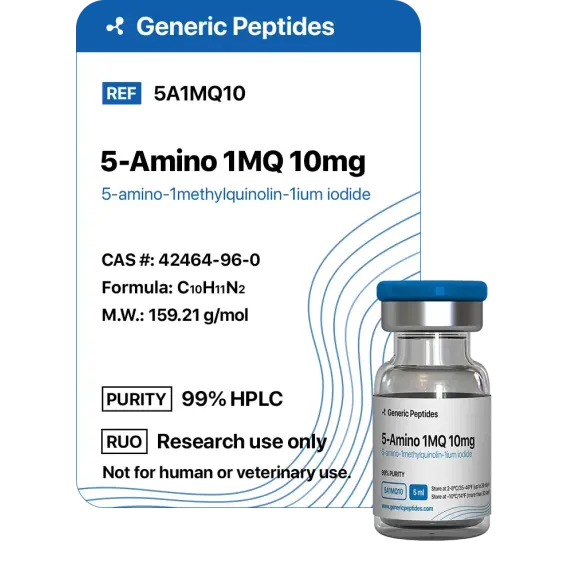
5-Amino-1MQ 10mg
Certificate of Analysis available


Researchers at the University of Texas Medical Branch noticed something strange in obese animal fat tissue: an enzyme called NNMT was running at hyperactive levels compared to lean controls. Levels far above what healthy metabolism needed. So they went hunting for a molecule that could shut it down. Neelakantan and colleagues screened quinolinium compounds, tested membrane permeability, and in a 2017 Journal of Medicinal Chemistry paper landed on the lead candidate. The compound was 5-Amino-1MQ. Within months it became the most-used pharmacological tool for studying what happens when you take the brakes off NAD+ metabolism in fat cells.
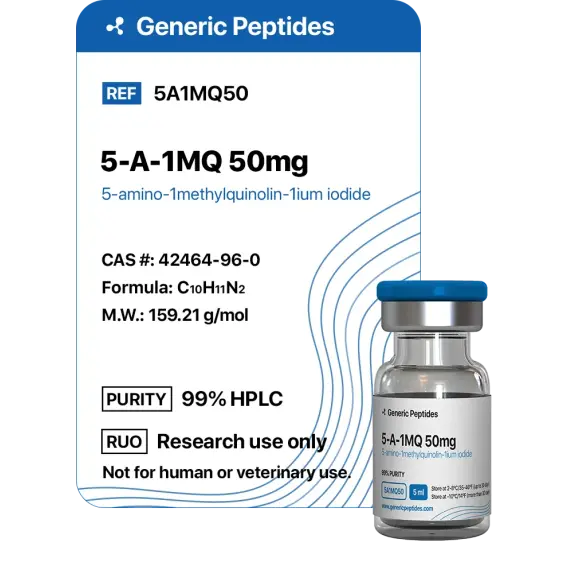
5-Amino-1MQ is a small-molecule research compound — not a peptide. The full chemical name is 5-amino-1-methylquinolinium, typically sold as the iodide salt (CAS 42464-96-0). It belongs to the quinolinium family of cyclic aromatic compounds, structurally distinct from anything else commonly sold in the metabolic research space. The molecular weight is roughly 159 daltons (free base) or 286 daltons (iodide salt) — orders of magnitude smaller than the peptides that make up most of the metabolic research toolkit.
It works as a selective inhibitor of nicotinamide N-methyltransferase (NNMT). NNMT is an enzyme that catalyzes the transfer of methyl groups from S-adenosylmethionine (SAM) to nicotinamide, generating 1-methylnicotinamide (1-MNA) as a metabolic dead-end product. When NNMT is overactive — as it is in obese adipose tissue — it consumes both nicotinamide (depleting NAD+ precursor pools) and SAM (depleting methylation potential). 5-Amino-1MQ blocks that enzyme, restoring nicotinamide availability for NAD+ synthesis and preserving SAM for downstream methylation reactions.
Here's why metabolic researchers got excited: NNMT inhibition appears to simultaneously address two of the most important metabolic dysfunctions in obesity. Restoring NAD+ availability supports mitochondrial function, sirtuin activity, and cellular energy production. Restoring SAM availability affects methylation patterns governing gene expression in adipose tissue, including the genes that determine whether cells commit to becoming fat-storage cells in the first place.
The 2017 Neelakantan paper documented that 5-Amino-1MQ in diet-induced obese mice produced significant body weight reduction, decreased fat mass, lower plasma cholesterol, improved lipid handling, and on-target reduction of 1-MNA confirming enzyme inhibition. Subsequent research has expanded into adipocyte differentiation studies (NNMT inhibition appears to interfere with the developmental program that drives preadipocytes into mature fat cells), satellite cell biology (skeletal muscle NNMT affects regenerative capacity), and broader NAD+ metabolism research where 5-Amino-1MQ has become a standard tool for studying NNMT-dependent pathways.
Here's the uncomfortable truth: 5-Amino-1MQ is genuinely early-stage. The compound is roughly nine years out from its first publication. There are no completed human clinical trials. The published evidence is preclinical — primarily mouse models and cell culture work. Anyone selling 5-Amino-1MQ with implications about specific human outcomes is going far beyond what the literature supports. The mechanism is real and well-characterized; the human translation question hasn't been answered yet.
That said, the mechanism's logic is unusually compelling. Unlike GLP-1 agonists that work through appetite suppression or stimulants that work through energy expenditure increases, 5-Amino-1MQ targets a specific metabolic dysfunction (hyperactive NNMT in obese adipose tissue) that's been documented across multiple research groups. The compound doesn't suppress appetite; it doesn't stimulate the cardiovascular system; it doesn't engage the central nervous system at conventional pharmacological levels. For research designs investigating NAD+ biology, adipose metabolism, or NNMT-dependent pathways specifically, 5-Amino-1MQ is currently the best-characterized chemical tool available.
Regulatory note: 5-Amino-1MQ is a small molecule research compound, not a peptide. It's not FDA-approved for any human indication, not on the FDA's 503A or 503B bulks lists, and not part of the recent peptide reclassification activity affecting BPC-157, Epitalon, and others. As a research compound for laboratory use, it remains commercially available in the United States. WADA's Prohibited List does not currently name 5-Amino-1MQ.
Here's a sourcing problem that's specific to 5-Amino-1MQ: despite being commonly sold alongside peptides, it requires completely different synthesis chemistry and quality verification. The compound is a small organic molecule synthesized through quinolinium chemistry — fundamentally different production methods than the solid-phase peptide synthesis that produces BPC-157 or Sermorelin. Cheap suppliers in the peptide research market often source 5-Amino-1MQ from unverified small-molecule manufacturers without the analytical methods needed to confirm purity, salt form, or contaminant levels for non-peptide compounds. The result: material that may or may not be the labeled compound, may have synthesis impurities that compete with NNMT binding, or may be sold as the wrong salt form. Without analytical verification using methods appropriate for small-molecule chemistry (not peptide HPLC), the difference is invisible to buyers but ruins any NNMT-dependent research.
Generic Peptides supplies research-grade 5-Amino-1MQ for sale at 99% purity, manufactured in the USA. Domestic synthesis with small-molecule analytical verification — the part that determines whether your NNMT inhibition assay produces the published profile or fails to replicate.
Order 5-Amino-1MQ for sale in the USA — 99% purity, full small-molecule analytical verification, manufactured domestically.
Yes — 5-Amino-1MQ is legally available as a research compound in the United States. As a small molecule (not a peptide), it occupies a different regulatory category from the peptide compounds currently in 503A bulks list transition. Not FDA-approved for human use. WADA does not currently list it as prohibited.
No. 5-Amino-1MQ is a small organic molecule (5-amino-1-methylquinolinium) — much smaller than peptides and synthesized through completely different chemistry. It's commonly sold alongside peptides in the research compound market because researchers studying metabolism often investigate both peptide and small-molecule tools, but the chemistry, regulatory status, and quality verification methods differ.
NNMT (nicotinamide N-methyltransferase) is an enzyme that consumes both nicotinamide (an NAD+ precursor) and S-adenosylmethionine (SAM, the universal methyl donor) when it's overactive. In obese fat tissue, NNMT runs at hyperactive levels, depleting NAD+ availability and methylation potential simultaneously. Inhibiting NNMT restores both pools, addressing two metabolic dysfunctions at once.
Completely different mechanisms targeting different problems. GLP-1 agonists work through central appetite suppression and pancreatic insulin secretion. 5-Amino-1MQ works peripherally on adipose tissue NAD+ metabolism without affecting appetite or the central nervous system. The research applications don't overlap — they're tools for studying different aspects of metabolic regulation.
Probably not at the same purity. The compound requires small-molecule synthesis verification (not peptide-style HPLC), and many research compound suppliers source from unverified manufacturers without appropriate analytical methods. Cheap material may have synthesis impurities, wrong salt forms, or contaminants that compromise NNMT binding. With small molecules, label verification means almost nothing without analytical confirmation.
Sources
Neelakantan H et al. — "Selective and membrane-permeable small molecule inhibitors of nicotinamide N-methyltransferase reverse high fat diet-induced obesity in mice." Journal of Medicinal Chemistry, 2017. The foundational discovery paper documenting 5-Amino-1MQ's NNMT inhibition and metabolic effects in obese mouse models. https://pubmed.ncbi.nlm.nih.gov/29059531/
Liu JR, Deng ZH, Zhu XJ, Zeng YR, Guan XX, Li JH — "Roles of Nicotinamide N-Methyltransferase in Obesity and Type 2 Diabetes." BioMed Research International, 2021. Comprehensive review of NNMT in metabolic disease. https://pubmed.ncbi.nlm.nih.gov/?term=liu+NNMT+obesity+type+2+diabetes+review
Kraus D et al. — "Nicotinamide N-methyltransferase knockdown protects against diet-induced obesity." Nature, 2014. Documents the foundational genetic evidence linking NNMT to adipose metabolism dysfunction. https://pubmed.ncbi.nlm.nih.gov/24717514/
PubChem — 5-Amino-1MQ chemical data and identification. CAS 42464-96-0 for the iodide salt. Documents structural identity and chemical properties. https://pubchem.ncbi.nlm.nih.gov/compound/5-amino-1-methylquinolinium
A small molecule, not a peptide. NNMT inhibition is the mechanism. Verification matters at this scale.
5-Amino-1MQ ships as a white to off-white lyophilized powder in a sealed glass vial. As a small-molecule NNMT inhibitor (not a peptide), it's more chemically robust than most research peptides — but cold, dark, dry storage still protects it from light-induced degradation and moisture uptake. Here's exactly how to store it.
| Parameter | Details | Notes |
|---|---|---|
| Storage Temperature | Freezer at −20°C (−4°F) for long-term storage up to 24 months. Refrigeration at 2–8°C (36–46°F) is fine for short-term use up to ~3 months. | Original sealed vial in the freezer is the safest default. |
| Light Sensitivity | Yes — the aromatic quinolinium structure can undergo photodegradation under UV or bright light. | Always keep in the original box or an opaque, amber container. |
| Freezing | Allowed and recommended. −20°C is standard for long-term storage; −80°C extends stability further if available. | Freeze from the start if you won't use it within 3 months. |
| Signs of Degradation | Healthy powder is white to off-white and loose or crystalline. Watch for yellowing, browning, darkening, clumping, visible moisture, or a sticky texture. | Any color change beyond light off-white, clumping, or moisture = discard the vial. |
| Common Mistakes | Leaving the vial at room temperature after delivery, storing in a humid kitchen or bathroom, or opening a cold vial and letting condensation form inside. | Put it in the freezer on arrival, and let sealed vials warm to room temperature before opening. |
Every order is processed quickly and shipped with full tracking. All products come directly from the official Generic Peptides supply chain — in original manufacturer packaging, carefully handled from warehouse to your door.
| Destination | Delivery Time | Notes |
|---|---|---|
| USA Domestic | 2–5 business days | Faster when local warehouse stock is selected at checkout |
| International | 10–15 business days | Tracking included; update frequency may vary by destination country |
| Order Processing | 24–48 business hours | Processing begins after payment confirmation |
| Tracking | Provided on all orders | Tracking number sent after dispatch; multiple warehouses may result in separate shipments |
This product is supplied through the official Generic Peptides distribution chain and shipped in original manufacturer packaging. Orders are packed securely to protect the contents during transit and to respect customer privacy as a standard practice.
Outer packaging is neutral and does not display product details on the exterior — a common approach to protect shipments from damage, tampering, and unnecessary exposure during delivery.
Every order includes full authenticity assurance: official Generic Peptides presentation, batch-linked lab documentation, and sealed original packaging — giving customers confidence in every purchase.
| Authenticity Feature | Details |
|---|---|
| Packaging | Original manufacturer packaging — sealed and unaltered |
| Lab Documentation | Batch-linked certificate of analysis available on request |
| Supply Chain | Sourced exclusively through official Generic Peptides distribution |
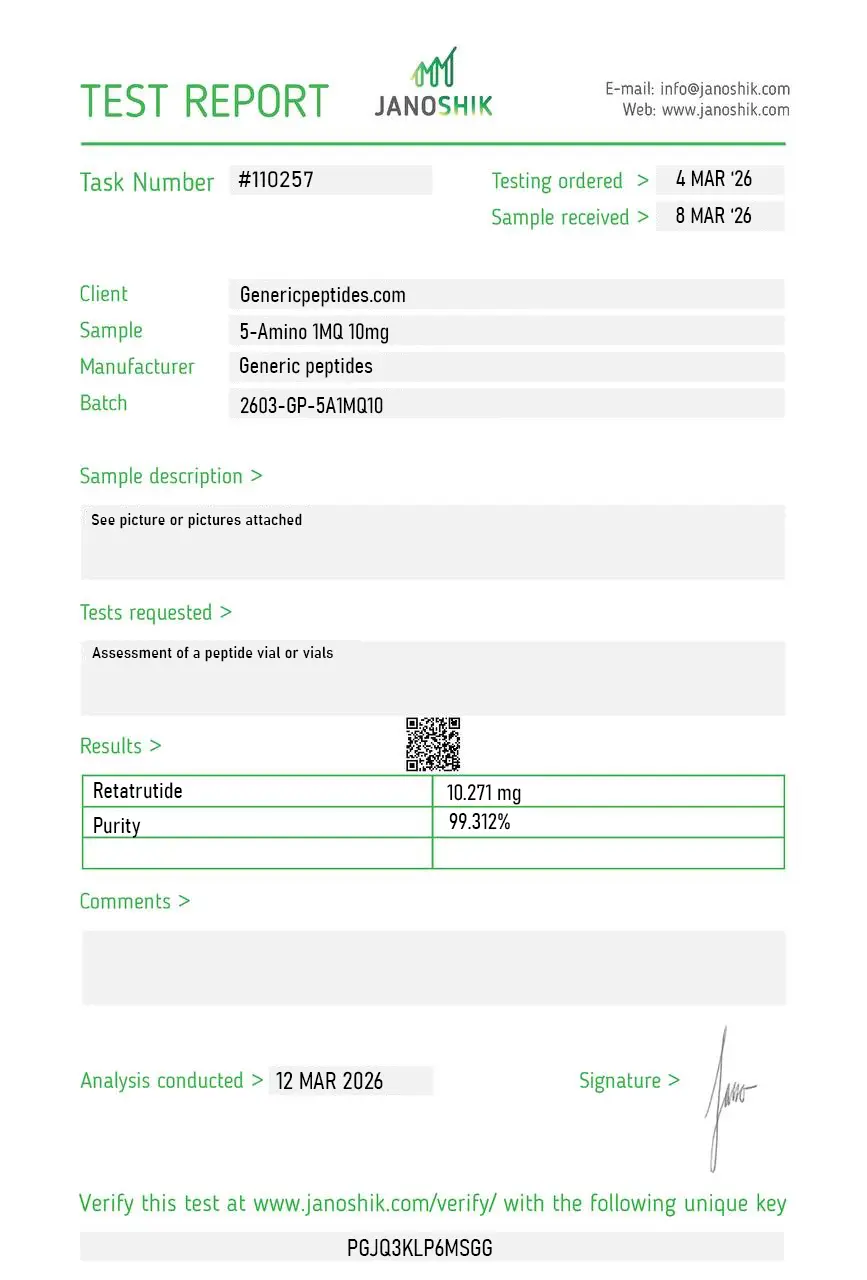
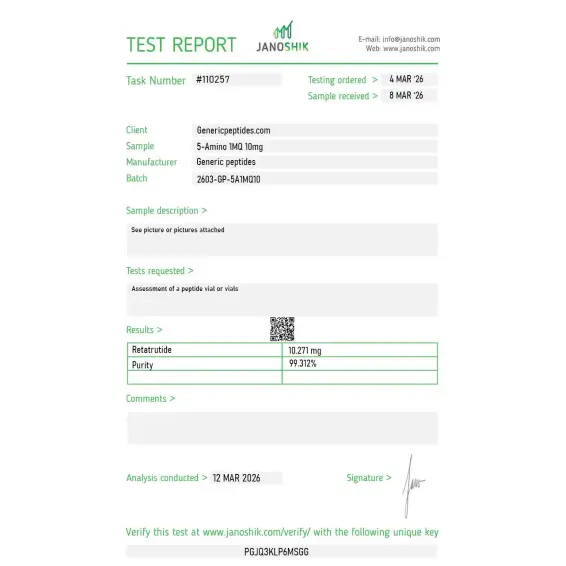
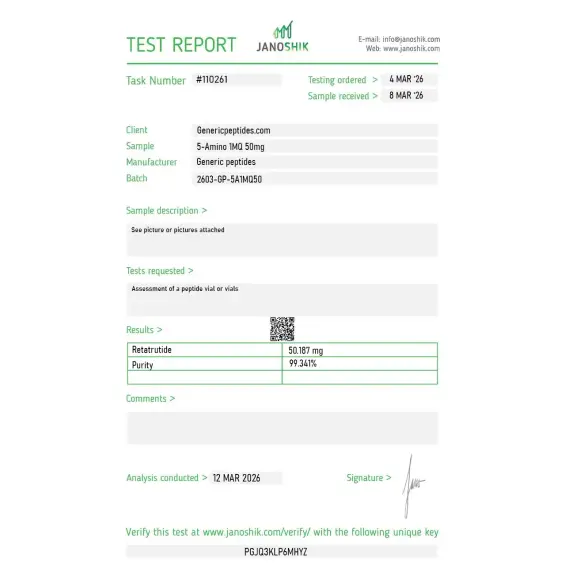
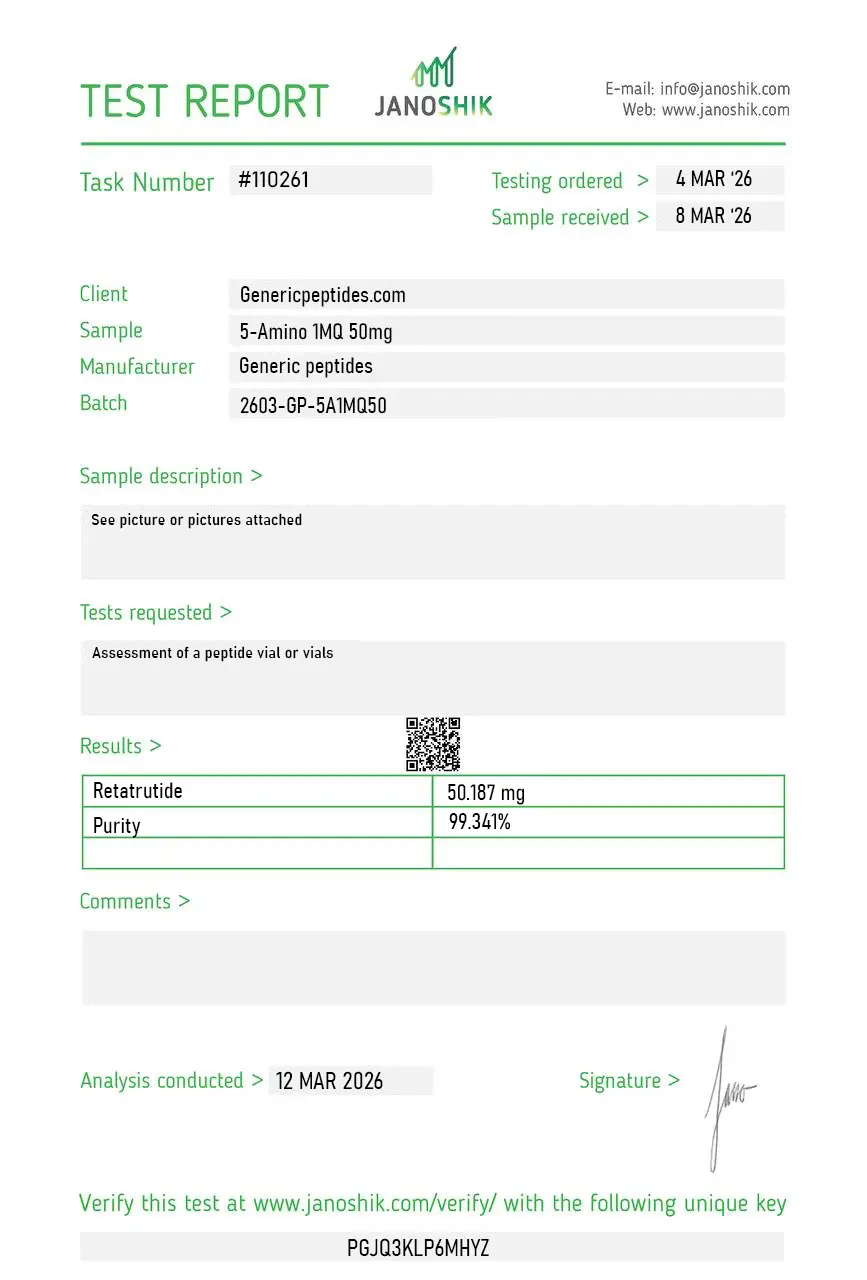
Independent lab test reports are available for 5-Amino-1MQ 10mg and 50mg batches. Each certificate provides batch-level verification details, including measured content, purity result, analysis date, and report documentation.
NNMT inhibition assays in adipocytes. Clean enzyme kinetics.
We benchmark NNMT inhibitors and this one's our reference standard since the McHardy group papers. Material has matched our internal potency assays each batch. Nothing exciting to say, which in QC terms is the best possible outcome.
Does what a research-grade NNMT inhibitor should. No complaints across three orders.
Cheaper than the specialty chemistry houses and the purity by HPLC was actually slightly better than the last lot I got from one of them. Pleasant surprise.
For adipose tissue NNMT biology research — building on the Kraus et al. Nature 2014 demonstration that adipocyte NNMT knockout protects from diet-induced obesity in mice — 5-Amino-1MQ provides the pharmacological inhibition complement to genetic knockout approaches. The supplier carrying this small molecule alongside the peptide products for comparative adipose biology research allows for diverse experimental design approaches within a single catalog.
Reorder for ongoing adipocyte NNMT work. Fine.
Product has been good across three orders. The reason I'm at four stars is that for 5-Amino-1MQ specifically, where the published research base is dominated by the McHardy/UT Health San Antonio group with limited independent replication, the product page should be explicit about this single-research-program dominance. Researchers familiar with the broader NAD+ metabolism literature (Verdin, Sinclair, Imai groups) understand 5-Amino-1MQ exists within a wider research context, but the specific compound's evidence base is narrower than the parent NNMT biology field.
The compound binds to and inhibits the enzyme NNMT (nicotinamide N-methyltransferase) in cells. NNMT normally transfers methyl groups from SAM (S-adenosylmethionine) to nicotinamide, producing 1-methylnicotinamide. When NNMT runs at hyperactive levels (as in obese adipose tissue), it depletes both NAD+ precursor pools and methylation potential simultaneously. Inhibiting NNMT restores both, with downstream effects on mitochondrial function, sirtuin activity, and adipocyte gene expression.
Mechanism and pharmacology. Traditional weight loss compounds work through appetite suppression (GLP-1 agonists), stimulant effects (sympathomimetics), or absorption blockade (lipase inhibitors). 5-Amino-1MQ works peripherally on adipose tissue metabolism without affecting appetite, central nervous system, or absorption. It targets a specific enzymatic dysfunction (overactive NNMT) rather than caloric balance.
The mechanism isn't fully resolved but appears related to inflammatory signaling and metabolic stress in expanding adipose tissue. NNMT expression is increased by transcription factors active in obese adipose tissue, and the enzyme's hyperactivity then perpetuates metabolic dysfunction by depleting NAD+ and methylation capacity. The 2014 Kraus Nature paper established the foundational genetic link between NNMT and obesity-related metabolic dysfunction.
The compound requires small-molecule synthesis chemistry (different from peptide synthesis), and many research compound suppliers in the peptide market don't have appropriate analytical methods to verify purity, salt form, or contaminant levels for non-peptide compounds. Cheap producers often source from unverified small-molecule manufacturers without proper quality control, delivering material that may have synthesis impurities or wrong salt forms.
5-Amino-1MQ was developed and characterized by Stanley Watowich's research group at the University of Texas Medical Branch, with the foundational paper published in the Journal of Medicinal Chemistry in 2017 (Neelakantan et al.). The work built on earlier NNMT genetic studies, particularly the 2014 Kraus paper in Nature establishing NNMT's role in obesity. The compound has approximately nine years of published research history.
5-Amino-1MQ is not currently named on the WADA Prohibited List as of 2025. The compound's mechanism — peripheral NNMT inhibition affecting adipose metabolism — doesn't fit standard performance-enhancing categories. Athletes subject to drug testing should consult their governing body's specific rules, as anti-doping regulations can include unspecified substances under broad categories.
5-amino-1-methylquinolinium (the full chemical name), 5A1MQ, 5-Amino 1MQ (without hyphen), and the chemical descriptor 1-methyl-5-aminoquinolinium iodide for the salt form. CAS 42464-96-0 (iodide salt). Different formatting conventions across literature, all referring to the same small molecule.
Adipose tissue metabolism and obesity research lead by volume. There's also active work in NAD+ biology and sirtuin pathway research, where 5-Amino-1MQ serves as a tool for restoring NAD+ availability through NNMT inhibition. Skeletal muscle satellite cell research, hepatic steatosis models, and aging-related metabolic decline are additional active research areas.
Different approaches to similar metabolic goals. NAD+ supplementation (via NMN or NR precursors) directly provides substrate for NAD+ synthesis. 5-Amino-1MQ blocks the enzyme that wastes nicotinamide, indirectly preserving NAD+ precursor pools. Researchers sometimes investigate both approaches as complementary — supplementation provides building blocks, NNMT inhibition prevents their wasteful methylation.
Beyond being a small molecule rather than a peptide, 5-Amino-1MQ targets an intracellular enzyme rather than a cell surface receptor. Most metabolic research peptides (GLP-1 agonists, growth hormone secretagogues, melanocortin agonists) work through receptor binding at cell membranes. 5-Amino-1MQ enters cells and inhibits a cytosolic enzyme directly. That different cellular target means different research applications, different pharmacokinetic considerations, and different quality verification methods than peptide compounds require.