After Ozempic, FDA’s Next Peptide Fight Is Here: PSM Opposes All Seven Substances
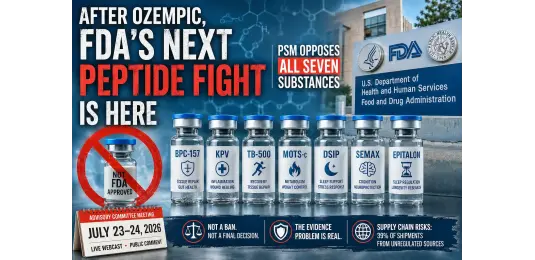
After Ozempic, FDA's Next Peptide Fight Is Here: PSM Opposes All Seven Substances
The deadline for comments guaranteed to reach the advisory committee has passed. BPC-157, TB-500, MOTS-c, Semax and three other peptides now face a decision that could close their clearest path into legal pharmacy compounding.
Ozempic changed more than weight loss.
It taught millions of Americans to think of injectable molecules as something they could discuss with a telehealth provider, order through an online clinic and receive from a compounding pharmacy. What had once been a narrow pharmaceutical practice suddenly became part of mainstream wellness culture.
But the GLP-1 boom also brought fake products, misleading advertising, questionable imports and growing confusion over one basic question:
When does a compounded drug become a legitimate medical product—and who is actually watching the companies selling it?
That same argument has now moved into the wider peptide market.
On July 23 and 24, an FDA advisory committee will examine seven substances that have become familiar names in recovery, metabolic research, sleep science and biohacking communities:
BPC-157, KPV, TB-500, MOTS-c, Emideltide or DSIP, Semax and Epitalon.
FDA staff has already proposed keeping every free-base and acetate form of those substances off the Section 503A Bulks List. Now the Partnership for Safe Medicines has filed a formal 12-page comment urging the committee to reject all seven.
The deadline for comments guaranteed to be provided directly to committee members passed on July 9.
The broader docket remains open through July 22, but comments arriving now will be considered by FDA rather than being guaranteed a place in the committee's advance materials.
This is not yet a ban. It is not a final FDA decision. But it is the most consequential regulatory test these seven peptides have faced in years.
Quick Answer
FDA is deciding whether seven bulk peptide substances should be eligible for use by qualifying traditional compounding pharmacies under Section 503A.
FDA staff currently recommends against all seven. The Partnership for Safe Medicines, or PSM, has now formally supported that position, arguing that the substances lack adequate human evidence, could mislead patients and would place more pressure on an already difficult-to-police supply chain.
The advisory committee will discuss the substances individually on July 23 and 24. Its recommendations will not legally bind FDA, although the agency says it generally follows advisory committee recommendations.
What Is Actually at Risk?
The phrase "503A Bulks List" sounds like something designed to make ordinary readers stop paying attention.
The real meaning is much simpler.
Traditional compounding pharmacies can prepare patient-specific medications from certain bulk drug ingredients when statutory conditions are met. Inclusion on the 503A Bulks List can provide a legal pathway for a substance that is not already covered through another qualifying route.
If these seven peptides remain off the list, pharmacies generally will not gain that pathway for preparing patient-specific compounded products from the reviewed bulk ingredients.
That would not erase the molecules from existence. It would not prohibit laboratory research. And it would not suddenly transform every vial bearing one of these names into contraband.
But it could make the divide much sharper:
On one side, FDA-approved medicines and substances that qualify for pharmacy compounding.
On the other, research-chemical websites, overseas sellers, loosely supervised wellness companies and products not legally authorized for human use.
That distinction is why this meeting matters far beyond a technical committee vote.
The Seven Peptides, Without the Regulatory Language
The substances do not belong to one scientific category, and they are not interchangeable.
BPC-157, KPV and TB-500 are most commonly discussed around tissue repair, inflammation and wound-healing research. FDA is specifically evaluating BPC-157 for ulcerative colitis, KPV for wound healing and inflammatory conditions, and TB-500 for wound healing.
MOTS-c is the metabolic substance in the group. It has generated interest because of preclinical research involving glucose metabolism, exercise-related signaling and mitochondrial biology. FDA is reviewing its nomination for obesity and osteoporosis.
Emideltide, better known as DSIP, is being evaluated for opioid withdrawal, chronic insomnia and narcolepsy.
Semax is associated with neurological research and is being reviewed for cerebral ischemia, migraine and trigeminal neuralgia.
Epitalon has become popular in longevity discussions, although FDA's meeting focuses specifically on its nomination for insomnia.
These compounds are often grouped together online under the vague label "peptides." Scientifically, however, they have different structures, proposed uses, evidence records and safety questions.
That should mean seven separate evaluations—not one collective judgment about whether the peptide industry feels trustworthy.
No, These Are Not Ozempic Copies
None of the seven substances is semaglutide, tirzepatide or a GLP-1 drug.
Calling them "Ozempic alternatives" or "Ozempic analogs" would be inaccurate.
The Ozempic connection is about the business model surrounding them.
The GLP-1 boom showed how quickly an injectable drug category can move from medical practice into telehealth advertising, celebrity culture, online subscription programs and mass-market wellness.
It also exposed how easily patients can confuse an FDA-approved product with a compounded version—or assume that anything supplied through a clinic has undergone full FDA review.
PSM explicitly invokes that history in its argument against MOTS-c. It warns that compounders could market MOTS-c as an unapproved alternative to established obesity drugs such as semaglutide and tirzepatide, even though MOTS-c does not have comparable clinical evidence.
That does not make MOTS-c a GLP-1 drug.
It means the fight over GLP-1 compounding has become a template for how regulators and patient-safety groups now view the broader injectable-wellness market.
PSM Has Entered the Fight
The Partnership for Safe Medicines submitted its formal comment on July 1.
The organization describes itself as a coalition of patient advocates, healthcare professionals, pharmacists and public-health groups focused on counterfeit, contaminated and substandard medicines.
Its position is unambiguous:
None of the seven substances should be added to the 503A Bulks List.
PSM gives three central reasons.
First, it says the available human evidence is too limited to establish safety or effectiveness.
Second, it argues that inclusion could create false legitimacy. A patient might hear that a substance is "FDA-listed" and reasonably—but incorrectly—assume that FDA had approved the peptide as a drug.
Third, PSM argues that regulators do not have enough capacity to oversee the manufacturers, importers, pharmacies, clinics and telehealth businesses that could enter an expanded peptide-compounding market.
PSM is not conducting the official FDA evaluation. It is an advocacy organization submitting a position to the public docket.
But its filing matters because it closely supports the negative direction already taken by FDA staff.
The Evidence Problem Is Real
The most persuasive part of the PSM filing is not its rhetoric about the wellness industry.
It is the weakness of the human evidence.
According to the organization's summary:
-
BPC-157: Human evidence involves fewer than 36 participants across three studies, while most of the wider literature comes from animal models.
-
KPV: There is preclinical and human-cell research, but PSM says it found no trials involving administration to living human participants.
-
TB-500: The peptide itself has been examined in only one human tolerance or toxicity study. Research involving full-length thymosin beta-4 cannot automatically prove that the TB-500 fragment has the same effects or safety profile.
-
MOTS-c: There is no completed clinical evidence supporting its nominated uses of obesity and osteoporosis.
-
Emideltide or DSIP: Small, older human studies exist, but later development did not result in regulatory approval.
-
Semax: Human research has been conducted outside the United States, but PSM argues that the available studies do not meet the evidence and oversight standards expected by FDA.
-
Epitalon: Limited foreign studies exist, but PSM and FDA staff consider the available evidence methodologically inadequate for the nominated use.
This is the uncomfortable center of the debate.
Interesting mechanisms are not the same as proven treatments.
Animal results are not human safety data.
And decades of online anecdotes do not establish identity, dose consistency, sterility, long-term risk or clinical effectiveness.
The 39% Import Number Is Alarming—but Easy to Misuse
PSM's most dramatic supply-chain claim concerns peptide shipments entering the United States.
According to the filing, freight data for the first quarter of 2026 identified 127 shipments categorized broadly as "peptides not elsewhere classified." PSM says that 50 of those shipments—approximately 39%—originated from manufacturers operating outside FDA oversight and without explicit authorization to import drugs into the United States.
That is a serious warning signal.
But it does not mean that 39% of all peptide vials purchased online are counterfeit. It does not prove that four out of every ten consumers receive a contaminated product. And it does not identify every shipment as intended for patient use.
The number describes a set of freight records analyzed and presented by PSM. It is not a consumer-level failure rate.
What it does show is that the peptide supply chain is difficult to see clearly.
A label can say "99% purity." A website can display a certificate. A clinic can describe a product as pharmaceutical grade.
None of those statements alone proves where the active ingredient was made, whether it was the correct molecule, whether the finished product was sterile or whether the vial remained stable during transport.
That problem exists regardless of whether someone supports or opposes legal compounding.
The Legal Trap: "FDA-Listed" Is Not "FDA-Approved"
This may be the most important distinction in the entire debate.
Adding a substance to the 503A Bulks List would not mean that FDA had approved it as safe and effective.
It would not turn BPC-157 into an approved ulcerative-colitis treatment.
It would not make MOTS-c an approved obesity drug.
It would not prove that Epitalon improves sleep or extends life.
It would mean that qualifying pharmacies could use the bulk substance in patient-specific compounding when the other requirements of Section 503A are satisfied.
Compounded drugs do not pass through the same premarket approval process as conventional FDA-approved medicines.
The concern is that marketing can blur that distinction.
Terms such as "FDA-reviewed," "FDA-listed," "pharmacy compounded" and "physician prescribed" may sound like different versions of "FDA-approved" to a patient who has never needed to understand pharmaceutical law.
They are not.
PSM is right to demand clearer language around that difference.
But Closing the Legal Path Creates Its Own Risk
Here is where the debate becomes harder.
Keeping the seven peptides off the list does not necessarily eliminate demand for them.
People who currently seek BPC-157, TB-500, MOTS-c, Semax or Epitalon may not suddenly lose interest because an advisory committee recommends against pharmacy compounding.
Some will simply move toward research-chemical sellers, private groups, offshore websites or products with even less oversight.
Supporters of inclusion therefore make a serious counterargument:
A controlled pharmacy pathway could be safer than forcing an existing market further underground.
PSM acknowledges that argument but concludes that the benefits of a regulated pathway do not outweigh the evidence and enforcement risks.
That conclusion is debatable.
A weak evidence base can justify restricting medical claims. Poor manufacturing can justify stricter standards. Misleading clinics can justify enforcement.
But none of those facts automatically proves that removing regulated compounding is safer than leaving consumers with an uncontrolled gray market.
The committee must consider both sides of the risk equation:
What could happen if pharmacies are allowed to compound these substances?
And:
What could happen if demand remains but the pharmacy pathway is closed?
FDA Is Supposed to Judge the Peptides Separately
PSM asks for one answer covering all seven substances: no.
FDA's own evaluation framework is more specific.
The agency says it considers physical and chemical characterization, safety issues, available evidence of effectiveness and historical use. Those factors are supposed to be balanced on a substance-by-substance basis.
That matters.
KPV should not be rejected because MOTS-c lacks human obesity data.
Epitalon should not be judged through the evidence for BPC-157.
Research involving full-length thymosin beta-4 should not automatically be treated as proof for TB-500—but it should not automatically be treated as irrelevant either.
Semax's history outside the United States deserves scrutiny, but "foreign research" is not, by itself, a scientific conclusion.
A category-wide rejection is administratively simple. It may not be scientifically precise.
The Comment Window Is Only Partly Closed
The procedural deadline that triggered this update passed on July 9.
Comments received by that date are to be provided to the Pharmacy Compounding Advisory Committee.
The public docket itself remains open until 11:59 p.m. Eastern Time on July 22. Comments received between July 10 and July 22 can still be considered by FDA, but they are not guaranteed to be included in the committee members' advance materials.
That distinction is important because the committee is not the final decision-maker.
It will hear evidence and make recommendations. FDA will then decide what action to take, and any broader regulatory outcome may require additional agency steps.
What Happens on July 23 and 24
On July 23, the committee is scheduled to consider:
- BPC-157
- KPV
- TB-500
- MOTS-c
On July 24, it will consider:
- Emideltide or DSIP
- Semax
- Epitalon
FDA plans to provide a free live webcast, and the meeting will include public presentations and committee discussion.
The panel will not be deciding whether peptides are promising.
It will be deciding whether the available evidence and manufacturing information justify giving these specific bulk substances a place within the 503A compounding framework.
Those are very different questions.
The Bottom Line
The peptide market is heading toward a regulatory dividing line.
FDA staff has proposed rejecting every substance and form on the July agenda. PSM has now added a coordinated patient-safety argument supporting rejection of all seven.
But nothing has been banned by this filing.
No final vote has occurred.
And the July 9 deadline did not close the public docket—it closed the guaranteed route for written comments to go directly into the committee's advance materials.
The real argument is larger than BPC-157, MOTS-c or Epitalon.
It is about whether substances with promising biology but incomplete clinical evidence should have a controlled pharmacy pathway—or whether allowing that pathway gives experimental compounds a level of legitimacy they have not earned.
Ozempic showed how quickly a niche injectable market can become mainstream.
The July committee meeting will show whether FDA intends to prevent the next peptide boom before it begins—or whether it believes carefully regulated compounding can be part of the solution.
Generic Peptides will follow the July 23–24 meeting and report the committee's recommendation for each substance individually. Subscribe to our free updates to receive the results as soon as they are announced.