FDA Staff Recommends Against All Seven Peptides Before July PCAC Vote: Why That May Be a Bad Idea
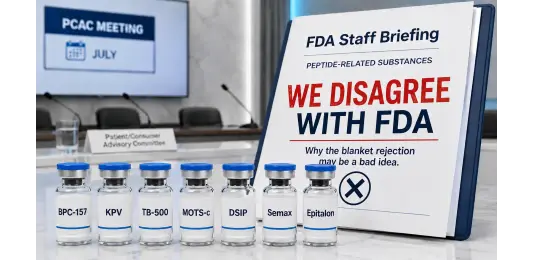
FDA Staff Recommends Against All Seven Peptides Before July PCAC Vote: Why That May Be a Bad Idea
Reading Time: 6 mins
Regulatory News · FDA · PCAC · Peptide Compounding · 503A Bulks List
FDA staff has now taken the clearest possible position before the July 2026 Pharmacy Compounding Advisory Committee meeting: do not add any of the seven peptide-related substances under review to the 503A Bulks List.
That does not mean the final decision has already been made. It does not mean the July 23–24 meeting no longer matters. And it does not mean BPC-157, KPV, TB-500, MOTS-c, DSIP/Emideltide, Semax, or Epitalon have suddenly become "banned" in a new way overnight.
But it does change the tone of the meeting.
Until now, the July PCAC review looked like a question: could these seven peptides move toward a clearer legal compounding pathway? After the FDA briefing document, the question is sharper: will the advisory committee agree with FDA staff's negative recommendation, or will it push for a more flexible approach?
What FDA Staff Is Recommending
The July 2026 PCAC meeting covers seven peptide-related bulk drug substance groups:
- BPC-157-related bulk drug substances
- KPV-related bulk drug substances
- TB-500-related bulk drug substances
- MOTS-c-related bulk drug substances
- Emideltide-related bulk drug substances, also referred to as DSIP
- Epitalon-related bulk drug substances
- Semax-related bulk drug substances
Each is being reviewed in both free-base and acetate form. In the FDA briefing document, the agency's staff position is negative across the board. FDA is proposing that none of the seven, in either form, be included on the 503A Bulks List.
That matters because the 503A Bulks List is one of the legal pathways that allows licensed compounding pharmacies to prepare certain drug products from bulk drug substances for patient-specific prescriptions. If a substance is not on that list, does not have an applicable USP or NF monograph, and is not a component of an FDA-approved drug, the legal pathway becomes much narrower.
In plain English: the staff recommendation is not a drug approval decision. It is not the final PCAC vote. But it is a strong signal that FDA staff does not believe these seven substances currently meet the agency's standard for inclusion.
Why This Looks Bad for the Seven Peptides
The immediate problem is simple: all seven peptides are now walking into the advisory committee meeting with FDA staff already recommending "no."
That is very different from a neutral review. The committee can still ask questions, hear presentations, weigh public comment, and vote differently. FDA advisory committee recommendations are not binding. The agency also says it does not intend to make a final determination until the advisory committee process and all reviews are complete.
Still, the starting position matters. FDA staff sets the scientific and regulatory frame the committee must respond to. If the staff position is that all seven should stay off the 503A list, then supporters of any peptide have to overcome that negative baseline.
That is especially important because this series has followed the seven substances one by one:
- BPC-157 for ulcerative colitis:
https://genericpeptides.com/news/bpc-157-fda-review-july-2026-5944 - KPV for wound healing and inflammatory conditions:
https://genericpeptides.com/news/kpv-fda-review-july-2026-5945 - TB-500 for wound healing:
https://genericpeptides.com/news/tb-500-fda-review-july-2026-5946 - MOTS-c for obesity and osteoporosis:
https://genericpeptides.com/news/mots-c-fda-review-july-2026-5947 - DSIP/Emideltide for opioid withdrawal, chronic insomnia, and narcolepsy:
https://genericpeptides.com/news/dsip-emideltide-fda-review-july-2026-5948 - Semax for cerebral ischemia, migraine, and trigeminal neuralgia:
https://genericpeptides.com/news/semax-fda-review-july-2026-5949 - Epitalon for insomnia:
https://genericpeptides.com/news/epitalon-fda-review-july-2026-5950
Each nomination had its own evidence question. Now the broader pattern is hard to miss: FDA staff appears unconvinced by the entire group.
Why a Blanket "No" May Be a Bad Idea
The safety concerns are real. That part should not be dismissed.
Several of these peptides have limited human data, uneven clinical evidence, unresolved questions around immunogenicity, and quality concerns related to manufacturing, impurities, and characterization. FDA is not wrong to care about those issues. A peptide that looks interesting in animal models or early research is not automatically ready for broad clinical use.
But the policy question is bigger than whether every peptide has perfect evidence.
The problem with a blanket rejection is that it may not reduce real-world demand. It may simply move that demand away from regulated compounding pharmacies and deeper into less transparent channels.
That is the uncomfortable part of the July 2026 review. Peptide demand already exists. People are already searching for BPC-157, TB-500, KPV, Semax, Epitalon, MOTS-c, and DSIP. Some are reading scientific papers. Some are following wellness influencers. Some are buying from research-only suppliers. Some are getting advice from forums instead of clinicians.
If FDA staff says no to every possible 503A pathway, the agency may protect the formal compounding system while leaving the wider gray-market problem untouched.
That is why critics may see the recommendation as a bad idea. Not because safety should be ignored. Not because every peptide should be treated as proven. But because a simple "no" can create a vacuum. And in the peptide market, vacuums usually get filled by lower-quality sourcing, weaker documentation, and less medical oversight.
The Better Question: Ban, Allow, or Control?
The most important question may not be whether FDA should say yes or no to all seven peptides.
The better question is whether a controlled pathway could be safer than forcing the market into unofficial channels.
A strict compounding pathway could include clearer identity standards, stronger batch documentation, route-specific restrictions, patient-specific prescriptions, and better adverse event tracking. It could also distinguish between substances with some human evidence and those with little more than preclinical rationale.
That would not make these peptides FDA-approved drugs. It would not prove they work. It would not erase safety concerns.
But it could create a more transparent system than the one many people use now.
This is where the July PCAC meeting becomes important. The committee is not being asked to approve these peptides like new drugs. It is being asked whether these bulk drug substances should be included on the 503A Bulks List for compounding purposes. That is a narrower question, but it has very real consequences for access, quality control, and the direction of the peptide market.
Why the PCAC Vote Still Matters
Even with FDA staff recommending against all seven peptides, the July 23–24 meeting is still worth watching.
Advisory committees provide recommendations. They are influential, but they are not the final legal decision. FDA can consider the committee's input, the staff briefing materials, public comments, nominations, safety concerns, and other issues before making a final determination.
That means there are still several possible outcomes:
- The committee could agree with FDA staff and recommend against all seven.
- The committee could split the group, supporting some substances and rejecting others.
- The committee could push for more limited or conditional pathways.
- FDA could take more time before any final rulemaking action.
The first outcome would be the cleanest from an enforcement standpoint. But it may not be the cleanest from a public health standpoint if it leaves demand in the shadows.
What This Means for the July 2026 Peptide Series
This update belongs after the full FDA Peptide Meeting July 2026 overview and the seven individual peptide articles because it changes the stakes for the whole series.
Overview:
https://genericpeptides.com/news/fda-peptide-meeting-july-2026-5943
The earlier question was: what will FDA evaluate?
The new question is: what happens when FDA staff recommends against every peptide before the committee even votes?
That is a different story. It is no longer just a compound-by-compound review. It is a broader test of how FDA wants to handle popular, non-approved peptides with active demand, incomplete evidence, and complicated sourcing realities.
A cautious FDA position is understandable. These peptides are not FDA-approved drugs. Many lack the kind of human evidence that would satisfy a traditional drug review. Some have serious unanswered questions.
But a blanket rejection may still be a bad idea if it treats demand as something that disappears when legal access narrows.
In reality, demand usually does not disappear. It moves.
And where it moves may matter just as much as what FDA decides on paper.
Bottom Line
FDA staff has recommended against adding all seven peptide-related substances to the 503A Bulks List before the July 2026 PCAC vote. That is a major development for BPC-157, KPV, TB-500, MOTS-c, DSIP/Emideltide, Semax, and Epitalon.
The recommendation is not final. The PCAC meeting still matters. But the agency's starting position is now clearly skeptical.
The strongest argument against the staff position is not that every peptide deserves easy access. It is that an across-the-board rejection may make the real-world market less regulated, not safer.
That is why the July vote matters. It will show whether FDA and its advisory committee see only the risks of allowing these substances into compounding, or whether they also see the risks of pushing demand outside regulated channels.
Sources
- FDA Briefing Document: Pharmacy Compounding Advisory Committee Meeting, July 23–24, 2026
https://www.fda.gov/media/193342/download - FDA Meeting Page: July 23–24, 2026 Pharmacy Compounding Advisory Committee
https://www.fda.gov/advisory-committees/advisory-committee-calendar/july-23-24-2026-meeting-pharmacy-compounding-advisory-committee-07232026 - FDA: Bulk Drug Substances Used in Compounding Under Section 503A
https://www.fda.gov/drugs/human-drug-compounding/bulk-drug-substances-used-compounding-under-section-503a-fdc-act