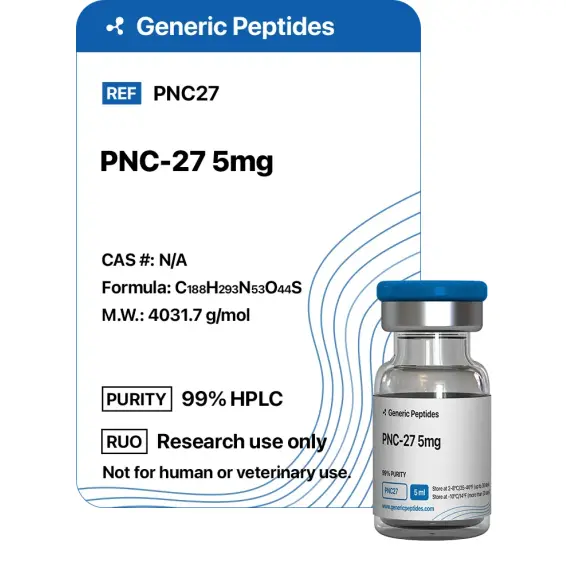
- For in vitro testing and laboratory use only.
- Not for human or animal consumption.
- Bodily introduction is illegal.
- Handle only by licensed professionals.
- Not a drug, food, or cosmetic.
- Educational use only.
Quick take on PNC-27
PNC-27 is an experimental 32-residue anti-cancer peptide developed by Matthew Pincus and colleagues at SUNY Downstate Medical Center in the early 2000s. It's a chimeric molecule combining two segments: residues 12-26 of the p53 tumor suppressor protein (the part that binds to HDM-2, a protein that regulates p53) fused to a cell-penetrating sequence called the membrane residency peptide (MRP). Originally designed as a "decoy peptide" to block p53-HDM-2 binding in the nucleus, it unexpectedly turned out to do something far more interesting.
Mechanism in plain English
This is where PNC-27 gets genuinely unusual. Cancer cells express HDM-2 on their outer cell membrane (normal cells don't, or only at very low levels). PNC-27 binds to this membrane-bound HDM-2 and, together with it, forms transmembrane pores that rupture the cell from the outside. Cancer cells die by necrosis — literally bursting — rather than the slower apoptosis most chemotherapies induce. The researchers coined a new term for this mechanism: "poptosis" (peptide-induced pore-osis). The process works independently of p53 status, multidrug resistance genes, and most intracellular signaling pathways, which is why it kills cancer cells that have become resistant to standard chemotherapy.
What it's used for
Almost nobody takes it outside research settings, and that's the first important thing to understand. PNC-27 is pre-clinical and early clinical research territory. It has shown activity in a wide range of cancer types in cell culture and animal models: pancreatic, breast, lung, colon, ovarian, cervical, acute and chronic myelogenous leukemia. Human trials are limited. The peptide has been sold on gray-market channels to people attempting to self-treat cancers, which is where the real complication lives.
Upsides and downsides
Main upside — a mechanism that genuinely spares normal cells, documented across dozens of cell lines and animal studies, with activity against cancers that standard therapies can't touch (p53-null tumors, drug-resistant leukemias). In principle, that's one of the most promising selectivity profiles any anti-cancer agent has shown.
Main downside — this is not a validated human therapy. Dose, timing, route, combination with standard treatments, and long-term safety in people are not established. Gray-market PNC-27 has unknown purity, no clinical support structure, and zero guarantee that what's in the vial matches the label.
Protocol
There's no legitimate "protocol" to cite because no standardized human protocol exists. Research doses in animal studies vary wildly depending on cancer model and administration route. Anyone using PNC-27 outside a clinical trial is operating without the evidence base that would make dosing meaningful.
Who should skip it
This is not a wellness peptide, a body composition tool, or a general-use compound. It's an experimental cancer therapy. Skip it entirely unless you are in a properly supervised research setting.
Regulatory status
Not on WADA's prohibited list — not a performance compound. No regulatory approval anywhere. Sold as a research chemical only.
Every cancer researcher knows about p53 — the "guardian of the genome." It's the tumor suppressor gene that monitors cellular damage and triggers cell death if things go wrong. About half of all human cancers have mutations that disable p53. And in many cancers where p53 is still functional, a protein called HDM-2 (also called MDM-2) latches onto it and marks it for degradation, effectively silencing the guardian.
For decades, pharmaceutical companies have tried to disrupt the p53-HDM-2 interaction from outside the cell — drugging that molecular handshake so p53 can do its job again. This is one of the most-pursued approaches in cancer drug discovery.
In the early 2000s, a research team at SUNY Downstate — led by Josef Michl and Matthew Pincus — took a completely different angle. Instead of restoring p53's anti-cancer activity, they would use p53's binding domain as a weapon. They fused a p53 fragment that binds HDM-2 onto a membrane-penetrating sequence, and they discovered something nobody predicted: the resulting peptide didn't just restore p53 function. It killed cancer cells directly — through a completely novel mechanism that works even in cancer cells with no functional p53 at all.
That peptide is PNC-27. And while it's been shown to selectively destroy a wide range of human cancer cells in lab and animal studies while leaving normal cells completely untouched, it has never been tested in human clinical trials. Understanding what this peptide is, what it might be able to do, and what we genuinely don't know about it matters more than with most peptides covered on this blog.
PNC-27: what it is and how it works in a nutshell
PNC-27 is a synthetic 32-amino-acid chimeric peptide — meaning it's engineered by fusing two functional domains from different sources:
- p53 residues 12-26 (PPLSQETFSDLWKLL) — the segment of p53 that normally binds HDM-2
- A "membrane residency peptide" (MRP) — a cell-penetrating leader sequence derived from the Antennapedia homeodomain (penetratin), attached at the C-terminus
It was developed at SUNY Downstate Medical Center by the laboratories of Josef Michl and Matthew Pincus, with foundational work published starting in 2001 by Kanovsky et al. in PNAS [1], and the mechanism fully characterized in Sarafraz-Yazdi et al. 2010 in PNAS [2].
PNC-27 is not a drug. It has not completed any human clinical trials. It exists entirely within the preclinical research space — cell culture experiments, mouse models, and mechanistic studies. This is a compound with genuinely novel biology but essentially zero human data.
PNC-27 mechanism of action: what it actually does in the body
This is where PNC-27 becomes genuinely strange and interesting. Unlike most anti-cancer approaches, it doesn't act through p53, DNA damage, apoptosis, or any conventional signaling cascade. It physically punches holes in cancer cell membranes.
The key biological observation. HDM-2 normally lives inside cells, in the nucleus and cytoplasm, where it regulates p53. But Michl and Pincus's team discovered something unexpected: HDM-2 also shows up on the outer plasma membrane of cancer cells — but not on the membranes of normal cells [2]. This membrane-localized HDM-2 is what PNC-27 targets.
The mechanism in steps:
- PNC-27 is injected and circulates through the bloodstream
- When it encounters a cancer cell with HDM-2 on its surface, the p53 portion of PNC-27 binds HDM-2 with high affinity (NMR structural studies confirm PNC-27 adopts the same binding conformation as native p53 bound to HDM-2)
- Bound complexes aggregate in the membrane
- The penetratin leader sequence inserts into the lipid bilayer and helps organize transmembrane pores
- Pores form, cell contents leak out, and the cancer cell undergoes necrosis — not apoptosis, but physical rupture [3]
- Normal cells with no membrane HDM-2 have nothing for PNC-27 to bind to, so they are unaffected
The pore formation has been directly imaged using immuno-scanning electron microscopy, showing PNC-27 and HDM-2 in 1:1 complexes arranged in ring-shaped pore structures in the membranes of treated cancer cells, with no such pores in normal fibroblasts [4].
Why this approach is unique. Most anti-cancer peptides and drugs work through signaling cascades that cancer cells can eventually evade through mutation. PNC-27 works mechanically. A cell either has HDM-2 on its surface or it doesn't. There's no signaling to disable, no downstream pathway to mutate. The specificity depends entirely on membrane HDM-2 expression being a cancer-specific trait.
p53-independence confirmed. The research team tested PNC-27 on K562 leukemia cells that have complete homozygous deletion of p53 — meaning no functional p53 exists in these cells at all. PNC-27 killed them normally [5]. This confirmed the mechanism doesn't require p53 to be present — PNC-27 is using the p53-derived peptide purely as a "targeting warhead" that recognizes membrane HDM-2.
Mechanism-of-action nuance. The SUNY team coined the term "poptosis" — a portmanteau of "pore" and "apoptosis" — to describe this novel cancer-specific necrotic death pathway. Whether "poptosis" takes hold in mainstream oncology remains to be seen.
Who uses PNC-27 and what for
This section will be shorter than usual, because the honest answer is: almost nobody uses PNC-27 legitimately, and that's the correct response given the current evidence.
- Cancer research labs — the primary legitimate user group. PNC-27 is a standard tool for studying membrane-targeted cancer therapy concepts, HDM-2 biology, and the poptosis mechanism.
- Academic researchers studying peptide-based oncology — the Michl/Pincus group and collaborators continue to publish on PNC-27's mechanism, cell line specificity, and potential applications.
- Experimental use in integrative oncology clinics — extremely rare, mostly in jurisdictions with looser regulatory oversight. Not supported by any clinical trial data.
- Self-experimentation by patients with advanced cancer — some individuals with terminal diagnoses do seek out PNC-27 after exhausting conventional options. This is legally and medically complicated territory.
Realistic expectations based on preclinical data:
In cancer cell culture systems, PNC-27 has demonstrated cytotoxicity against a wide range of cancer types including breast, pancreas, lung, colon, ovary, and various leukemias — with no effect on corresponding normal cells [6]. In nude mouse xenograft studies, it has shown the ability to eradicate tumors without detectable toxicity to normal tissues.
Crucial framing: none of this translates automatically to human clinical efficacy or safety. The history of cancer drug development is littered with compounds that killed cancer beautifully in mice and failed completely in humans — either through lack of efficacy, unexpected toxicity, or pharmacokinetic issues that didn't show up until large-scale human testing. The dose used in animal work, the injection route, the tumor types, the length of treatment — all of these change dramatically when crossing to human medicine.
What preclinical data DOES suggest:
- A genuinely novel mechanism worth continued investigation
- Strong cancer cell specificity in multiple in vitro and in vivo systems
- No detected toxicity to normal cells including hematopoietic stem cells
- Effect independent of p53 status, which is a real advantage over most cancer drugs
What preclinical data DOES NOT prove:
- Safety in humans
- Efficacy in humans
- Appropriate dosing for humans
- Interactions with standard cancer treatments in humans
- Long-term effects of any kind
What PNC-27 stacks with: researched combinations
Legitimate research into combinations is limited. Published data includes:
- PNC-27 + ketogenic metabolic intervention — research from the same group suggested acetoacetate and 3-hydroxybutyrate (ketone bodies) may selectively enhance PNC-27 tumor cell killing, possibly by altering cancer cell metabolism and membrane properties.
- PNC-27 + standard chemotherapy — theoretical combinations with agents like gemcitabine in pancreatic cancer models. Limited published data.
- PNC-28 — a related peptide from the same research group (p53 residues 17-26 plus MRP) with similar mechanism but slightly different specificity profile.
These are research directions, not established protocols.
PNC-27 side effects and risks
Reported in preclinical studies: minimal to no detected toxicity to normal tissues at doses that killed tumor cells or eradicated tumors in mice. Normal hematopoietic stem cells from cord blood showed no sensitivity to PNC-27 in culture, unlike typical chemotherapy which devastates bone marrow. The peptide appears to truly spare cells that don't display HDM-2 on their plasma membrane.
The honest reality about human side effects: we don't know. Zero human clinical trial data exists. Any side effect profile is extrapolation from animal studies, which historically understate or miss key issues that only appear in humans.
Theoretical concerns that would need evaluation in any human trial:
- Immunogenicity — any injected peptide, especially a chimeric one with a foreign penetratin sequence, carries theoretical immunogenic risk. The human immune response to PNC-27 has not been characterized.
- Off-target membrane effects — while the selectivity for cancer cells with membrane HDM-2 is documented in vitro, edge cases (inflamed tissue, regenerating tissue, certain normal cell states) could theoretically express HDM-2 on their membranes transiently.
- Pharmacokinetic unknowns — peptide degradation rates, distribution, half-life, clearance — all of these are poorly characterized in humans.
- Dose-response unknowns — effective doses, tolerance, toxicity thresholds have not been established in humans.
Who absolutely should not use PNC-27 without expert oncology supervision:
- Anyone who thinks it's a better option than standard cancer treatment (it isn't — it's unvalidated)
- Anyone without a confirmed cancer diagnosis
- People who haven't exhausted standard therapies
- Anyone who isn't working with an oncologist and willing to accept full uncertainty
This is a compound where "just try it" is not an appropriate response to interesting preclinical data.
How to use and store PNC-27
Published preclinical protocols have used intravenous or intraperitoneal administration in animal models at doses ranging widely across studies. No standardized human protocol exists because no human trials have been completed.
Storage (for research use): lyophilized form at -20°C. After reconstitution, aliquoted and frozen; solutions are relatively unstable and need careful handling.
We're deliberately not providing specific "typical dose" numbers here because doing so would imply that self-administered protocols have been validated, and they haven't. Anyone genuinely in a situation where PNC-27 might be considered needs to be working with an oncologist who can supervise the attempt and monitor for unexpected effects.
PNC-27 vs alternatives: what's different
- Standard chemotherapy (platinum agents, taxanes, etc.) — effective, established, but broadly toxic to dividing cells including healthy ones. Bone marrow suppression, hair loss, GI toxicity, organ damage are the cost of action. PNC-27's theoretical advantage is cancer-specific action without normal cell toxicity — but "theoretical" is the key word.
- Immune checkpoint inhibitors (anti-PD-1, anti-CTLA-4) — modern immunotherapy that unleashes the immune system on tumors. Dramatic effects in some cancers, serious immune-related side effects. Very different mechanism.
- Targeted therapies (kinase inhibitors, antibody-drug conjugates) — target specific molecular features of specific cancers. Require mutation testing and selection. Different paradigm entirely.
- MDM-2 inhibitor drugs (nutlin analogs, idasanutlin) — block the intracellular p53-MDM2 interaction to restore p53 function. Real drugs with real clinical trials, but fundamentally different mechanism from PNC-27 (intracellular p53 restoration vs extracellular membrane poration).
PNC-27's distinguishing feature: a fundamentally novel mechanism of cancer cell killing that could theoretically work where standard approaches have failed — but without the clinical validation to know if "theoretically" translates to "actually."
Myths about PNC-27
- "PNC-27 is a natural alternative to chemotherapy." It's a synthetic chimeric peptide engineered by cancer researchers. "Natural" is not an accurate descriptor. It's also not an alternative to chemotherapy in any evidence-supported sense — it's an unvalidated experimental compound.
- "PNC-27 eradicated tumors in mice so it must work in humans." Approximately 95% of cancer compounds that show efficacy in mouse models fail in human clinical trials — either through lack of effect, toxicity, or pharmacokinetic problems. Mouse tumor eradication is a necessary but far from sufficient step in the path to clinical efficacy. Anyone treating PNC-27 as a proven cancer treatment based on preclinical data misunderstands how drug development works.
Sources
- Kanovsky, M., Raffo, A., Drew, L., Rosal, R., Do, T., Friedman, F. K., Rubinstein, P., Visser, I., Robinson, R., Brandt-Rauf, P. W., Michl, J., Fine, R. L., & Pincus, M. R. (2001). Peptides from the amino terminal mdm-2-binding domain of p53, designed from conformational analysis, are selectively cytotoxic to transformed cells. Proceedings of the National Academy of Sciences, 98(22), 12438-12443. — foundational paper establishing the anti-cancer activity of p53-derived membrane-penetrating peptides.
- Sarafraz-Yazdi, E., Bowne, W. B., Adler, V., Sookraj, K. A., Wu, V., Shteyler, V., Patel, H., Oxbury, W., Brandt-Rauf, P., Zenilman, M. E., Michl, J., & Pincus, M. R. (2010). Anticancer peptide PNC-27 adopts an HDM-2-binding conformation and kills cancer cells by binding to HDM-2 in their membranes. Proceedings of the National Academy of Sciences, 107(5), 1918-1923. https://pubmed.ncbi.nlm.nih.gov/20080680/ — the paper establishing membrane HDM-2 as PNC-27's target.
- Sookraj, K. A., Bowne, W. B., Adler, V., Sarafraz-Yazdi, E., Michl, J., & Pincus, M. R. (2010). The anti-cancer peptide, PNC-27, induces tumor cell lysis as the intact peptide. Cancer Chemotherapy and Pharmacology, 66(2), 325-331. https://pubmed.ncbi.nlm.nih.gov/20182728/ — demonstrates that PNC-27 requires the whole intact peptide for activity.
- Sarafraz-Yazdi, E., Mumin, S., Cheung, D., Fridman, D., Lin, B., Wong, L., Rosal, R., Rudolph, R., Frenkel, M., Thadi, A., Morano, W. F., Bowne, W. B., Pincus, M. R., & Michl, J. (2022). PNC-27, a Chimeric p53-Penetratin Peptide Binds to HDM-2 in a p53 Peptide-like Structure, Induces Selective Membrane-Pore Formation and Leads to Cancer Cell Lysis. Biomedicines, 10(5), 945. https://www.mdpi.com/2227-9059/10/5/945 — the comprehensive mechanistic paper with direct imaging of transmembrane pores.
- Davitt, K., Babcock, B. D., Fenelus, M., Poon, C. K., Sarkar, A., Trivigno, V., Zolkind, P. A., Matthew, S. M., Grin'kina, N., Orynbayeva, Z., Shaikh, M. F., Adler, V., Michl, J., Sarafraz-Yazdi, E., & Pincus, M. R. (2014). The anti-cancer peptide, PNC-27, induces tumor cell necrosis of a poorly differentiated non-solid tissue human leukemia cell line that depends on expression of HDM-2 in the plasma membrane of these cells. Annals of Clinical and Laboratory Science, 44(3), 241-248. — demonstrates p53-independent killing in K562 leukemia cells.
- Michl, J., Scharf, B., Schmidt, A., Hannan, R., von Gizycki, H., Friedman, F. K., Brandt-Rauf, P. W., Fine, R. L., & Pincus, M. R. (2006). PNC-28, a p53 peptide that is cytotoxic to cancer cells, blocks pancreatic cancer cell growth in vivo. International Journal of Cancer, 119(7), 1577-1585. — related peptide (PNC-28) in pancreatic cancer xenograft models, relevant to the PNC-27 mechanism and family.
- Wang, H., Zhao, D., Nguyen, L. X., Wuz, H., Ling, L., Dong, D., Troadec, E., Zhu, Y., Hoang, D. H., Stein, A. S., et al. (2020). Targeting Cell Membrane HDM2: A Novel Therapeutic Approach for Acute Myeloid Leukemia. Leukemia, 34, 75-86. — independent research group confirming membrane HDM-2 as a viable cancer target, supporting the PNC-27 mechanism premise.
PNC-27 Dosage Guide
PNC-27 is a synthetic 32-amino-acid chimeric peptide containing residues 12–26 of the p53 tumor suppressor protein linked to a penetratin (cell-penetrating) sequence. It binds HDM-2 expressed on the surface of cancer cell membranes, forming transmembrane pores that cause rapid cancer cell necrosis while sparing normal cells that don't express membrane HDM-2. This guide is aimed at researchers exploring experimental oncology peptides and users investigating HDM-2-targeted therapy for documented cancers. Dosing below combines the Sarafraz-Yazdi and Michl preclinical studies, the Wang et al. 2020 leukemia mouse data (40 mg/kg IP), and the limited community/vendor protocols that have emerged — it is critical to note that no human clinical trials have been conducted and the FDA has issued warnings regarding PNC-27 products.
Real-World Dosage Protocols by Experience Level
| Experience Level | Dose | Frequency | Notes |
|---|---|---|---|
| Beginner | 100 mcg | Once daily, SC | Initial assessment; no human safety data exists |
| Standard | 200–300 mcg | 3 times weekly, SC | Vendor-protocol range for research use |
| Intermediate | 300–500 mcg | Once daily, SC | Upper community protocol range |
| Aggressive | 500 mcg+ | Once daily, SC | Purely speculative beyond this point |
| Preclinical reference (rodent IP) | 40 mg/kg | Once daily, IP, 2–3 weeks | Wang 2020 leukemia model; not for human scaling |
| Preclinical reference (pump infusion) | 10 mg total | Continuous, 2 weeks | Alzet pump mouse pancreatic cancer model |
Doses also shift depending on the specific cancer type being researched. The same peptide used for hematologic malignancies versus solid tumors can follow quite different protocols.
Dosage by Goal
| Goal | Recommended Dose | Frequency | Cycle Length |
|---|---|---|---|
| Acute myeloid leukemia research | 100–300 mcg | Once daily, SC | 8–12 weeks |
| Solid tumor research (breast, ovarian, pancreatic) | 200–500 mcg | Once daily, SC | 8–16 weeks |
| Adjunct to chemotherapy research | 200 mcg | 3 times weekly, SC | Aligned with chemo cycles |
| Melanoma / colorectal research | 200–300 mcg | Once daily, SC | 8–12 weeks |
| Continuous infusion research (animal model) | Continuous via pump | — | 2 weeks minimum |
Understand that PNC-27 has no established human safety data and no completed human clinical trials — this is the single most important point with this peptide. The FDA has specifically warned consumers about products sold as PNC-27, and all dosing protocols are theoretical extrapolations from mouse models that used 40 mg/kg intraperitoneally, a route and dose not directly translatable to human SC use. Absolute contraindications include pregnancy, breastfeeding, pediatric use, and any patient not under active oncologist supervision for a diagnosed, HDM-2-characterized malignancy — do not use PNC-27 as a preventive or speculative "anti-cancer" therapy without tumor-specific biomarker confirmation, since normal healthy tissues without membrane HDM-2 expression are the rationale for its claimed selectivity.
PNC-27 Storage Guide: How to Keep Your Research Peptide Stable and Effective
PNC-27 ships as a white lyophilized powder in a sealed glass vial, freeze-dried to preserve its 32-amino-acid structure and extend its shelf life. With a few simple habits — cold, dark, dry — the sealed vial stays in perfect condition for its full shelf life. Here's exactly how to store it.
Lyophilized Powder (Unreconstituted)
| Parameter | Details | Notes |
|---|---|---|
| Storage Temperature | Freezer at −20°C (−4°F) for long-term storage up to 24 months. Refrigeration at 2–8°C (36–46°F) is fine for short-term use up to ~3 months. | Original sealed vial in the freezer is the safest default. |
| Light Sensitivity | Yes — PNC-27 contains three tryptophan residues that are highly prone to photodegradation. | Always keep in the original box or an opaque, amber container. |
| Freezing | Allowed and recommended. −20°C is standard for long-term storage; −80°C extends stability further if available. | Freeze from the start if you won't use it within 3 months. |
| Oxidation Sensitivity | The three tryptophan residues and one methionine residue make PNC-27 particularly prone to oxidation if the vial seal is broken or the powder is exposed to air. | Keep the aluminum crimp cap intact until ready to reconstitute, and minimize air exposure during handling. |
| Signs of Degradation | Healthy powder is white to off-white and loose or cake-like. Watch for yellowing, browning, clumping, visible moisture, or a sticky texture. | Any color change, clumping, or moisture = discard the vial. |
| Common Mistakes | Leaving the vial at room temperature after delivery, storing in a humid kitchen or bathroom, or opening a cold vial and letting condensation form inside. | Put it in the freezer on arrival, and let sealed vials warm to room temperature before opening. |
Shipping & Product Authenticity
Every order is processed quickly and shipped with full tracking. All products come directly from the official Generic Peptides supply chain — in original manufacturer packaging, carefully handled from warehouse to your door.
Shipping Times
| Destination | Delivery Time | Notes |
|---|---|---|
| USA Domestic | 4–5 business days | Faster when local warehouse stock is selected at checkout |
| International | 13–15 business days | Tracking included; update frequency may vary by destination country |
| Order Processing | 24–48 business hours | Processing begins after payment confirmation |
| Tracking | Provided on all orders | Tracking number sent after dispatch; multiple warehouses may result in separate shipments |
Direct Supply & Secure Delivery
This product is supplied through the official Generic Peptides distribution chain and shipped in original manufacturer packaging. Orders are packed securely to protect the contents during transit and to respect customer privacy as a standard practice.
Outer packaging is neutral and does not display product details on the exterior — a common approach to protect shipments from damage, tampering, and unnecessary exposure during delivery.
What to Expect
- Orders are processed after payment confirmation
- USA domestic shipping is typically faster when local stock is selected
- International orders include tracking, though update frequency may vary by destination
- Multiple warehouses may result in separate shipments when applicable
Authenticity & Verified Supply
Every order includes full authenticity assurance: official Generic Peptides presentation, batch-linked lab documentation, and sealed original packaging — giving customers confidence in every purchase.
| Authenticity Feature | Details |
|---|---|
| Packaging | Original manufacturer packaging — sealed and unaltered |
| Lab Documentation | Batch-linked certificate of analysis available on request |
| Supply Chain | Sourced exclusively through official Generic Peptides distribution |
Shipping & Returns
PNC-27 is a synthetic 32-amino-acid chimeric peptide originally developed at Mount Sinai School of Medicine and SUNY Downstate as a potential anti-cancer agent. It combines two functional pieces: a segment from the tumor suppressor protein p53 (residues 12–26, which bind to HDM-2) and a cell-penetrating "leader sequence" called the membrane residency peptide (MRP). Its unique feature is that it appears to selectively kill cancer cells by punching physical holes in their membranes, while leaving healthy cells intact. PNC-27 is strictly an experimental research peptide — it is not FDA-approved and has not completed human clinical trials.
PNC-27 targets HDM-2 (the human version of MDM2), a protein that most cancer cells express on their outer cell membrane, while healthy cells normally keep HDM-2 inside the cell. When PNC-27 encounters a cancer cell, its p53-derived segment binds to membrane-bound HDM-2, and the peptide then assembles into a structure that forms transmembrane pores. These pores rupture the cell, causing rapid necrosis — essentially the cancer cell splits open and dies. This is a completely different mechanism from chemotherapy, which works through intracellular apoptosis pathways.
Preclinical research has tested PNC-27 against a wide range of cancer cell lines, including pancreatic cancer (MIA-PaCa-2, TUC-3), melanoma, breast cancer (MCF-7), leukemia (K562), glioblastoma, and various solid tumors. In cell culture and animal studies, it has shown activity against both solid tumors and non-solid cancers like leukemia, as long as the cancer cells express HDM-2 on their membrane. It has also worked in p53-deficient cancer cells, which is important because many aggressive cancers have lost functional p53.
No. PNC-27 has never been approved by the FDA, EMA, or any other major regulatory body, and it has not completed formal human clinical trials. All published evidence comes from cell culture experiments and animal studies. It is sold exclusively as a research chemical labeled "not for human consumption," though a small number of alternative and integrative cancer clinics outside the U.S. have reportedly offered it off-label to patients — a practice that remains controversial and unsupported by regulated trial data.
In laboratory studies, yes — and this selectivity is the most striking feature of the peptide. PNC-27 kills cancer cells within minutes to hours while leaving untransformed fibroblasts, normal lymphocytes, and healthy tissue cells untouched. The key is membrane-bound HDM-2, which cancer cells express but healthy cells generally do not. When researchers artificially engineered normal cells to display HDM-2 on their membranes, those cells also became susceptible to PNC-27, confirming the mechanism. That said, "selective in the lab" and "safe in humans" are not the same thing.
There is no established human clinical dose for PNC-27. In preclinical research, cancer cells in culture are typically treated at concentrations of 25–75 μM, and in animal studies the peptide has been administered by intravenous or intraperitoneal routes. Any dosing protocols circulating online come from unregulated clinics or individual experimentation, not controlled clinical trials. Because no proper dose-finding study has been completed, self-administration involves guessing about both dose and safety.
In published preclinical studies, PNC-27 has shown a surprisingly clean safety profile — animal studies reported no significant off-target effects, and cell studies showed no toxicity to normal cells. Theoretical and reported side effects from unsupervised human use include injection-site reactions, fever or flu-like symptoms (possibly from rapid tumor lysis), fatigue, and potential allergic reactions to the peptide itself. However, without controlled human trials, the actual human safety profile remains unknown, and rare or serious adverse events simply have not been systematically catalogued.
No — and anyone making that claim is getting ahead of the evidence. PNC-27 is a genuinely interesting research peptide with a novel mechanism and encouraging preclinical data, but "promising in the lab" is a very different thing from "proven in humans." Countless cancer drugs have looked excellent in cell culture and mouse models only to fail in human trials. Until PNC-27 completes rigorous Phase I, II, and III clinical trials, calling it a cancer cure is scientifically unsupported. Patients seeking cancer treatment should work with qualified oncologists using evidence-based therapies.
Traditional chemotherapy usually works by damaging DNA or interfering with cell division, which is why it also harms rapidly dividing healthy cells (causing hair loss, nausea, and immune suppression). PNC-27's proposed mechanism is entirely different — it physically punches holes in cancer cell membranes via a specific cancer-marker target (membrane HDM-2), theoretically sparing healthy tissue. If the mechanism proves valid in humans, it could represent a genuinely novel class of anti-cancer agent, but "if" is doing a lot of work in that sentence until proper trials are completed.
PNC-27 is sold by a handful of research peptide vendors online, labeled "not for human consumption" and intended for laboratory research only. This places it in a legal grey zone — possession for research is generally legal, but marketing it as a treatment or injecting it for medical purposes can run afoul of drug laws in many countries. Some alternative medicine clinics in Mexico and a few other jurisdictions reportedly offer PNC-27 to cancer patients outside regulatory oversight, but these are not peer-reviewed treatment environments and the quality of the product, dosing, and monitoring is highly variable.