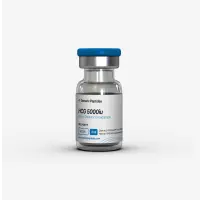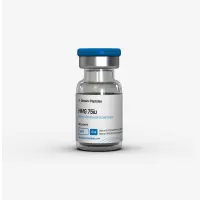
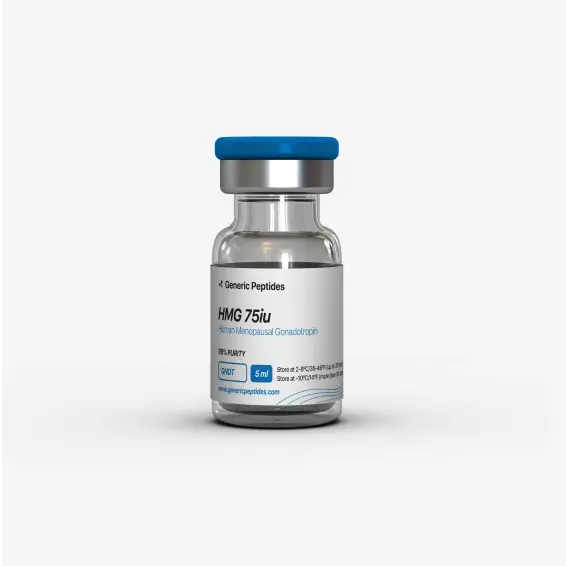
HMG 75 IU
Certificate of Analysis available
In 1949, an Italian researcher named Piero Donini figured out how to extract gonadotropins from urine. The source he chose was unusual: postmenopausal women. After menopause, FSH and LH levels skyrocket because the ovaries no longer respond to feedback signals. That hormonal flood, present in their urine, became the raw material for HMG — the medication that made modern fertility treatment possible.
HMG (Human Menopausal Gonadotropin), also called menotropins, is a mixture of two glycoprotein hormones: follicle-stimulating hormone (FSH) and luteinizing hormone (LH), typically in roughly a 1:1 ratio. It's purified from the urine of postmenopausal women, which contains both hormones in elevated quantities due to the natural hormonal changes of menopause. The product is freeze-dried and reconstituted before injection.
The mechanism is direct hormone replacement at the level of pituitary gonadotropins. FSH stimulates ovarian follicle development in women and supports spermatogenesis in men. LH triggers ovulation in women and stimulates Leydig cell testosterone production in men. By providing both hormones simultaneously, HMG mimics the natural pituitary-driven reproductive cascade — useful when the patient's own pituitary signaling is impaired.
Bruno Lunenfeld successfully introduced HMG into clinical practice in 1961. Before that, fertility treatment options for hypogonadotropic patients were extremely limited. HMG made controlled ovarian stimulation possible, which made IVF possible. The compound is in the lineage of every modern assisted reproductive technology.
Recombinant alternatives have since been developed — recombinant FSH (Gonal-F, Follistim) and recombinant LH — which allow precise control over the FSH:LH ratio without the variability of urinary extraction. But HMG remains in clinical use because the combination preparation is convenient and, in many protocols, clinically equivalent. Menopur (Ferring Pharmaceuticals) is currently the sole FDA-approved HMG product in the United States after Repronex and Bravelle were discontinued.
The honest part: HMG is not a single defined molecule. It's a urinary extract containing FSH, LH, traces of HCG (which mimics LH activity and is sometimes added to standardize the product), and other proteins that vary by purification method. Highly purified HMG (HP-hMG) reduces the contaminating proteins; less purified versions retain more biological complexity. That's a meaningful difference for research applications — what's in the vial varies by purification grade in ways that affect FSH:LH bioactivity ratios and potential immunogenicity.
Regulatory note: HMG is an FDA-approved prescription drug, not a research peptide on the 503A bulks list. Menopur is approved for controlled ovarian stimulation in IVF and ovulation induction in anovulatory women. The compound has experienced intermittent supply shortages since late 2023, partly because biological manufacturing from urinary extraction is harder to scale than recombinant production, and partly because Menopur is currently the sole FDA-approved hMG product in the US market with no generic competition. WADA prohibits HMG for athletes in tested sports — gonadotropins are listed under category S2.3.
Here's a sourcing problem that's specific to HMG: it's a complex biological mixture, not a synthesized peptide, and its bioactivity depends entirely on the FSH and LH glycoproteins remaining intact through extraction, purification, and storage. Cheap HMG sourced from unverified channels routinely arrives with degraded FSH activity, inconsistent LH content, or significant non-active protein contamination. The "1:1 FSH:LH ratio" claim on a label means nothing if the analytical verification isn't done — and most cheap suppliers don't run the bioactivity assays needed to confirm it. Glycoprotein integrity isn't visible by inspection.
Generic Peptides supplies research-grade HMG for sale at 99% purity, manufactured in the USA. Domestic processing with bioactivity verification — the part that matters when the molecule is a complex protein mixture rather than a simple synthesized chain.
Order HMG for sale in the USA — 99% purity, FSH/LH bioactivity verified, manufactured domestically.
HMG is an FDA-approved prescription drug (brand name Menopur) for fertility indications. As an FDA-approved biologic, it requires a prescription for human use. Sales as a research compound for laboratory use exist in a separate channel, focused on reproductive endocrinology research applications.
Technically, no — HMG is a mixture of two glycoprotein hormones (FSH and LH), each consisting of an alpha and beta subunit. The molecules are full proteins with carbohydrate modifications, much larger and more complex than typical research peptides. The terminology "peptide" gets used loosely sometimes, but HMG is structurally and regulatorily a biologic.
Different molecules, different mechanisms. HCG mimics LH activity exclusively — it binds the LH/CG receptor. HMG contains both FSH and LH activity, so it stimulates follicle development (FSH) and ovulation/testosterone production (LH). They're often used together in fertility protocols: HMG to develop follicles, HCG to trigger their release.
Repronex and Bravelle, two earlier HMG products, were discontinued, leaving Menopur (Ferring Pharmaceuticals) as the sole FDA-approved menotropins product in the United States. There's no approved generic or biosimilar — biological manufacturing of urinary-derived gonadotropins is significantly more complex than chemical drug production, and the regulatory pathway for biosimilars adds further barriers.
Probably not at the same purity or bioactivity. Cheap online HMG often comes from unverified manufacturers where FSH:LH ratios aren't reliably maintained and protein integrity isn't documented. With a glycoprotein mixture, label claims mean nothing without bioactivity verification — and most budget suppliers don't run the assays.
Sources
Menotropin — Wikipedia summary of the urinary extraction development by Donini (1949) and clinical introduction by Lunenfeld (1961). https://en.wikipedia.org/wiki/Menotropin
"Recombinant follicular stimulating hormone plus recombinant luteinizing hormone versus human menopausal gonadotropins." PMC, 2021. Documents the FSH/LH composition of hMG and the role of HCG in standardization. https://www.ncbi.nlm.nih.gov/pmc/articles/PMC8655989/
"A review of luteinising hormone and human chorionic gonadotropin when used in assisted reproductive technology." PMC, 2014. Documents hMG composition variability and the role of contaminating proteins. https://www.ncbi.nlm.nih.gov/pmc/articles/PMC4287577/
WADA — "Prohibited List" 2025. Documents gonadotropin classification under category S2.3 for tested athletes. https://www.wada-ama.org/en/prohibited-list
Two glycoproteins. One ratio that has to be right. Bioactivity verification isn't optional.
HMG (Human Menopausal Gonadotropin, or menotropins) ships as a sterile white lyophilized powder in a sealed glass vial, freeze-dried to preserve the FSH and LH glycoprotein activity and extend its shelf life. With a few simple habits — cool, dark, dry — the sealed vial stays in perfect condition until the expiration date printed on the label. Here's exactly how to store it.
| Parameter | Details | Notes |
|---|---|---|
| Storage Temperature | Refrigerated at 2–8°C (36–46°F) or at controlled room temperature up to 25°C (77°F) until the printed expiration date, typically 18–24 months from manufacture. | A cool, dark cabinet works; the fridge is a safer default if your room runs warm. |
| Light Sensitivity | Yes — protect from direct light to prevent hormone degradation. | Keep in the original box or carton until ready to reconstitute. |
| Freezing | Not recommended for the unreconstituted vial. Freezing the lyophilized powder may damage the glycoprotein activity (FSH/LH), and reconstituted solution must never be frozen. | Stick to the fridge or a cool room — no freezer needed or advised. |
| Signs of Degradation | Healthy powder is white, dry, and loose or cake-like. Watch for yellowing, browning, clumping, visible moisture, or a sticky texture. | Any color change, clumping, or moisture = discard the vial. |
| Common Mistakes | Storing near a heat source (stove, radiator, sunny windowsill), keeping in a humid bathroom cabinet, or opening a cold vial and letting condensation form inside. | Keep in a cool, dark spot, and let refrigerated vials warm to room temperature before opening. |
Every order is processed quickly and shipped with full tracking. All products come directly from the official Generic Peptides supply chain — in original manufacturer packaging, carefully handled from warehouse to your door.
| Destination | Delivery Time | Notes |
|---|---|---|
| USA Domestic | 2–5 business days | Faster when local warehouse stock is selected at checkout |
| International | 10–15 business days | Tracking included; update frequency may vary by destination country |
| Order Processing | 24–48 business hours | Processing begins after payment confirmation |
| Tracking | Provided on all orders | Tracking number sent after dispatch; multiple warehouses may result in separate shipments |
This product is supplied through the official Generic Peptides distribution chain and shipped in original manufacturer packaging. Orders are packed securely to protect the contents during transit and to respect customer privacy as a standard practice.
Outer packaging is neutral and does not display product details on the exterior — a common approach to protect shipments from damage, tampering, and unnecessary exposure during delivery.
Every order includes full authenticity assurance: official Generic Peptides presentation, batch-linked lab documentation, and sealed original packaging — giving customers confidence in every purchase.
| Authenticity Feature | Details |
|---|---|
| Packaging | Original manufacturer packaging — sealed and unaltered |
| Lab Documentation | Batch-linked certificate of analysis available on request |
| Supply Chain | Sourced exclusively through official Generic Peptides distribution |
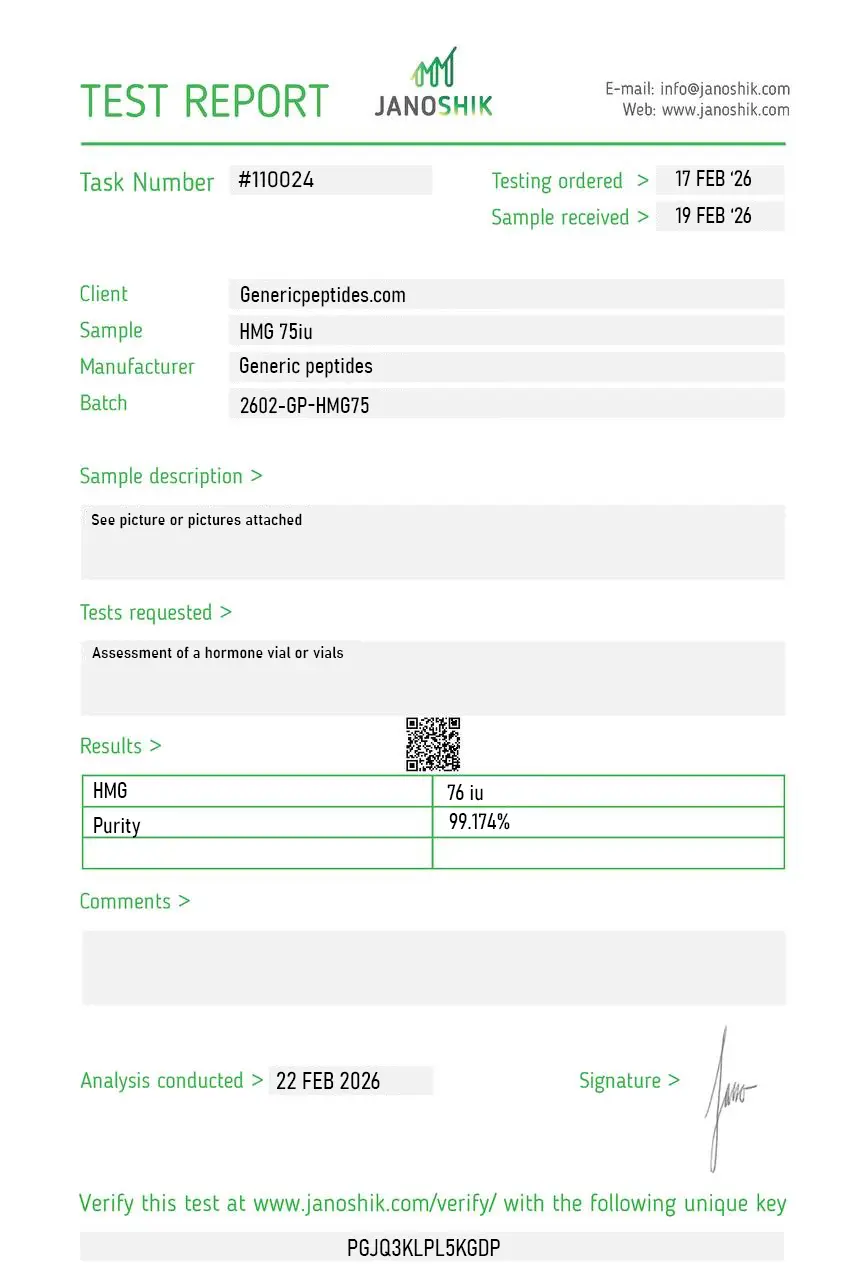
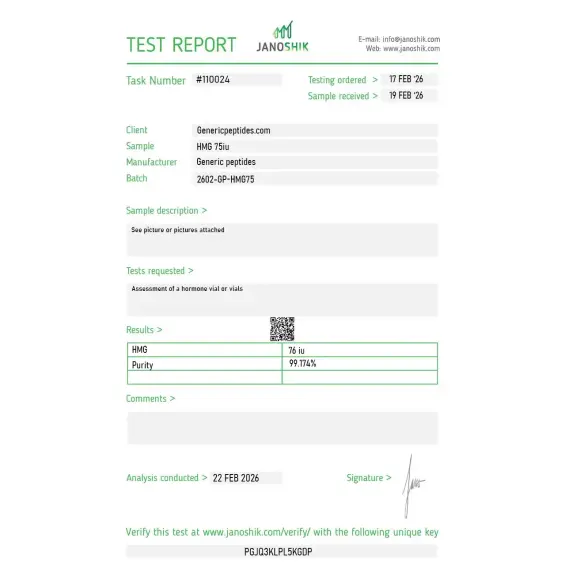
An independent lab test report is available for HMG 75 IU. The certificate provides batch-level verification details, including measured content, purity result, analysis date, and report documentation.
Follicular development protocol in animal research models — needed the natural FSH:LH ratio rather than recombinant single-hormone preparations, which is why HMG over the recombinant alternatives. The dual-gonadotropin profile matched our reference protocols. Consistent.
The thing to understand about HMG is that it's a mixture, not a defined single hormone — FSH and LH together at roughly one-to-one, urinary-derived. For an extraction-based gonadotropin preparation the COA should report the FSH:LH ratio specifically, not a single combined activity number. This vendor's documentation was decent but the ratio breakdown took a request. Star off for that.
The Donini/Serono history is genuinely deep — Pergonal came out of Istituto Serono in 1949, making HMG one of the oldest gonadotropin preparations in continuous use. The listing acknowledges that heritage rather than treating it as novel. Material gave consistent activity in our follicular-development assays.
We pair HMG with HCG in our reproductive-biology research — HMG for the follicular phase, HCG for the ovulation trigger, the classic two-step protocol. Sourcing both from one catalog with matched documentation keeps the procurement and the record-keeping clean. That sequential pairing is the actual experimental design.
What I value is the listing being explicit about urinary-derived versus recombinant source — most catalogs just say "HMG" and leave you guessing, but the source determines the glycoform profile and whether it matches your reference protocols. Knowing it's the urinary preparation upfront saved a clarification email. Material consistent.
For comparing the dual-gonadotropin HMG against recombinant single-hormone FSH we run them side by side — the natural mixture versus the defined recombinant, characterizing whether the LH component in HMG changes the follicular response. Sourcing the comparison material consistently matters. That mixture-versus-defined contrast is the experiment.
The IU-based activity rather than mass concentration is the right way to think about HMG — it's biological activity that matters for a gonadotropin, not milligrams, and the listing reporting in IU consistent with the established preparations is correct. For dosing our animal protocols by bioactivity that consistency is what we rely on. Material held its IU activity across orders.
HMG provides exogenous FSH and LH directly, replacing the natural pituitary signaling that drives ovarian and testicular function. FSH binds FSH receptors on granulosa cells (women) or Sertoli cells (men) to drive follicle development or support spermatogenesis. LH binds the LH/CG receptor on theca cells (women) or Leydig cells (men) to trigger ovulation or stimulate testosterone production. The mechanism is direct hormone replacement, not signal modulation.
HMG is purified from postmenopausal women's urine and contains both FSH and LH (plus other proteins) in a fixed-ish ratio. Recombinant FSH (Gonal-F, Follistim) and recombinant LH are produced via DNA technology in cell culture and contain only the specific hormone with no other proteins. Recombinant products allow precise FSH:LH ratio control; HMG provides a combined preparation in a single injection.
HMG is a complex biological mixture extracted from urine, with bioactivity depending on intact glycoprotein structure for both FSH and LH. Production quality determines whether the FSH:LH ratio remains stable, whether contaminating proteins are minimized, and whether bioactivity is preserved through purification and storage. Cheap manufacturing routinely fails on multiple of these dimensions simultaneously.
Piero Donini developed the urinary extraction method for gonadotropins in 1949. Bruno Lunenfeld successfully introduced HMG into clinical fertility practice in 1961. The product has been continuously refined through purification advances since then — the modern highly purified HMG (HP-hMG) is significantly cleaner than the original 1960s preparations.
Yes. WADA prohibits HMG for athletes subject to drug testing under category S2.3 — Chorionic Gonadotrophin, Luteinizing Hormone and their releasing factors (and gonadotropin-stimulating substances) — for males. Female athletes face different restrictions since some of these hormones are naturally elevated during pregnancy. Athletes in tested sports should consult their governing body's specific rules.
Menotropins (the FDA-approved generic name), human menopausal gonadotropins (the full descriptor), and brand names Menopur (Ferring), historically Pergonal, Repronex, Bravelle, and others now discontinued in the US. Internationally also sold as Merional, Menogon, Metrodin, and Fertinex. The active ingredients FSH+LH in 1:1 ratio identify the compound.
Reproductive endocrinology and assisted reproduction lead by volume — folliculogenesis, ovarian stimulation models, and gonadotropin receptor pharmacology. There's also active work in male reproductive biology, particularly spermatogenesis support in hypogonadotropic hypogonadism research. Comparative studies of urinary-derived versus recombinant gonadotropins continue to generate research interest.
HMG stimulates multiple follicles to develop simultaneously, which is the entire point in IVF protocols. The trade-off in less-controlled ovulation induction protocols (without IVF egg retrieval) is multiple pregnancy risk — twins, triplets, and higher-order multiples. This is why fertility specialists carefully monitor follicle development with ultrasound during HMG treatment cycles.
HCG mimics LH activity at the LH/CG receptor, but with a much longer half-life (24-36 hours vs LH's 20 minutes). HMG contains actual LH plus FSH activity, providing both gonadotropin signals simultaneously. HCG is often added to HMG protocols specifically as the ovulation trigger, exploiting its longer-acting LH-like activity. They're complementary, not interchangeable.
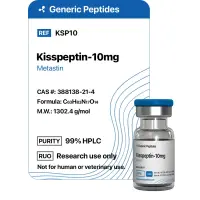
Researchers investigating gonadotropin pharmacology, follicular development, and reproductive axis regulation consistently examine HMG alongside compounds that target overlapping or complementary reproductive pathways. HCG is the most direct pairing — HMG provides both FSH and LH activity while HCG provides selective LH-equivalent activity; researchers studying the relative contributions of FSH vs LH to follicular maturation, ovarian stimulation, and male fertility protocols typically examine both to isolate each gonadotropin's specific role. Kisspeptin-10 sits upstream of the entire HPG axis — activating hypothalamic GnRH release that drives endogenous FSH and LH secretion — making it a valuable upstream reference compound when researchers need to distinguish between exogenous gonadotropin administration and endogenous HPG axis stimulation. Sermorelin and Tesamorelin occasionally appear in the same research context when studying interactions between the GH and reproductive axes — particularly in research on body composition, metabolic health, and hormonal dysregulation where both axes are simultaneously affected. Each represents a different regulatory level of the same hypothalamic-pituitary-gonadal biology that HMG research addresses.