Sermorelin vs Tesamorelin: Research Comparison
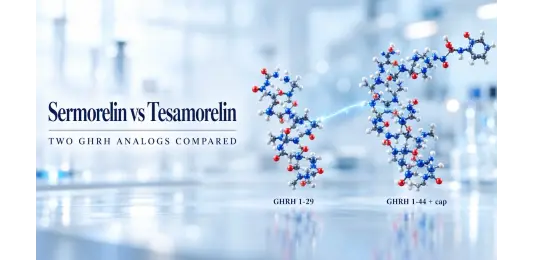
Sermorelin vs Tesamorelin: Two GHRH Analogs Compared
By Medical Team of Generic Peptides
Quick answer. Sermorelin and tesamorelin both act on the growth hormone–releasing hormone (GHRH) receptor, and both have been FDA-approved drugs. The difference lies in the molecule and the evidence. Sermorelin is the unmodified 29-amino-acid active fragment of GHRH. It is broken down within minutes, and its branded product, Geref, was discontinued in 2008. Tesamorelin is the full 44-amino-acid GHRH sequence with a protective chemical cap. Its cap was designed to resist enzymatic breakdown, and it has a larger, more recent clinical record. That record comes almost entirely from adults with HIV. No published study has compared the two head to head.
This guide compares sermorelin and tesamorelin on structure, stability, human study data and regulatory status. It does not cover use in people.
Sermorelin vs Tesamorelin at a Glance
| Sermorelin | Tesamorelin | |
|---|---|---|
| Sequence | GHRH (1-29), amidated | GHRH (1-44) |
| Key modification | None | trans-3-hexenoyl group on the N-terminal tyrosine |
| Molecular weight | ≈3,358 Da | ≈5,136 Da |
| Plasma half-life | ≈6–7 min after IV dosing (Geref label); ~10–20 min in some reviews | ≈26–38 min (original Egrifta); ≈8–11 min (current Egrifta SV/WR labels) |
| FDA history | Geref: diagnostic 1990, pediatric treatment 1997; discontinued 2008 | Egrifta: approved 2010; Egrifta SV and Egrifta WR formulations later |
| Approved indication | GH deficiency in children (historical) | Excess abdominal fat in adults with HIV and lipodystrophy |
| Largest human trials | Pediatric GH-deficiency trials; small studies in older adults | Two Phase III trials (>800 adults with HIV); liver-fat and cognition trials |
| WADA | Prohibited at all times (S2) | Prohibited at all times (S2) |
What Is Sermorelin?
Sermorelin is a synthetic copy of the first 29 amino acids of human GHRH. Researchers found in the early 1980s that this fragment carries essentially the full biological activity of the 44-residue hormone at its receptor.
Sermorelin was sold as Geref. The FDA approved it in December 1990 as a diagnostic test of pituitary growth hormone (GH) secretion. In September 1997 it approved a treatment indication for idiopathic GH deficiency in children with growth failure. EMD Serono stopped making Geref in 2008. In 2013 the FDA determined in the Federal Register that the product had not been withdrawn for reasons of safety or effectiveness.
For a full review, see our sermorelin research guide.
What Is Tesamorelin?
Tesamorelin keeps the full 44-amino-acid sequence of human GHRH and adds one chemical group, a trans-3-hexenoyl cap, to the first amino acid. That cap protects the molecule from the enzyme that normally inactivates GHRH.
The FDA approved tesamorelin as Egrifta on November 10, 2010. The approved use is narrow: reducing excess abdominal fat in adults with HIV who have lipodystrophy. More concentrated formulations followed: Egrifta SV in 2018 and Egrifta WR in March 2025. Tesamorelin is not approved for weight loss or any other indication.
Our tesamorelin research guide covers the trial program in detail.
Difference Between Sermorelin and Tesamorelin: Structure and Stability
The main structural difference between sermorelin and tesamorelin is how each deals with enzymatic breakdown. The half-life data show that this difference is smaller than it is often presented.
Half-Life and Enzymatic Breakdown
Native GHRH is cleaved between its second and third amino acids by dipeptidyl peptidase-4 (DPP-4). The product of that cut is nearly inactive. Sermorelin has the same vulnerable N-terminus. Its label gives a half-life of about 6–7 minutes after intravenous dosing; some reviews cite about 10–20 minutes.
Tesamorelin's hexenoyl cap blocks the DPP-4 cleavage site. The original Egrifta label reported a half-life of about 26 minutes in healthy adults and about 38 minutes in adults with HIV. The labels for the current formulations give shorter values: about 8 minutes for Egrifta SV and about 11 minutes for Egrifta WR, both in healthy subjects. In other words, the two peptides are both short-acting, and their measured half-lives overlap more than the "stabilized analog" label suggests. Neither acts for days the way CJC-1295 with DAC does.
Length and Molecular Weight
Sermorelin has 29 residues and a molecular weight of about 3,358 Da. Tesamorelin has 44 residues plus the cap, at about 5,136 Da. For researchers, this matters mainly in quality control. Mass spectrometry should confirm the expected weight. For tesamorelin, it should also confirm that the hexenoyl group is present, since unmodified GHRH (1-44) weighs about 96 Da less.
A third design, MOD GRF 1-29, takes another route. It keeps the 29-residue length but swaps four amino acids to resist DPP-4 and chemical degradation.
Mechanism: Same GHRH Receptor, Different Design
At the receptor level, sermorelin and tesamorelin work the same way. Both bind the GHRH receptor on somatotrophs, the GH-producing cells of the anterior pituitary. Binding raises intracellular cyclic AMP, which triggers GH release and supports new GH synthesis. GH then drives production of insulin-like growth factor 1 (IGF-1), mainly in the liver.
Two consequences follow for both peptides:
- They depend on a working pituitary. Unlike recombinant GH, a GHRH analog cannot raise GH if the somatotrophs are absent or suppressed.
- They stay under physiological control. Somatostatin and IGF-1 feedback still apply, so GH continues to be released in pulses rather than as a flat elevation.
The difference is in molecular design and in the clinical record, not in how the receptor is activated.
What Human Studies Measured
The two peptides were studied in very different populations, which makes direct comparison difficult.
Sermorelin: Pediatric Trials and Small Studies in Older Adults
Most sermorelin data come from the 1990s. The pivotal study, by the Geref International Study Group, followed prepubertal children with GH deficiency. In this open-label, uncontrolled study, mean height velocity rose from about 4 cm per year before treatment to about 7 cm per year at 12 months.
Studies in older adults were small and mostly short:
- Corpas et al., 1992: 14 days of twice-daily GHRH (1-29) raised GH and IGF-1 in 10 older men to levels similar to those of young men.
- Vittone et al., 1997: 11 men aged 64–76 received six weeks of nightly injections in an uncontrolled study. Night-time GH rose, but IGF-1 and body composition did not change. Two of six strength measures improved.
- Khorram et al., 1997: 19 adults aged 55–71 received a closely related GHRH (1-29) analog for 16 weeks. GH, IGF-1 and lean body mass rose; bone density did not change.
Tesamorelin: HIV Lipodystrophy, Liver Fat and Cognition
Tesamorelin's record is larger and more recent:
- Falutz et al., 2007 (NEJM): a 26-week Phase III trial in 412 adults with HIV and abdominal fat accumulation. Visceral adipose tissue (VAT) fell by about 15% with tesamorelin and rose by about 5% with placebo. IGF-1 increased.
- Falutz et al., 2010 (JCEM): a pooled analysis of two Phase III trials. The VAT reduction held through 52 weeks with continued treatment.
- Stanley et al., 2019 (Lancet HIV): a 12-month trial in 61 adults with HIV and fatty liver. Hepatic fat fraction fell compared with placebo, and fewer participants showed fibrosis progression.
- Baker et al., 2012 (Archives of Neurology): a 20-week placebo-controlled trial of tesamorelin in 152 older adults, including people with mild cognitive impairment. Executive function scores improved compared with placebo.
Tesamorelin or Sermorelin for Muscle Growth? What the Data Show
"Tesamorelin or sermorelin for muscle growth" is a common search, but neither peptide has been tested as a muscle-building agent in a controlled trial.
What the studies did measure:
- In the 2007 tesamorelin Phase III trial, lean body mass was a secondary measure. It rose by about 1.3 kg with tesamorelin and fell slightly with placebo, in adults with HIV.
- In the Khorram study of a sermorelin-like analog, lean body mass rose over 16 weeks in a small group of older adults. In the Vittone sermorelin study, body composition did not change, while two of six strength measures improved.
None of these studies used muscle strength or performance as a primary outcome. Neither enrolled healthy young adults or athletes. Lean body mass from DEXA scans also includes water and organ tissue, not only muscle. Our review of peptides and muscle growth looks at this gap across the whole peptide class.
Sermorelin vs Ipamorelin vs Tesamorelin
The three are often searched together, but ipamorelin works differently. Ipamorelin is a five-amino-acid agonist of the ghrelin receptor (GHS-R1a), not a GHRH analog. It raises GH through a separate receptor, which is why GHRH analogs and ghrelin-receptor agonists are often studied in combination. Ipamorelin was never approved by the FDA; its main human trial was a Phase II study in postoperative ileus. We compare it with sermorelin in Ipamorelin vs Sermorelin.
FDA, Compounding and WADA Status in 2026
Sermorelin. No sermorelin product is currently marketed in the US. Because the 2013 determination found Geref was not withdrawn for safety reasons, a generic version could in principle reference it. Sermorelin was not placed in Category 2 of the FDA's interim compounding policy in 2023, and it was not part of the 2024 or 2026 advisory committee reviews. Compounders generally treat it as a component of an FDA-approved drug under section 503A.
Tesamorelin. Tesamorelin is a marketed prescription drug (Egrifta) with one approved indication. It was not among the peptides placed in Category 2 in 2023.
Sport. The World Anti-Doping Agency prohibits GHRH and its analogs, naming sermorelin and tesamorelin, at all times under section S2.2.4 of its Prohibited List.
Research-grade sermorelin and tesamorelin are laboratory materials. They are separate from the approved drug products and are not alternatives to them.
Safety Signals Reported in Clinical Trials
The safety record of each peptide comes from its clinical program and is reported here for completeness only.
- Tesamorelin: the prescribing information lists joint pain, injection-site reactions, peripheral edema and muscle pain among the adverse events reported more often than with placebo; for some, such as joint pain, the difference was small. Because IGF-1 rises, glucose metabolism was monitored. In the label's pooled data, a larger share of tesamorelin-treated participants reached an HbA1c of 6.5% or higher than on placebo (5% vs 1%).
- Sermorelin: the Geref product information lists facial warmth or flushing and injection-site pain. Its smaller, older trials mean less long-term data.
For both peptides, data in populations other than those studied are limited.
How to Verify Research-Grade Material
Because the two peptides differ in length and modification, identity testing matters. A batch-specific certificate of analysis should include HPLC purity with the chromatogram and a mass spectrometry result matching the expected molecular weight. Our guide to reading a peptide COA explains what to check.
FAQ
What is the main difference between sermorelin and tesamorelin?
Sermorelin is the unmodified 29-amino-acid fragment of GHRH. Tesamorelin is the full 44-amino-acid sequence with an N-terminal cap that resists DPP-4. Both act on the same receptor and both are short-acting; the bigger difference is tesamorelin's larger clinical record.
Which has more human data?
Tesamorelin. Its program includes two Phase III trials with more than 800 adults, plus trials on liver fat and cognition. Most sermorelin data are older and come from children with GH deficiency or small studies in older adults.
Is sermorelin FDA approved?
It was. Geref was approved in 1990 as a diagnostic and in 1997 as a pediatric treatment, then discontinued in 2008. No sermorelin product is currently marketed.
Is tesamorelin like Ozempic?
No. Semaglutide (Ozempic) is a GLP-1 receptor agonist that acts on appetite and glucose pathways. Tesamorelin acts on the GHRH receptor in the pituitary. Its approved effect is on visceral fat in adults with HIV, not on body weight.
Why are they often studied alongside ipamorelin?
GHRH analogs and ghrelin-receptor agonists act through different receptors. Bowers and colleagues reported in 1990 that a GH-releasing peptide and GHRH given together produced a synergistic GH response in healthy men.
References
For research use only. Not for human consumption. This content is for informational purposes and is not medical advice.
[1] Falutz J, Allas S, Blot K, et al. Metabolic effects of a growth hormone–releasing factor in patients with HIV. N Engl J Med. 2007;357(23):2359–2370.
[2] Falutz J, Mamputu JC, Potvin D, et al. Effects of tesamorelin (TH9507), a growth hormone–releasing factor analog, in HIV-infected patients with excess abdominal fat: a pooled analysis of two multicenter, double-blind placebo-controlled phase 3 trials with safety extension data. J Clin Endocrinol Metab. 2010;95(9):4291–4304.
[3] Stanley TL, Fourman LT, Feldpausch MN, et al. Effects of tesamorelin on non-alcoholic fatty liver disease in HIV: a randomised, double-blind, multicentre trial. Lancet HIV. 2019;6(12):e821–e830.
[4] Baker LD, Barsness SM, Borson S, et al. Effects of growth hormone–releasing hormone on cognitive function in adults with mild cognitive impairment and healthy older adults: results of a controlled trial. Arch Neurol. 2012;69(11):1420–1429.
[5] Thorner MO, Rochiccioli P, Colle M, et al. Once daily subcutaneous growth hormone-releasing hormone therapy accelerates growth in growth hormone-deficient children during the first year of therapy. J Clin Endocrinol Metab. 1996;81(3):1189–1196.
[6] Corpas E, Harman SM, Piñeyro MA, Roberson R, Blackman MR. Growth hormone (GH)-releasing hormone-(1-29) twice daily reverses the decreased GH and insulin-like growth factor-I levels in old men. J Clin Endocrinol Metab. 1992;75(2):530–535.
[7] Vittone J, Blackman MR, Busby-Whitehead J, et al. Effects of single nightly injections of growth hormone-releasing hormone (GHRH 1-29) in healthy elderly men. Metabolism. 1997;46(1):89–96.
[8] Khorram O, Laughlin GA, Yen SS. Endocrine and metabolic effects of long-term administration of [Nle27]growth hormone-releasing hormone-(1-29)-NH2 in age-advanced men and women. J Clin Endocrinol Metab. 1997;82(5):1472–1479.
[9] U.S. Food and Drug Administration. EGRIFTA, EGRIFTA SV and EGRIFTA WR (tesamorelin for injection) prescribing information, application 022505 (original 2010 label and 2025 EGRIFTA WR label).
[10] U.S. Food and Drug Administration. Determination that GEREF (sermorelin acetate) injection was not withdrawn from sale for reasons of safety or effectiveness. Federal Register. 2013;78(42):14095–14096.
[11] U.S. Food and Drug Administration. Drugs@FDA: GEREF, NDA 019863 and NDA 020443.
[12] Bowers CY, Reynolds GA, Durham D, Barrera CM, Pezzoli SS, Thorner MO. Growth hormone (GH)-releasing peptide stimulates GH release in normal men and acts synergistically with GH-releasing hormone. J Clin Endocrinol Metab. 1990;70(4):975–982.
[13] World Anti-Doping Agency. The 2026 Prohibited List, section S2.2.4. https://www.wada-ama.org/en/prohibited-list