BPC-157 and TB-500 Together: What the Research Actually Shows
BPC-157 and TB-500 Together: What the Research Actually Shows
By Medical Team of Generic Peptides
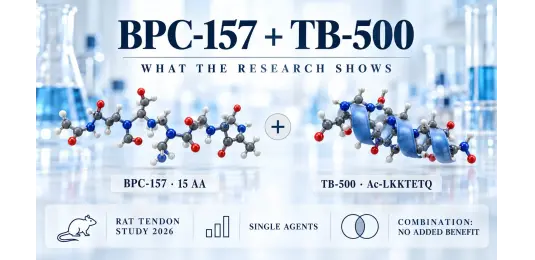
Quick answer. BPC-157 and TB-500 are the two most-searched "repair" peptides and are often discussed as a pair, sometimes under the nickname "Wolverine stack." The rationale is mechanistic: BPC-157 is studied mainly for effects on blood-vessel growth, nitric-oxide signaling, and fibroblast behavior, while TB-500, a fragment of thymosin β4, is studied for actin regulation and cell migration. Until 2026 there was no published study that tested the two side by side. The first one, a four-week rat Achilles-tendon study, found that each peptide improved histological scores, that TB-500 alone had the only significant biomechanical advantage, and that combining them added nothing over either agent alone. Both peptides remain unapproved; in July 2026 an FDA advisory committee voted narrowly to recommend them for pharmacy compounding, against the view of FDA reviewers. This article explains why the two are paired, what each has actually been shown to do and in what model, what the combination study found, and how to evaluate a product sold as a blend.
Why BPC-157 and TB-500 Are Paired
The pairing is not based on a clinical protocol. It comes from the idea that the two peptides act on different steps of tissue repair, so researchers studying wound or tendon healing might expect complementary effects.
| BPC-157 | TB-500 (Tβ4 fragment) | |
|---|---|---|
| Origin | Synthetic 15-residue sequence derived from a human gastric juice protein | Synthetic fragment (typically Ac-LKKTETQ, residues 17–23) of the 43-residue protein thymosin β4 |
| Molecular weight | ≈1,419 Da | ≈889 Da (acetylated heptapeptide); full Tβ4 ≈4,963 Da |
| Main mechanisms studied | VEGFR2 and nitric-oxide pathway activation; fibroblast migration; angiogenesis; gut-brain axis effects | Binding of G-actin via the LKKTETQ motif; promotion of cell migration; anti-inflammatory signaling; cardiac progenitor activation (full Tβ4) |
| Best-characterized models | Rat tendon, ligament, muscle, and gut injury | Mouse heart and skin injury; human trials of full-length Tβ4 in wounds and eyes |
| Human controlled trials | None published for efficacy (only a two-person open-label IV safety report, 2025) | None for the fragment; Phase II trials exist for full-length Tβ4 |
The complementarity argument is plausible but, as the table shows, it rests on two separate evidence bases that were built in different models by different groups. Whether the mechanisms add up in one tissue is an empirical question, and until recently nobody had asked it.
What BPC-157 Has Been Shown to Do
BPC-157 (Body Protection Compound 157) was first described in the early 1990s by Sikirić and colleagues in Zagreb, and most of its literature still comes from that group [1]. The core findings in animals:
- Tendon and ligament. In rats with transected Achilles tendon, BPC-157 was associated with better functional and histological recovery than controls; in cultured tendocytes it reversed oxidative growth inhibition rather than stimulating growth on its own [2]. In cultured rat tendon fibroblasts it increased cell outgrowth, survival, and migration, with upregulation of growth-hormone receptor expression [3].
- Muscle. In rat crush injury of the gastrocnemius, treated animals recovered function faster and showed less fibrosis [4]. In transected quadriceps, similar effects were reported [5].
- Blood vessels. In cultured human endothelial cells BPC-157 activated the VEGFR2–Akt–eNOS pathway; in a rat hind-limb ischemia model it increased blood-flow recovery, vessel number, and VEGFR2 expression [6].
- Gastrointestinal. The original work concerned gastric and intestinal protection in rats and remains the broadest part of the literature [1].
The limitation is consistent across the body of work: the studies are preclinical, mostly from one laboratory, and often use outcomes (histology, functional scores) that have not been translated into human trials. A 2019 review of BPC-157 in musculoskeletal soft-tissue healing found the efficacy evidence to be almost entirely preclinical, with human data limited to small or unpublished pilots, and called for independent replication [7]. Our full BPC-157 guide goes deeper.
What TB-500 Has Been Shown to Do
"TB-500" is a market name for a synthetic fragment of thymosin β4, usually the acetylated heptapeptide LKKTETQ, which is the actin-binding motif of the parent protein [8]. The important distinction for reading the evidence is that almost all the published work concerns full-length Tβ4, not the fragment:
- Cardiac repair (animal). Full-length Tβ4 promoted cardiomyocyte migration and survival and improved cardiac function after infarction in mice, through integrin-linked kinase signaling [9].
- Skin wound healing (animal and human). Tβ4 accelerated dermal healing in rodent models and showed a signal in Phase II trials of venous and pressure ulcers [10, 11].
- Eye (human). A Phase II trial of Tβ4 eye drops (RGN-259) in dry eye met several secondary endpoints but not its primary ones [12].
- Muscle (animal). After muscle injury in mice, endogenous Tβ4 is released and acts as a chemoattractant for myoblasts [13].
For the LKKTETQ fragment itself, the evidence is thinner: it retains actin binding and some migration-promoting activity in cell assays, but there are few controlled animal efficacy studies and no human data. Our TB-500 guide explains the fragment-versus-protein question in detail.
The First Head-to-Head Study: BPC-157 vs TB-500 vs Both (2026)
In 2026, a Turkish orthopedics group published what appears to be the first controlled comparison of BPC-157, TB-500, and their combination in the same injury model [14].
Design. 32 male Sprague-Dawley rats underwent standardized Achilles tendon transection and repair, then were randomized to four groups of eight: control, BPC-157, TB-500, and BPC-157 + TB-500. Treatment was given for four weeks post-operatively, and tendons were harvested at four weeks for biomechanical testing (maximum load to failure), histology (Bonar and Movin scores), and collagen type I and III immunohistochemistry.
Results.
| Outcome | BPC-157 | TB-500 | Combination |
|---|---|---|---|
| Maximum load to failure vs. control | Higher, not statistically significant | Higher, significant | No additional benefit over single agents |
| Bonar histology score (lower = better) | Lower, not significant | Significantly lower | Not significant |
| Movin histology score (lower = better) | Lower, not significant | Significantly lower | Significantly lower |
| Collagen type I | No difference between groups | No difference | No difference |
| Collagen type III | Differed between groups | Differed | Differed |
What the authors concluded. Both peptides were associated with improved histopathological parameters; TB-500 additionally showed a significant biomechanical advantage at four weeks; and the combination "did not confer additional benefits compared to either agent alone." They describe the study as exploratory, with a small sample, a single time point, and a need for longer follow-up.
How to read it. One study of eight rats per group cannot settle the question, and the result might differ at a later time point or in a different tissue. But it is the only direct test of the pairing hypothesis so far, and it did not support the idea that the two peptides are more than the sum of their parts. For anyone designing a study, it argues for including single-agent arms rather than assuming synergy.
Regulatory Status in 2026
Neither BPC-157 nor TB-500 is an approved drug anywhere.
- FDA, 2023. Both were placed in Category 2 of the interim 503A bulk-substances list — substances that "may present significant safety risks" for compounding — citing the lack of human safety data [15].
- FDA PCAC, July 23, 2026. The Pharmacy Compounding Advisory Committee reviewed seven peptides over two days. On July 23 it voted 8–6 with one abstention to recommend BPC-157, KPV, and TB-500 for the 503A bulks list; MOTS-c was recommended the same day, epitalon and Semax the next day, and emideltide (DSIP) was rejected. FDA career scientists had argued the evidence was insufficient to assess safety and effectiveness and raised identity questions, since "TB-500" can refer to different sequences [16, 17]. The committee's vote is advisory; no final rule has been issued, and until it is, compounding remains prohibited.
- WADA. Both are prohibited in sport: BPC-157 under S0 (non-approved substances) and TB-500/Tβ4 under S2 [18].
Products from Generic Peptides, including BPC-157 and TB-500, are supplied for laboratory research only.
Evaluating a Blend Versus Two Separate Vials
Some suppliers sell BPC-157 and TB-500 pre-mixed in one vial. From a research-quality standpoint, a blend raises questions that two separate vials do not:
- Identity of each component. A certificate of analysis for a blend should show separate HPLC peaks and mass-spectrometry masses for each peptide (≈1,419 Da and ≈889 Da for the acetylated heptapeptide). A single purity figure for "the blend" does not establish that both are present at the stated ratio.
- Which TB-500. The COA should state the sequence. As the FDA noted in its 2026 review, "TB-500" is used for more than one molecule; a blend that does not specify which one cannot be compared with any published study.
- Stability. The two peptides have different chemistry — BPC-157 is reported to be unusually stable, while short acetylated fragments can degrade — so a blend's stated shelf life should be supported by data for both components.
- Reproducibility. Separate vials let a laboratory vary the ratio or run single-agent controls, which the 2026 rat study showed is necessary to interpret any combined effect.
Our guide to reading a research peptide COA covers these checks in general.
Open Questions
- Does the combination help in any tissue? One tendon study at one time point says no. Muscle, ligament, gut, and skin have not been tested.
- Is the fragment equivalent to the protein? Nearly all TB-500 claims borrow from full-length Tβ4 data; direct comparisons are rare.
- Independent replication of BPC-157. The 2026 study is notable partly because it comes from outside the Zagreb group that produced most of the earlier work, and it found BPC-157's effects weaker than TB-500's in this model.
- Human data. A 2025 open-label intravenous safety report in two volunteers is the only human BPC-157 study; it cannot support any safety or efficacy claim, and no controlled trial of either peptide has been published.
FAQ
What is the "Wolverine stack"?
A nickname for the pairing of BPC-157 and TB-500, referencing the comic-book character's healing ability. It describes a popular research combination, not a clinical protocol or an approved therapy.
Is there any study of BPC-157 and TB-500 used together?
Yes, one. A 2026 rat Achilles-tendon study compared each peptide alone and in combination over four weeks and found the combination added no benefit beyond either agent alone.
Which of the two has more evidence?
Full-length thymosin β4 has human Phase II trial data in wounds and eyes. BPC-157 has a larger animal literature, mostly from one laboratory, and no human efficacy data. The TB-500 fragment specifically has less evidence than either.
Are BPC-157 and TB-500 FDA-approved?
No. In July 2026 an FDA advisory committee voted 8–6 to recommend both for pharmacy compounding, but that recommendation is not final and neither peptide is an approved drug.
Is a pre-mixed BPC-157/TB-500 blend the same as two separate vials?
Not necessarily. A blend's certificate of analysis should identify both peptides separately, state the TB-500 sequence, and support the stated ratio and stability. Separate vials also allow single-agent controls.
References
For research use only. Not for human consumption. This content is for informational purposes and is not medical advice.
[1] Sikirić P, Petek M, Rucman R, et al. A new gastric juice peptide, BPC. An overview of the stomach-stress-organoprotection hypothesis and beneficial effects of BPC. J Physiol Paris. 1993;87(5):313–327. PMID 8298609.
[2] Staresinic M, Sebecic B, Patrlj L, et al. Gastric pentadecapeptide BPC 157 accelerates healing of transected rat Achilles tendon and in vitro stimulates tendocytes growth. J Orthop Res. 2003;21(6):976–983. PMID 14554208.
[3] Chang CH, Tsai WC, Lin MS, Hsu YH, Pang JH. The promoting effect of pentadecapeptide BPC 157 on tendon healing involves tendon outgrowth, cell survival, and cell migration. J Appl Physiol. 2011;110(3):774–780. PMID 21030672.
[4] Novinscak T, Brcic L, Staresinic M, et al. Gastric pentadecapeptide BPC 157 as an effective therapy for muscle crush injury in the rat. Surg Today. 2008;38(8):716–725. PMID 18668315.
[5] Staresinic M, Petrovic I, Novinscak T, et al. Effective therapy of transected quadriceps muscle in rat: gastric pentadecapeptide BPC 157. J Orthop Res. 2006;24(5):1109–1117. PMID 16609979.
[6] Hsieh MJ, Liu HT, Wang CN, et al. Therapeutic potential of pro-angiogenic BPC157 is associated with VEGFR2 activation and up-regulation. J Mol Med (Berl). 2017;95(3):323–333. PMID 27847966.
[7] Gwyer D, Wragg NM, Wilson SL. Gastric pentadecapeptide body protection compound BPC 157 and its role in accelerating musculoskeletal soft tissue healing. Cell Tissue Res. 2019;377(2):153–159. PMID 30915550.
[8] Goldstein AL, Hannappel E, Kleinman HK. Thymosin β4: actin-sequestering protein moonlights to repair injured tissues. Trends Mol Med. 2005;11(9):421–429. PMID 16099219.
[9] Bock-Marquette I, Saxena A, White MD, DiMaio JM, Srivastava D. Thymosin β4 activates integrin-linked kinase and promotes cardiac cell migration, survival and cardiac repair. Nature. 2004;432(7016):466–472. PMID 15565145.
[10] Treadwell T, Kleinman HK, Crockford D, Hardy MA, Guarnera G, Goldstein AL. The regenerative peptide thymosin β4 accelerates the rate of dermal healing in preclinical animal models and in patients. Ann N Y Acad Sci. 2012;1270:37–44. PMID 23050815.
[11] Guarnera G, DeRosa A, Camerini R. The effect of thymosin treatment of venous ulcers. Ann N Y Acad Sci. 2010;1194:207–212. PMID 20536470.
[12] Sosne G, Ousler GW, McLaughlin J. Thymosin beta 4 ophthalmic solution for dry eye: a randomized, placebo-controlled, Phase II clinical trial conducted using the controlled adverse environment (CAE) model. Clin Ophthalmol. 2015;9:877–884. PMID 26056426.
[13] Tokura Y, Nakayama Y, Fukada S, et al. Muscle injury-induced thymosin β4 acts as a chemoattractant for myoblasts. J Biochem. 2011;149(1):43–48. PMID 20880960.
[14] Biçer O, Adanir O, Güleryüz Y, Balci EC, Dinçel YM, Yenigün MY, et al. Effects of BPC-157 and TB-500 on Achilles tendon healing in rats: a histopathological and biomechanical study. Jt Dis Relat Surg. 2026;37(3):822–837. DOI 10.52312/jdrs.2026.2951.
[15] U.S. Food and Drug Administration. Certain bulk drug substances for use in compounding that may present significant safety risks. September 29, 2023.
[16] U.S. Food and Drug Administration. Pharmacy Compounding Advisory Committee meeting, July 23–24, 2026: briefing documents for BPC-157 and TB-500. Docket FDA-2025-N-6895.
[17] Pharmaceutical Executive. FDA panel votes to loosen restrictions for four peptides. July 2026.
[18] World Anti-Doping Agency. The Prohibited List 2026, Sections S0 and S2.