PNC-27
Certificate of Analysis available
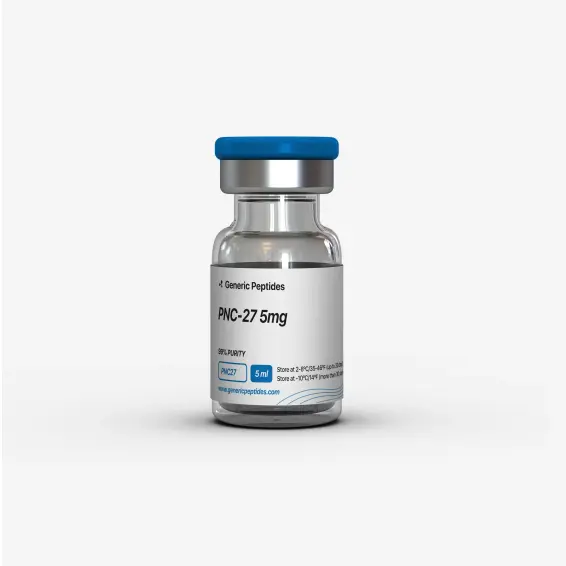
Most cancer-targeting research peptides try to restart the cell's own self-destruct program — the apoptosis pathway. PNC-27 takes a completely different approach. It binds a protein that cancer cells have somehow placed on their outer membrane instead of inside the nucleus, and then forms transmembrane pores that physically rupture the cancer cell. Healthy cells, which don't display this protein on their surface, are unaffected. That mechanism is unusual enough that researchers have been studying it for two decades trying to figure out exactly how it works.
PNC-27 is a synthetic 32-amino-acid chimeric peptide with two functional domains stitched together: residues 12-26 of the human p53 protein's HDM-2 binding region, fused to a 13-amino-acid penetratin-derived membrane-residency peptide (MRP) leader sequence. The p53 fragment is the targeting domain. The MRP leader is what lets the peptide insert itself into membranes. Neither domain alone produces the cancer-killing effect — they have to be covalently linked. That's the entire engineering point.
The molecular target is HDM-2 (the human equivalent of MDM-2 in mice), a protein that normally regulates p53 inside the cell nucleus. In healthy cells, HDM-2 stays where it belongs — bound to p53 in the nucleus, controlling cell cycle decisions. In many cancer cells, something goes wrong: HDM-2 ends up displayed on the outer plasma membrane. PNC-27 binds membrane-associated HDM-2 specifically. Healthy cells without surface HDM-2 don't bind PNC-27 and don't get killed. That selectivity is the compound's defining pharmacological feature.
PNC-27 doesn't trigger apoptosis. The treated cancer cells undergo rapid necrosis, not the orderly programmed cell death that most anti-cancer compounds induce. Transmission electron microscopy of treated cells shows transmembrane pores forming in the cancer cell membrane. The proposed mechanism: PNC-27 binds membrane-bound HDM-2, then PNC-27/HDM-2 complexes assemble into oligomers that aggregate into pore-forming structures, similar to how streptolysin-O (SLO) pores work — but with target selectivity that SLO lacks.
The work spans roughly two decades. Foundational research from Michael Bowne, Matthew Pincus, and colleagues established the chimeric peptide concept and demonstrated cancer-selective lysis in multiple cell lines and mouse xenograft models. The 2010 PNAS paper showed that PNC-27 kills even p53-null cancer cells — the ones where conventional p53-restoration approaches fail because there's no functional p53 left to restore. The 2022 review consolidated what's known about pore formation, demonstrating PNC-27/HDM-2 complex assembly directly via immuno-scanning electron microscopy. Some of this is impressive. None of it has progressed to human clinical trials yet.
Here's the uncomfortable truth: PNC-27's research base is impressive in mechanism and limited in clinical translation. Most published research comes from a relatively concentrated set of investigators — the Bowne/Pincus group has driven much of the foundational work over decades. Independent replication exists but is less extensive than for compounds with broader research adoption. There are no completed human clinical trials. Anyone selling PNC-27 with implications about specific human anti-cancer outcomes is going far beyond what the literature actually supports.
What's still defensible: the cancer-selective mechanism is real and reproducible across multiple in vitro and animal model systems. Membrane HDM-2 expression as a tumor-cell marker is a genuinely novel finding with implications for targeted cancer research beyond just PNC-27. For oncology research investigating selective cancer cell killing, p53/HDM-2 dynamics, or membrane-active peptide pharmacology, PNC-27 remains a unique research tool. For drawing conclusions about clinical cancer treatment, the gap between preclinical promise and clinical evidence is substantial.
Regulatory note: PNC-27 is not on the FDA's 503A bulks list. It wasn't part of the recent April 2026 reclassification activity affecting BPC-157, Epitalon, DSIP, and others — those compounds had been on Category 2; PNC-27 occupies a different regulatory category as a preclinical research peptide that hasn't been nominated for compounding pharmacy use. As of May 2026, PNC-27 remains commercially available as a research compound. Not FDA-approved for human use under any circumstance.
Here's a sourcing problem that's specific to PNC-27: it's a 32-amino-acid chimeric peptide — long enough that synthesis quality matters substantially, with a covalent fusion between two distinct functional domains. Cheap synthesis routinely produces material with truncated sequences, errors at the junction between the p53 fragment and the MRP leader, or peptide impurities that compete with the full-length compound. Critically, the cancer-selectivity that defines PNC-27's research utility depends on both domains being intact and properly covalently linked. A truncated PNC-27 lacking the membrane-residency leader can still bind HDM-2 in solution but won't insert into membranes — meaning the entire pore-formation mechanism that distinguishes this peptide is gone.
Generic Peptides supplies research-grade PNC-27 for sale at 99% purity, manufactured in the USA. Domestic synthesis with full 32-amino-acid sequence integrity verified — the part that determines whether your selectivity assay actually replicates published research or fails to behave like the literature describes.
Order PNC-27 for sale in the USA — 99% purity, full chimeric sequence verified, manufactured domestically.
Yes — PNC-27 is legally available as a research compound in the United States. It's not on the FDA's 503A bulks list and wasn't part of the recent Category 2 reclassification activity. It occupies a different regulatory category as a preclinical research peptide. Not FDA-approved for human use.
No — PNC-27 is a research compound for laboratory studies, not a clinical cancer treatment. There are no completed human clinical trials. Published research demonstrates cancer-selective killing in cell culture and animal models, but human translation hasn't happened. Anyone selling PNC-27 as a treatment is misrepresenting its regulatory and evidentiary status.
By forming transmembrane pores. PNC-27 binds HDM-2 protein that's abnormally displayed on cancer cell membranes (instead of confined to the nucleus, where it normally resides). PNC-27/HDM-2 complexes then aggregate into pore-forming oligomers that physically disrupt the cancer cell membrane, causing rapid necrosis. The mechanism is mechanistically similar to bacterial pore-forming toxins but with HDM-2-mediated cell selectivity.
Healthy cells have HDM-2 inside the nucleus where it belongs. Many cancer cells abnormally display HDM-2 on their outer plasma membrane. PNC-27 specifically binds membrane-associated HDM-2 — and most healthy cells don't have it on their surface, so the peptide has nothing to bind. This selectivity has been demonstrated in untransformed cell lines that fail to be killed by PNC-27 unless they're transfected to express membrane HDM-2.
Probably not at the same purity. The 32-amino-acid chimeric peptide has two distinct functional domains that both need to be intact for the published mechanism to work. Cheap synthesis routinely produces truncated material, junction errors, or peptide impurities that compromise the cancer-selectivity profile. Without analytical verification of full sequence integrity, you may be working with a peptide that doesn't behave like real PNC-27.
Sources
Davitt K et al. — "Anticancer peptide PNC-27 adopts an HDM-2-binding conformation and kills cancer cells by binding to HDM-2 in their membranes." PNAS, 2010. The foundational paper establishing the membrane-bound HDM-2 mechanism. https://www.pnas.org/doi/10.1073/pnas.0909364107
Sarafraz-Yazdi E et al. — "PNC-27, a Chimeric p53-Penetratin Peptide Binds to HDM-2 in a p53 Peptide-like Structure, Induces Selective Membrane-Pore Formation and Leads to Cancer Cell Lysis." Biomedicines, 2022. Comprehensive review documenting pore formation mechanism and cancer selectivity. https://pmc.ncbi.nlm.nih.gov/articles/PMC9138867/
Michl J et al. — "PNC-27, a chimeric (MDM2)-p53 peptide, induces necrosis in pancreatic cancer cells in vitro and inhibits pancreatic tumor growth in vivo." Documents in vivo efficacy in xenograft models. https://pubmed.ncbi.nlm.nih.gov/?term=michl+PNC-27+pancreatic
Bowne WB et al. — "The penetratin sequence in the anticancer PNC-28 peptide causes tumor cell necrosis rather than apoptosis of human pancreatic cancer cells." Annals of Surgical Oncology, 2008. Foundational work on the chimeric peptide concept and necrosis mechanism. https://pubmed.ncbi.nlm.nih.gov/?term=bowne+PNC-28+penetratin
A chimeric peptide with two domains that both have to be intact. Sourcing determines whether the mechanism works.
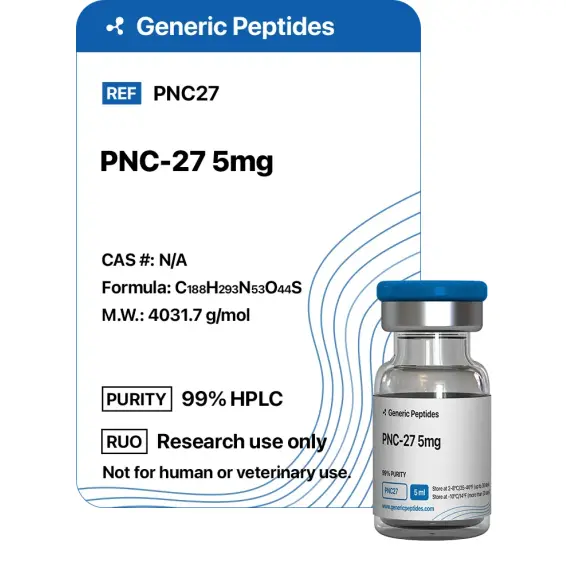
PNC-27 ships as a white lyophilized powder in a sealed glass vial, freeze-dried to preserve its 32-amino-acid structure and extend its shelf life. With a few simple habits — cold, dark, dry — the sealed vial stays in perfect condition for its full shelf life. Here's exactly how to store it.
| Parameter | Details | Notes |
|---|---|---|
| Storage Temperature | Freezer at −20°C (−4°F) for long-term storage up to 24 months. Refrigeration at 2–8°C (36–46°F) is fine for short-term use up to ~3 months. | Original sealed vial in the freezer is the safest default. |
| Light Sensitivity | Yes — PNC-27 contains three tryptophan residues that are highly prone to photodegradation. | Always keep in the original box or an opaque, amber container. |
| Freezing | Allowed and recommended. −20°C is standard for long-term storage; −80°C extends stability further if available. | Freeze from the start if you won't use it within 3 months. |
| Oxidation Sensitivity | The three tryptophan residues and one methionine residue make PNC-27 particularly prone to oxidation if the vial seal is broken or the powder is exposed to air. | Keep the aluminum crimp cap intact until ready to reconstitute, and minimize air exposure during handling. |
| Signs of Degradation | Healthy powder is white to off-white and loose or cake-like. Watch for yellowing, browning, clumping, visible moisture, or a sticky texture. | Any color change, clumping, or moisture = discard the vial. |
| Common Mistakes | Leaving the vial at room temperature after delivery, storing in a humid kitchen or bathroom, or opening a cold vial and letting condensation form inside. | Put it in the freezer on arrival, and let sealed vials warm to room temperature before opening. |
Every order is processed quickly and shipped with full tracking. All products come directly from the official Generic Peptides supply chain — in original manufacturer packaging, carefully handled from warehouse to your door.
| Destination | Delivery Time | Notes |
|---|---|---|
| USA Domestic | 2–5 business days | Faster when local warehouse stock is selected at checkout |
| International | 10–15 business days | Tracking included; update frequency may vary by destination country |
| Order Processing | 24–48 business hours | Processing begins after payment confirmation |
| Tracking | Provided on all orders | Tracking number sent after dispatch; multiple warehouses may result in separate shipments |
This product is supplied through the official Generic Peptides distribution chain and shipped in original manufacturer packaging. Orders are packed securely to protect the contents during transit and to respect customer privacy as a standard practice.
Outer packaging is neutral and does not display product details on the exterior — a common approach to protect shipments from damage, tampering, and unnecessary exposure during delivery.
Every order includes full authenticity assurance: official Generic Peptides presentation, batch-linked lab documentation, and sealed original packaging — giving customers confidence in every purchase.
| Authenticity Feature | Details |
|---|---|
| Packaging | Original manufacturer packaging — sealed and unaltered |
| Lab Documentation | Batch-linked certificate of analysis available on request |
| Supply Chain | Sourced exclusively through official Generic Peptides distribution |
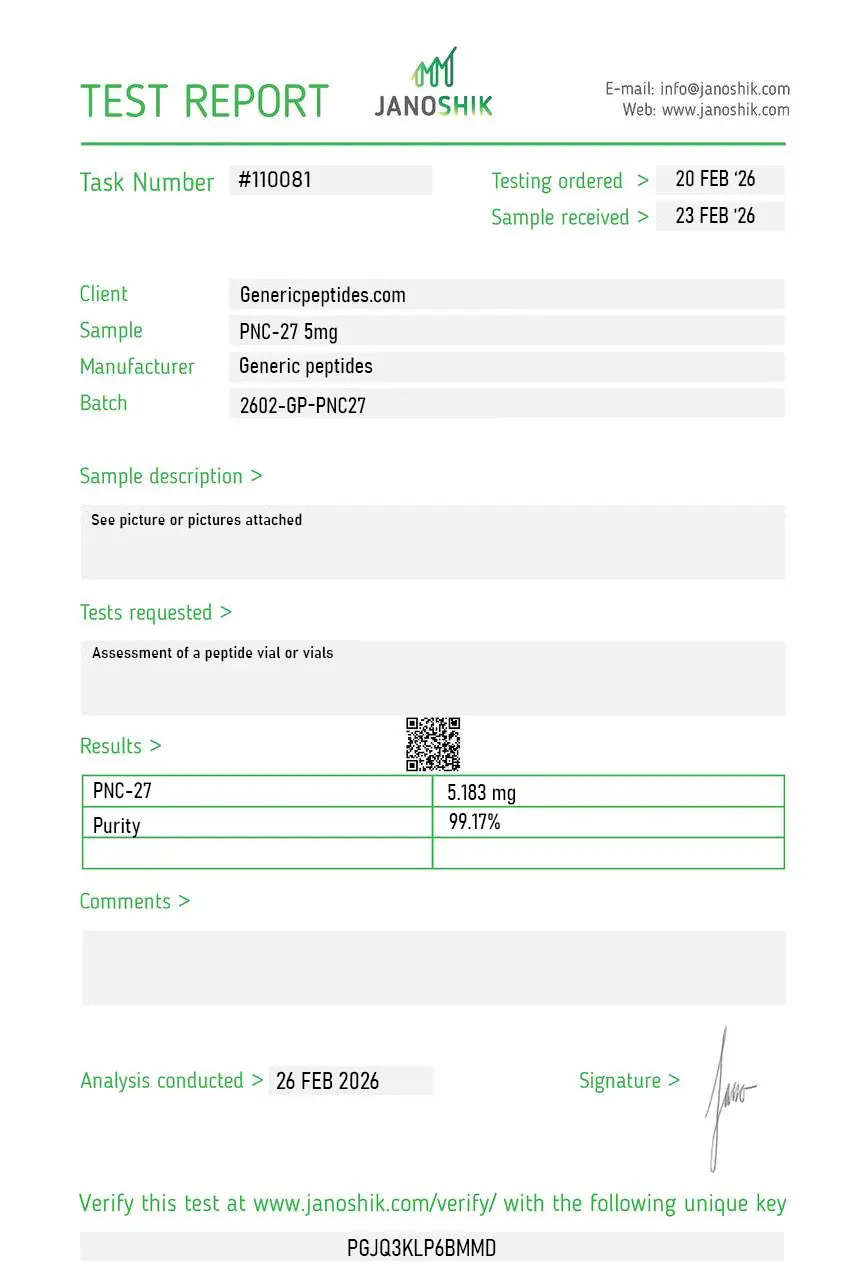
An independent lab test report is available for PNC-27. The certificate provides batch-level verification details, including measured content, purity result, analysis date, and report documentation.
Membrane HDM-2 cytotoxicity assays in pancreatic cancer lines, run in parallel with normal control cells. Selectivity profile tracked what we'd characterized before.
The thing buyers need to understand is that this is a hybrid construct — the p53 MDM2-binding fragment fused to a membrane-penetrating leader. Two functional domains, not a simple peptide. The vendor frames it correctly. Star off because for a 32-residue hybrid the COA really should verify both domains and the linker separately, since degradation at the junction would give you a non-functional construct that still reads as "pure."
The mechanism that makes PNC-27 interesting is that it targets membrane-associated HDM-2, which Pincus's group reported is preferentially expressed on cancer cell surfaces — distinct from the intracellular MDM2-p53 disruptors like the nutlins. Whether that membrane-HDM-2 selectivity holds up under independent scrutiny is exactly what we're testing. Material behaved consistently in our initial dose-response work.
We use it as a necrosis-inducing tool compound — PNC-27 kills through membrane disruption rather than the apoptotic pathway most cytotoxic agents trigger, so it's useful for distinguishing necrotic from apoptotic death modalities in flow cytometry. That mechanistic distinction is the actual research value for us, independent of the selectivity debate. Material gave reproducible necrotic signatures.
For comparative work we run PNC-27 against the small-molecule MDM2 inhibitors — nutlin-3 and the clinical-candidate compounds — to contrast the membrane-targeting peptide approach with conventional intracellular MDM2-p53 disruption. Entirely different mechanisms aimed at related biology. Having the peptide with proper documentation for that comparison was useful.
The Pincus group's PNAS characterization is the foundational reference, and it's worth reading critically before working with this — the selectivity-through-membrane-HDM-2 model is elegant but rests heavily on one program's assays. We're characterizing it independently and the material has been consistent enough to make that a fair test. That's all I want from a supplier for this kind of work.
PNC-27 targets HDM-2 protein expressed on the outer plasma membrane — a phenomenon that occurs in cancer cells but not in most healthy cells. Healthy cells contain HDM-2 inside the nucleus where it interacts with p53 in normal cell-cycle regulation. Cancer cells somehow traffic HDM-2 to their outer membrane surface, and that's the molecular flag PNC-27 uses to identify them. Untransformed cells lacking membrane HDM-2 don't bind PNC-27 and aren't affected.
PNC-28 is a closely related chimeric peptide developed by the same research group, with a different membrane-penetrating leader sequence. Both peptides target membrane-associated HDM-2 in cancer cells through similar pore-forming mechanisms. Research has explored both as parallel investigative tools, with PNC-27 receiving more sustained attention in published literature.
Most p53-pathway-targeting cancer compounds work inside the nucleus to restore apoptotic signaling — programmed cell death. PNC-27 doesn't do this. It physically forms transmembrane pores in the cancer cell membrane, causing rapid necrosis (uncontrolled cell rupture). The 2D NMR structural data shows PNC-27 adopts an amphipathic alpha-helix-loop-alpha-helix conformation suitable for membrane pore formation, which differs fundamentally from intracellular signaling activation.
The 32-amino-acid chimeric peptide has two functional domains (the p53 fragment and the membrane-residency leader) joined by a covalent linkage. All three elements need to be intact for the published mechanism to work. Cheap synthesis routinely produces truncated material, junction errors, or peptide impurities. Detection requires HPLC-MS analysis of the full-length sequence — not standard quality control for budget peptide producers.
PNC-27 emerged from research at New York Medical College and SUNY Downstate Health Sciences University in the early-to-mid 2000s, with foundational papers from Michael Bowne, Matthew Pincus, Josef Michl, and colleagues. The chimeric design — combining the p53 12-26 binding region with a penetratin-derived leader — was novel for cancer-targeting peptide research. Subsequent work over two decades has expanded the mechanistic understanding without yet reaching human clinical trials.
PNC-27 is not specifically named on the WADA Prohibited List as of 2025. The compound is a research-only chimeric peptide without anabolic, hormonal, or performance-modifying effects that would place it in standard anti-doping categories. Athletes subject to drug testing should consult their governing body's specific rules — anti-doping rules can include unspecified substances under broad categories.
The compound is consistently called PNC-27 in the published literature, occasionally written as PNC27 or PNC 27. It's also described chemically as the p53(12-26) — penetratin chimeric peptide. The amino acid sequence (with the p53 segment ETFSDLWKLLPENNVL fused to the MRP leader KKWKMRRNQFWVKVQRG) identifies it unambiguously regardless of label.
Cancer biology and targeted oncology research lead by volume — particularly studies of pancreatic cancer, leukemia, melanoma, and other tumor types in cell culture and animal models. There's also active work in membrane biophysics (using PNC-27 as a model for pore-forming peptide assembly), p53/HDM-2 protein interaction studies, and cell-penetrating peptide pharmacology. The compound appears in literature across multiple research disciplines.
The p53 portion of PNC-27 (residues 12-26) is the region of natural p53 that normally binds HDM-2. By incorporating just this fragment into a chimeric peptide, researchers exploit p53's natural binding affinity for HDM-2 without requiring intact p53 protein structure. This is what allows PNC-27 to kill p53-null cancer cells — it doesn't need any functional p53 in the target cell, just membrane-displayed HDM-2.
Most cancer-targeting peptides either deliver toxic payloads (linked to chemotherapy agents), restore apoptosis pathways inside cells, or block specific intracellular signaling. PNC-27 is unusual because it kills cancer cells through direct physical membrane disruption, with selectivity coming from a target (membrane-associated HDM-2) that other approaches don't recognize. The mechanism is mechanistically distinct from nearly every other research-stage cancer-targeting peptide.
Researchers investigating cancer-selective peptide pharmacology, p53/HDM-2 dynamics, and membrane-active anticancer mechanisms consistently examine PNC-27 alongside compounds that target overlapping or complementary aspects of cancer cell biology. Thymosin Alpha-1 is the most natural immune oncology pairing — where PNC-27 physically disrupts cancer cell membranes through HDM-2-mediated pore formation, Thymosin Alpha-1 modulates the immune response to cancer cells through TLR2/TLR9 activation on dendritic cells; researchers studying combined direct cytotoxic and immune-mediated approaches to cancer cell killing sometimes examine both. BPC-157 occasionally appears in the same research context given its documented effects on cell survival signaling and angiogenesis — researchers studying the tumor microenvironment sometimes examine pro-regenerative and anti-cancer compounds together to map competing signaling pressures. Thymalin shares the broader cancer biology and immune modulation research space — both are studied in oncology contexts, and Thymalin's KE and EW peptide components affect immune cell function that intersects with the tumor immune microenvironment that PNC-27 research addresses. Epitalon appears in the same anti-aging and cancer prevention research tradition given both compounds' documented effects on cell proliferation regulation and their shared research base in the peptide bioregulator literature.